

Cereal, other, chocolate
Common food

Photo: Wikipedia
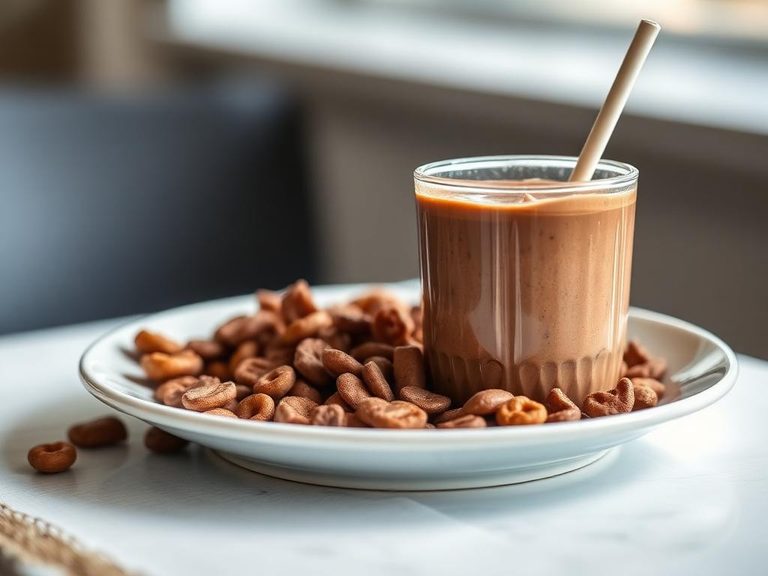
This is a crunchy, sweetened breakfast cereal, often in the form of puffs, flakes, or clusters, with a distinct cocoa flavor and a satisfyingly crisp texture that softens in milk. It delivers a significant carbohydrate and sugar punch, providing a quick energy boost but with minimal protein or fat to balance it. It's a classic, indulgent way to start the day, primarily valued for its comforting taste and convenience.
Calorie split: 6% protein · 84% carbs · 11% fat
↓ Full nutrition💚 Why it's loved
People love it for its nostalgic, sweet chocolate flavor and the satisfying crunch that makes breakfast feel like a treat. Its simplicity and speed make it a go-to for busy mornings or a comforting late-night snack.
⚠️ Watch-outs & how to enjoy it better
The high sugar content (nearly 35g per 100g) can lead to a rapid blood-sugar spike followed by a crash, and it's low in satiating protein and fat. To counteract this, pair it with a protein source like Greek yogurt or a handful of nuts, and practice portion control by measuring a single serving instead of eating from the box.
Key benefits
- Quick source of energy from carbohydrates
- Fortified with essential vitamins and minerals (like iron, B vitamins)
- Convenient and requires no preparation
- Provides a small amount of dietary fiber
- A familiar, comforting breakfast option for many
🍽️ Popular dishes


🌍 Where it's eaten
💡 Did you know?
The chocolate flavor in many cereals comes from cocoa powder processed with alkali (known as Dutch process), which mellows its bitterness and darkens its color.
Full nutrition (USDA data · scales with serving)
| Water | 6.7 g |
| Energy | 384 kcal |
| Protein | 5.4 g |
| Total lipid (fat) | 4.6 g |
| Carbohydrate, by difference | 81.4 g |
| Fiber, total dietary | 3.2 g |
| Total Sugars | 35.0 g |
| Calcium, Ca | 90.0 mg |
| Iron, Fe | 9.9 mg |
| Magnesium, Mg | 36.0 mg |
| Phosphorus, P | 97.0 mg |
| Potassium, K | 120 mg |
| Sodium, Na | 486 mg |
| Zinc, Zn | 0.90 mg |
| Copper, Cu | 0.22 mg |
| Selenium, Se | 6.1 ug |
| Vitamin C, total ascorbic acid | 11.4 mg |
| Thiamin | 0.53 mg |
| Riboflavin | 0.52 mg |
| Niacin | 6.6 mg |
| Vitamin B-6 | 0.70 mg |
| Folate, total | 222 ug |
| Folic acid | 207 ug |
| Folate, food | 15.0 ug |
| Folate, DFE | 367 ug |
| Choline, total | 7.0 mg |
| Vitamin B-12 | 0.89 ug |
| Vitamin B-12, added | 0.89 ug |
| Vitamin A, RAE | 3.0 ug |
| Retinol | 0.00 ug |
| Carotene, beta | 24.0 ug |
| Carotene, alpha | 16.0 ug |
| Cryptoxanthin, beta | 0.00 ug |
| Lycopene | 0.00 ug |
| Lutein + zeaxanthin | 412 ug |
| Vitamin E (alpha-tocopherol) | 0.60 mg |
| Vitamin E, added | 0.00 mg |
| Vitamin D (D2 + D3) | 4.9 ug |
| Vitamin K (phylloquinone) | 2.3 ug |
| Alcohol, ethyl | 0.00 g |
| Caffeine | 7.0 mg |
| Theobromine | 61.0 mg |
Fat & fatty acid profile (per 100g)
| Fatty acids, total saturated | 0.65 g |
| SFA 4:0 | 0.00 g |
| SFA 6:0 | 0.00 g |
| SFA 8:0 | 0.00 g |
| SFA 10:0 | 0.00 g |
| SFA 12:0 | 0.00 g |
| SFA 14:0 | 0.01 g |
| SFA 16:0 | 0.41 g |
| SFA 18:0 | 0.20 g |
| Fatty acids, total monounsaturated | 2.3 g |
| MUFA 16:1 | 0.01 g |
| MUFA 18:1 | 2.2 g |
| MUFA 20:1 | 0.06 g |
| MUFA 22:1 | 0.00 g |
| Fatty acids, total polyunsaturated | 1.2 g |
| PUFA 18:2 | 0.94 g |
| PUFA 18:3 | 0.25 g |
| PUFA 18:4 | 0.00 g |
| PUFA 20:4 | 0.00 g |
| PUFA 20:5 n-3 (EPA) | 0.00 g |
| PUFA 22:5 n-3 (DPA) | 0.00 g |
| PUFA 22:6 n-3 (DHA) | 0.00 g |
| Cholesterol | 0.00 mg |
Amino acid profile (per 100g)
Estimated from Cereals ready-to-eat, POST, HONEY BUNCHES OF OATS, honey roasted — USDA does not publish this profile for Cereal.
| Tryptophan | 0.09 g |
| Threonine | 0.24 g |
| Isoleucine | 0.26 g |
| Leucine | 0.80 g |
| Lysine | 0.12 g |
| Methionine | 0.10 g |
| Cystine | 0.11 g |
| Phenylalanine | 0.39 g |
| Tyrosine | 0.21 g |
| Valine | 0.34 g |
| Arginine | 0.24 g |
| Histidine | 0.18 g |
| Alanine | 0.46 g |
| Aspartic acid | 0.48 g |
| Glutamic acid | 1.9 g |
| Glycine | 0.27 g |
| Proline | 0.49 g |
| Serine | 0.38 g |
FAQ
Is chocolate cereal healthy?
It's generally considered a treat rather than a health food. While it's often fortified with vitamins, its high sugar and refined carbohydrate content mean it should be enjoyed in moderation as part of a balanced diet.
Can I eat chocolate cereal on a diet?
You can include it in a calorie-controlled diet by practicing strict portion control (e.g., a 30g serving) and pairing it with protein and fiber to increase satiety and stabilize blood sugar.
What makes it turn soggy in milk?
The cereal's porous structure absorbs liquid, causing the starches to gelatinize and the crunchy texture to soften. Eating it quickly or choosing a denser, less porous variety can help it stay crunchy longer.
Nutrient density (calculated · NRF9.3)
Nutrient Rich Foods index: beneficial nutrients (protein, fiber, vitamins, minerals) minus saturated fat, added sugar & sodium, per 100 kcal.
NRF9.3 index — Fulgoni, Keast & Drewnowski, 2009. Computed from USDA nutrients.
Weight-loss friendliness (composite index)
Energy density 3.84 kcal/g · 6% calories from protein · 3.2 g fiber · 35.0 g sugar per 100 g.
Composite of energy density (Rolls et al., 1999), protein & fiber satiety, minus sugar. A calculated heuristic — ranks satiety-per-calorie, not a clinical measure.
Dietary load (calculated from USDA values)
Potential renal acid load. Positive = acid-forming, negative = alkaline-forming.
Sodium-to-potassium ratio: 4.05 (lower is better — aim for ≤ 1)
Sodium:potassium per WHO potassium guidance. Computed from USDA nutrients.