

Cereal, other, NFS
Common food

Photo: Wikipedia
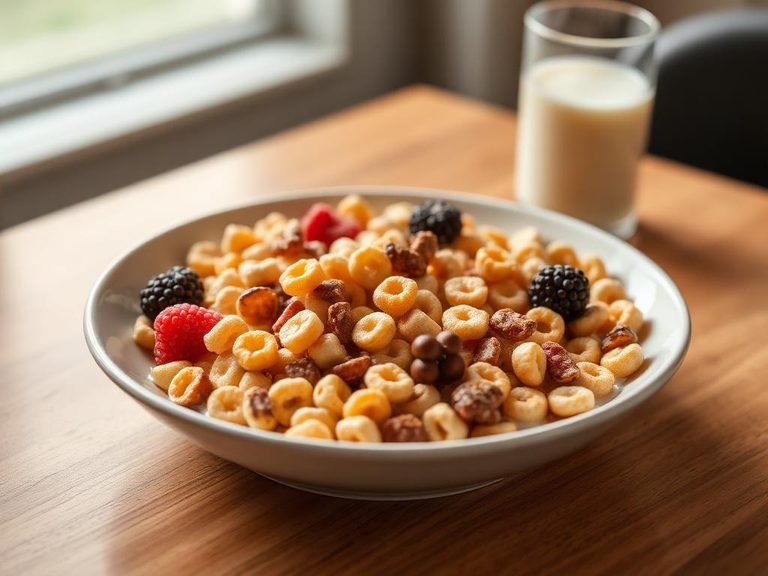
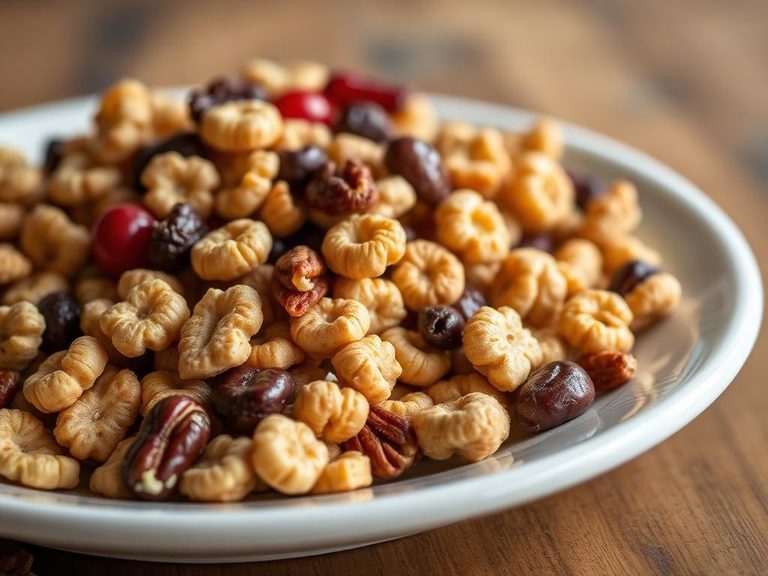
A broad, catch-all category for ready-to-eat breakfast cereals that don't fit into specific types like flakes or puffs. These are typically sweetened, crunchy, and come in a variety of shapes and flavors, often with a toasted grain or corn base. Nutritionally, they are a high-carbohydrate, moderate-sugar energy source, providing quick fuel but lacking in substantial protein or fat.
Calorie split: 7% protein · 82% carbs · 10% fat
↓ Full nutrition💚 Why it's loved
People love it for its sweet, crunchy convenience and nostalgic comfort, often enjoying it as a quick breakfast or snack. Its versatility allows it to be eaten dry, with milk, or even as a topping for yogurt and desserts.
⚠️ Watch-outs & how to enjoy it better
The high sugar content can lead to rapid blood-sugar spikes and subsequent energy crashes, making it a poor choice for those managing diabetes or seeking sustained satiety. To counteract this, pair it with a source of protein or healthy fat (like nuts or Greek yogurt) and practice portion control by sticking to a single serving.
Key benefits
- Provides quick energy from carbohydrates
- Convenient and requires no preparation
- Often fortified with vitamins and minerals
- Offers a crunchy texture that many find satisfying
- Can be a source of dietary fiber, depending on the variety
🍽️ Popular dishes

🌍 Where it's eaten
💡 Did you know?
The category 'Cereal, other, NFS' (Not Further Specified) is a USDA data entry used when a specific cereal type isn't identified, highlighting the vast and diverse market of breakfast cereals, which includes thousands of products worldwide.
Full nutrition (USDA data · scales with serving)
| Water | 8.0 g |
| Energy | 381 kcal |
| Protein | 6.9 g |
| Total lipid (fat) | 4.4 g |
| Carbohydrate, by difference | 78.5 g |
| Fiber, total dietary | 4.8 g |
| Total Sugars | 25.4 g |
| Calcium, Ca | 116 mg |
| Iron, Fe | 16.1 mg |
| Magnesium, Mg | 50.0 mg |
| Phosphorus, P | 149 mg |
| Potassium, K | 154 mg |
| Sodium, Na | 530 mg |
| Zinc, Zn | 1.3 mg |
| Copper, Cu | 0.18 mg |
| Selenium, Se | 11.6 ug |
| Vitamin C, total ascorbic acid | 14.3 mg |
| Thiamin | 0.79 mg |
| Riboflavin | 0.72 mg |
| Niacin | 9.0 mg |
| Vitamin B-6 | 0.96 mg |
| Folate, total | 265 ug |
| Folic acid | 245 ug |
| Folate, food | 20.0 ug |
| Folate, DFE | 436 ug |
| Choline, total | 13.4 mg |
| Vitamin B-12 | 1.2 ug |
| Vitamin B-12, added | 1.2 ug |
| Vitamin A, RAE | 3.0 ug |
| Retinol | 0.00 ug |
| Carotene, beta | 28.0 ug |
| Carotene, alpha | 18.0 ug |
| Cryptoxanthin, beta | 0.00 ug |
| Lycopene | 0.00 ug |
| Lutein + zeaxanthin | 510 ug |
| Vitamin E (alpha-tocopherol) | 0.48 mg |
| Vitamin E, added | 0.00 mg |
| Vitamin D (D2 + D3) | 5.0 ug |
| Vitamin K (phylloquinone) | 2.1 ug |
| Alcohol, ethyl | 0.00 g |
| Caffeine | 2.0 mg |
| Theobromine | 15.0 mg |
Fat & fatty acid profile (per 100g)
| Fatty acids, total saturated | 0.64 g |
| SFA 4:0 | 0.00 g |
| SFA 6:0 | 0.00 g |
| SFA 8:0 | 0.00 g |
| SFA 10:0 | 0.00 g |
| SFA 12:0 | 0.01 g |
| SFA 14:0 | 0.01 g |
| SFA 16:0 | 0.44 g |
| SFA 18:0 | 0.15 g |
| Fatty acids, total monounsaturated | 1.8 g |
| MUFA 16:1 | 0.01 g |
| MUFA 18:1 | 1.8 g |
| MUFA 20:1 | 0.03 g |
| MUFA 22:1 | 0.00 g |
| Fatty acids, total polyunsaturated | 1.4 g |
| PUFA 18:2 | 1.2 g |
| PUFA 18:3 | 0.17 g |
| PUFA 18:4 | 0.00 g |
| PUFA 20:4 | 0.00 g |
| PUFA 20:5 n-3 (EPA) | 0.00 g |
| PUFA 22:5 n-3 (DPA) | 0.00 g |
| PUFA 22:6 n-3 (DHA) | 0.00 g |
| Cholesterol | 0.00 mg |
Amino acid profile (per 100g)
Estimated from Cereals ready-to-eat, POST, HONEY BUNCHES OF OATS, honey roasted — USDA does not publish this profile for Cereal.
| Tryptophan | 0.09 g |
| Threonine | 0.24 g |
| Isoleucine | 0.26 g |
| Leucine | 0.80 g |
| Lysine | 0.12 g |
| Methionine | 0.10 g |
| Cystine | 0.11 g |
| Phenylalanine | 0.39 g |
| Tyrosine | 0.21 g |
| Valine | 0.34 g |
| Arginine | 0.24 g |
| Histidine | 0.18 g |
| Alanine | 0.46 g |
| Aspartic acid | 0.48 g |
| Glutamic acid | 1.9 g |
| Glycine | 0.27 g |
| Proline | 0.49 g |
| Serine | 0.38 g |
FAQ
What does 'NFS' mean in 'Cereal, other, NFS'?
NFS stands for 'Not Further Specified.' It's a USDA database category for generic or unbranded cereals that don't fit into more specific types like flakes, puffs, or granola.
Is this cereal healthy?
It's a source of quick energy but can be high in sugar and low in protein and fiber. Its nutritional value varies widely, so checking the specific product's label is key.
How can I make it more filling?
Add protein and healthy fats by mixing it with milk, yogurt, nuts, seeds, or fresh fruit. This slows digestion and helps maintain steady energy levels.
Can I use it in cooking?
Yes, it can be used as a crunchy coating for baked chicken or fish, a topping for casseroles, or mixed into snack bars and energy balls.
Nutrient density (calculated · NRF9.3)
Nutrient Rich Foods index: beneficial nutrients (protein, fiber, vitamins, minerals) minus saturated fat, added sugar & sodium, per 100 kcal.
NRF9.3 index — Fulgoni, Keast & Drewnowski, 2009. Computed from USDA nutrients.
Weight-loss friendliness (composite index)
Energy density 3.81 kcal/g · 7% calories from protein · 4.8 g fiber · 25.4 g sugar per 100 g.
Composite of energy density (Rolls et al., 1999), protein & fiber satiety, minus sugar. A calculated heuristic — ranks satiety-per-calorie, not a clinical measure.
Dietary load (calculated from USDA values)
Potential renal acid load. Positive = acid-forming, negative = alkaline-forming.
Sodium-to-potassium ratio: 3.44 (lower is better — aim for ≤ 1)
Sodium:potassium per WHO potassium guidance. Computed from USDA nutrients.