

Carrots, raw, salad with apples
Common food

Photo: Wikipedia
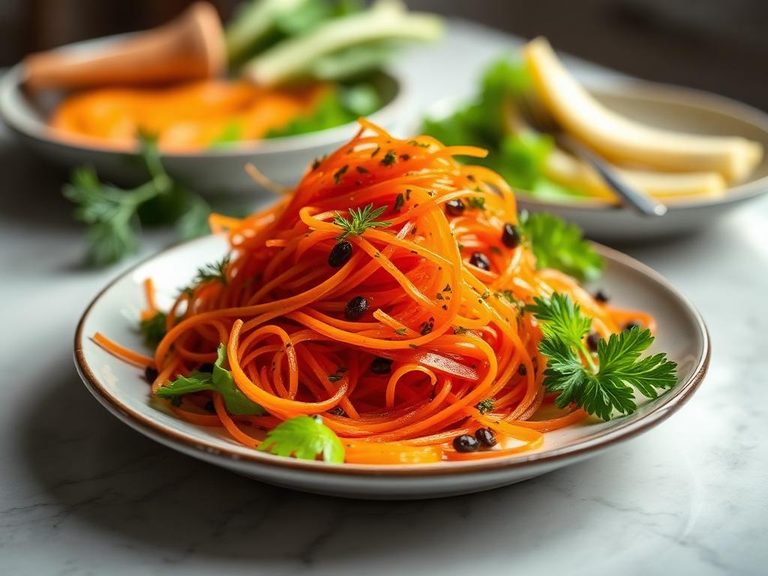
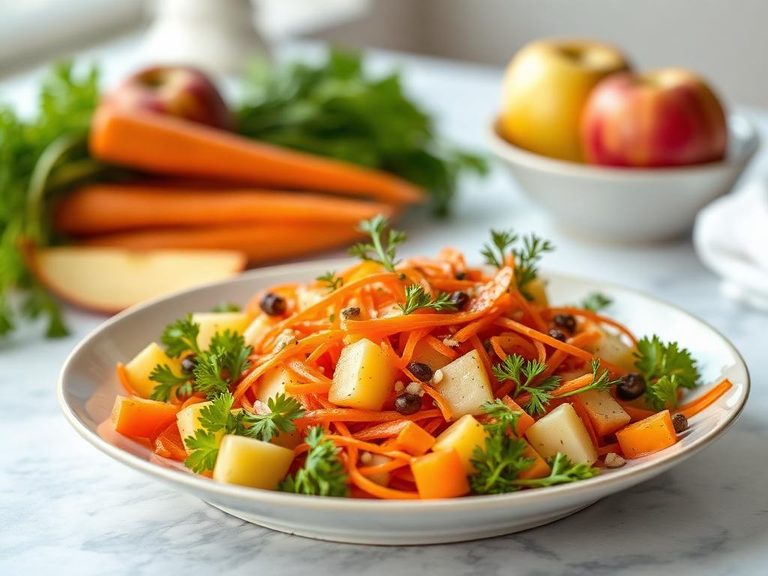
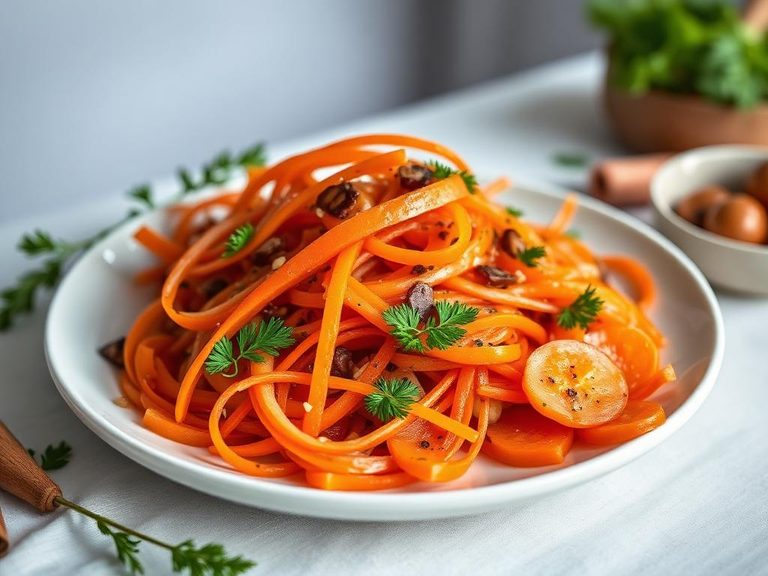
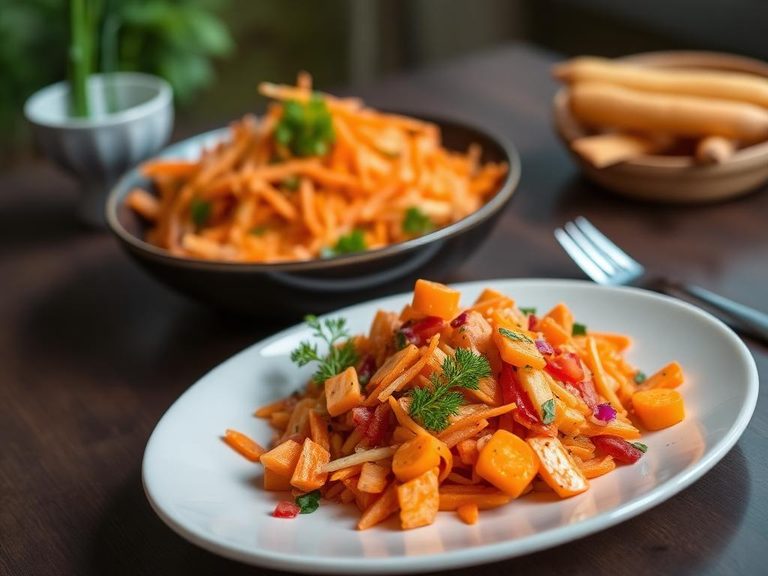
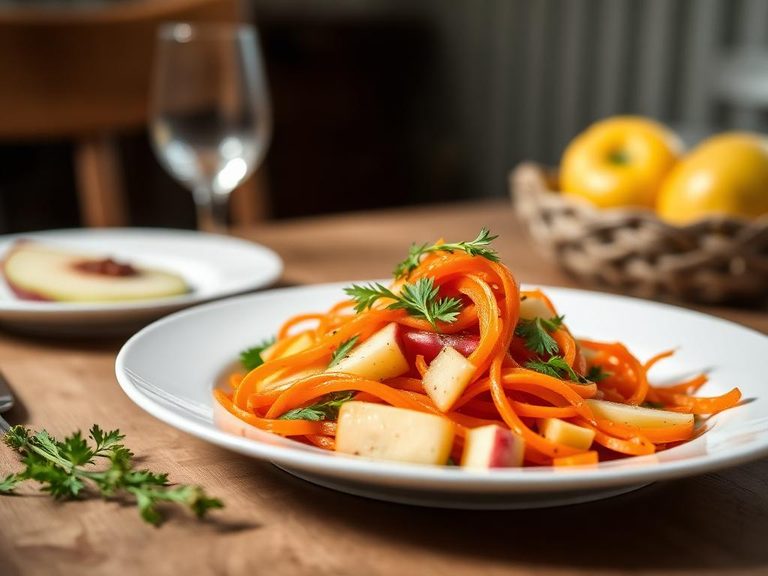
A vibrant, crunchy salad of shredded raw carrots and diced apples, bound with a creamy dressing that gives it a surprisingly rich, sweet-savory profile. The texture is a delightful contrast between the crisp, earthy carrot and the juicy, tart apple, all coated in a smooth, slightly tangy sauce. Despite its fresh appearance, the dressing contributes a notable fat content, making it more substantial than a simple fruit-and-veg mix.
Calorie split: 2% protein · 19% carbs · 79% fat
↓ Full nutrition💚 Why it's loved
People love it for the satisfying crunch and the sweet-tart balance between the carrots and apples, which feels both refreshing and indulgent. It’s a versatile side dish that pairs well with sandwiches, grilled meats, or stands alone as a light, healthy snack.
⚠️ Watch-outs & how to enjoy it better
The creamy dressing can add significant fat and calories, which may be a concern for those monitoring intake. The natural sugars from apples and carrots can cause a blood-sugar spike if eaten in large portions without protein or fat; pairing it with a source of protein like nuts or cheese can help stabilize blood sugar levels.
Key benefits
- Rich in beta-carotene and vitamin A from raw carrots
- Provides dietary fiber from both carrots and apples
- Contains natural sugars for quick energy
- Offers a crunchy, satisfying texture without cooking
- Combines two whole-food ingredients for a simple, minimally processed side
🍽️ Popular dishes
🌍 Where it's eaten
💡 Did you know?
The classic creamy dressing in many European carrot-apple salads is often made with mayonnaise or a yogurt-based sauce, which was popularized in the 19th century as a way to preserve and enhance the flavor of raw root vegetables.
Full nutrition (USDA data · scales with serving)
| Water | 73.6 g |
| Energy | 181 kcal |
| Protein | 0.85 g |
| Total lipid (fat) | 16.0 g |
| Carbohydrate, by difference | 8.6 g |
| Fiber, total dietary | 2.3 g |
| Total Sugars | 4.5 g |
| Calcium, Ca | 23.0 mg |
| Iron, Fe | 0.16 mg |
| Magnesium, Mg | 9.0 mg |
| Phosphorus, P | 31.0 mg |
| Potassium, K | 198 mg |
| Sodium, Na | 189 mg |
| Zinc, Zn | 0.19 mg |
| Copper, Cu | 0.05 mg |
| Selenium, Se | 0.50 ug |
| Vitamin C, total ascorbic acid | 6.4 mg |
| Thiamin | 0.05 mg |
| Riboflavin | 0.07 mg |
| Niacin | 0.91 mg |
| Vitamin B-6 | 0.10 mg |
| Folate, total | 25.0 ug |
| Folic acid | 0.00 ug |
| Folate, food | 25.0 ug |
| Folate, DFE | 25.0 ug |
| Choline, total | 13.4 mg |
| Vitamin B-12 | 0.02 ug |
| Vitamin B-12, added | 0.00 ug |
| Vitamin A, RAE | 532 ug |
| Retinol | 3.0 ug |
| Carotene, beta | 5242 ug |
| Carotene, alpha | 2198 ug |
| Cryptoxanthin, beta | 3.0 ug |
| Lycopene | 1.0 ug |
| Lutein + zeaxanthin | 168 ug |
| Vitamin E (alpha-tocopherol) | 1.1 mg |
| Vitamin E, added | 0.00 mg |
| Vitamin D (D2 + D3) | 0.00 ug |
| Vitamin K (phylloquinone) | 43.0 ug |
| Alcohol, ethyl | 0.00 g |
| Caffeine | 0.00 mg |
| Theobromine | 0.00 mg |
Fat & fatty acid profile (per 100g)
| Fatty acids, total saturated | 2.5 g |
| SFA 4:0 | 0.00 g |
| SFA 6:0 | 0.00 g |
| SFA 8:0 | 0.00 g |
| SFA 10:0 | 0.00 g |
| SFA 12:0 | 0.00 g |
| SFA 14:0 | 0.01 g |
| SFA 16:0 | 1.7 g |
| SFA 18:0 | 0.66 g |
| Fatty acids, total monounsaturated | 3.6 g |
| MUFA 16:1 | 0.02 g |
| MUFA 18:1 | 3.5 g |
| MUFA 20:1 | 0.05 g |
| MUFA 22:1 | 0.01 g |
| Fatty acids, total polyunsaturated | 9.5 g |
| PUFA 18:2 | 8.3 g |
| PUFA 18:3 | 1.2 g |
| PUFA 18:4 | 0.00 g |
| PUFA 20:4 | 0.01 g |
| PUFA 20:5 n-3 (EPA) | 0.00 g |
| PUFA 22:5 n-3 (DPA) | 0.00 g |
| PUFA 22:6 n-3 (DHA) | 0.00 g |
| Cholesterol | 9.0 mg |
Amino acid profile (per 100g)
Estimated from Carrots, canned, no salt added, drained solids — USDA does not publish this profile for Carrots.
| Tryptophan | 0.01 g |
| Threonine | 0.02 g |
| Isoleucine | 0.03 g |
| Leucine | 0.03 g |
| Lysine | 0.03 g |
| Methionine | 0.00 g |
| Cystine | 0.01 g |
| Phenylalanine | 0.02 g |
| Tyrosine | 0.01 g |
| Valine | 0.03 g |
| Arginine | 0.03 g |
| Histidine | 0.01 g |
| Alanine | 0.04 g |
| Aspartic acid | 0.08 g |
| Glutamic acid | 0.12 g |
| Glycine | 0.02 g |
| Proline | 0.02 g |
| Serine | 0.02 g |
FAQ
Is this salad healthy despite the high fat content?
Yes, the fat often comes from a dressing like mayonnaise or oil, which can be part of a balanced diet. The salad is still rich in fiber, vitamins, and natural sugars, making it a nutritious choice when consumed in moderation.
Can I make this salad without a creamy dressing?
Absolutely. You can use a light vinaigrette, lemon juice, or even a simple honey-mustard dressing to reduce fat while keeping the flavor fresh and tangy.
Is this salad suitable for people with diabetes?
It can be, but portion control is important due to the natural sugars. Pairing it with protein or healthy fats can help manage blood sugar levels.
What makes this salad different from coleslaw?
While coleslaw typically uses cabbage, this salad features carrots and apples, giving it a sweeter, fruitier flavor and a different texture. The dressing is also often lighter and less tangy than traditional coleslaw.
Nutrient density (calculated · NRF9.3)
Nutrient Rich Foods index: beneficial nutrients (protein, fiber, vitamins, minerals) minus saturated fat, added sugar & sodium, per 100 kcal.
NRF9.3 index — Fulgoni, Keast & Drewnowski, 2009. Computed from USDA nutrients.
Weight-loss friendliness (composite index)
Energy density 1.81 kcal/g · 2% calories from protein · 2.3 g fiber · 4.5 g sugar per 100 g.
Composite of energy density (Rolls et al., 1999), protein & fiber satiety, minus sugar. A calculated heuristic — ranks satiety-per-calorie, not a clinical measure.
Dietary load (calculated from USDA values)
Potential renal acid load. Positive = acid-forming, negative = alkaline-forming.
Sodium-to-potassium ratio: 0.95 (lower is better — aim for ≤ 1)
Sodium:potassium per WHO potassium guidance. Computed from USDA nutrients.