

Candy, NFS
Common food
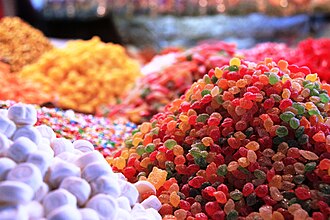
Photo: Wikipedia
Candy, NFS (Not Further Specified) is a broad category of sweet confections, typically characterized by a sugary, chewy, or hard texture and intense sweetness. Nutritionally, it is a dense source of quick energy, being almost entirely composed of carbohydrates, primarily from sugars, with minimal protein or fiber.
Calorie split: 2% protein · 81% carbs · 17% fat
↓ Full nutrition💚 Why it's loved
People love candy for its immediate, intense sweetness and the nostalgic comfort it often brings, recalling childhood or holidays. Its vast variety—from chewy caramels to sour gummies—makes it a versatile treat for satisfying specific cravings.
⚠️ Watch-outs & how to enjoy it better
The primary downside is its high sugar content, which can lead to blood-sugar spikes and crashes, and contributes to empty calories with little nutritional benefit. To mitigate this, practice strict portion control (e.g., a single small piece) and pair it with a source of protein or fat (like a handful of nuts) to slow sugar absorption.
Key benefits
- Provides rapid energy from simple carbohydrates
- Can offer a quick mood boost or psychological satisfaction
- Often used as a reward or in celebratory traditions
- Wide variety of flavors and textures for preference
🍽️ Popular dishes





🌍 Where it's eaten
💡 Did you know?
The term 'candy' derives from the Arabic word 'qandi,' meaning 'made of sugar,' reflecting the ancient origins of sugar confections in the Middle East.
Full nutrition (USDA data · scales with serving)
| Water | 2.5 g |
| Energy | 429 kcal |
| Protein | 1.9 g |
| Total lipid (fat) | 8.3 g |
| Carbohydrate, by difference | 86.6 g |
| Fiber, total dietary | 0.90 g |
| Total Sugars | 61.3 g |
| Calcium, Ca | 49.0 mg |
| Iron, Fe | 0.78 mg |
| Magnesium, Mg | 17.0 mg |
| Phosphorus, P | 54.0 mg |
| Potassium, K | 96.0 mg |
| Sodium, Na | 43.0 mg |
| Zinc, Zn | 0.58 mg |
| Copper, Cu | 0.14 mg |
| Selenium, Se | 1.6 ug |
| Vitamin C, total ascorbic acid | 0.00 mg |
| Thiamin | 0.03 mg |
| Riboflavin | 0.08 mg |
| Niacin | 0.10 mg |
| Vitamin B-6 | 0.01 mg |
| Folate, total | 3.0 ug |
| Folic acid | 0.00 ug |
| Folate, food | 3.0 ug |
| Folate, DFE | 3.0 ug |
| Choline, total | 11.5 mg |
| Vitamin B-12 | 0.19 ug |
| Vitamin B-12, added | 0.00 ug |
| Vitamin A, RAE | 15.0 ug |
| Retinol | 15.0 ug |
| Carotene, beta | 0.00 ug |
| Carotene, alpha | 0.00 ug |
| Cryptoxanthin, beta | 0.00 ug |
| Lycopene | 0.00 ug |
| Lutein + zeaxanthin | 2.0 ug |
| Vitamin E (alpha-tocopherol) | 0.16 mg |
| Vitamin E, added | 0.00 mg |
| Vitamin D (D2 + D3) | 0.00 ug |
| Vitamin K (phylloquinone) | 1.6 ug |
| Alcohol, ethyl | 0.00 g |
| Caffeine | 5.0 mg |
| Theobromine | 51.0 mg |
Fat & fatty acid profile (per 100g)
| Fatty acids, total saturated | 5.4 g |
| SFA 4:0 | 0.09 g |
| SFA 6:0 | 0.03 g |
| SFA 8:0 | 0.06 g |
| SFA 10:0 | 0.09 g |
| SFA 12:0 | 0.39 g |
| SFA 14:0 | 0.41 g |
| SFA 16:0 | 2.1 g |
| SFA 18:0 | 2.1 g |
| Fatty acids, total monounsaturated | 1.8 g |
| MUFA 16:1 | 0.10 g |
| MUFA 18:1 | 1.5 g |
| MUFA 20:1 | 0.00 g |
| MUFA 22:1 | 0.00 g |
| Fatty acids, total polyunsaturated | 0.34 g |
| PUFA 18:2 | 0.30 g |
| PUFA 18:3 | 0.03 g |
| PUFA 18:4 | 0.00 g |
| PUFA 20:4 | 0.00 g |
| PUFA 20:5 n-3 (EPA) | 0.00 g |
| PUFA 22:5 n-3 (DPA) | 0.00 g |
| PUFA 22:6 n-3 (DHA) | 0.00 g |
| Cholesterol | 6.0 mg |
Amino acid profile (per 100g)
Estimated from Oil, industrial, coconut, principal uses candy coatings, oil sprays, roasting nuts — USDA does not publish this profile for Candy.
| Tryptophan | 0.00 g |
| Threonine | 0.00 g |
| Isoleucine | 0.00 g |
| Leucine | 0.00 g |
| Lysine | 0.00 g |
| Methionine | 0.00 g |
| Cystine | 0.00 g |
| Phenylalanine | 0.00 g |
| Tyrosine | 0.00 g |
| Valine | 0.00 g |
| Arginine | 0.00 g |
| Histidine | 0.00 g |
| Alanine | 0.00 g |
| Aspartic acid | 0.00 g |
| Glutamic acid | 0.00 g |
| Glycine | 0.00 g |
| Proline | 0.00 g |
| Serine | 0.00 g |
FAQ
What does 'NFS' mean on a food label?
NFS stands for 'Not Further Specified.' It's a generic category used in nutrition databases for items like 'candy' when the exact type isn't identified.
Is candy purely sugar?
Mostly, yes. While some contain small amounts of fat (like chocolate) or protein (like nougat), the dominant macronutrient is carbohydrate, specifically sugars.
How can I include candy in a balanced diet?
Practice mindful portion control, choose higher-quality options (like dark chocolate), and enjoy it occasionally as a treat rather than a staple.
Nutrient density (calculated · NRF9.3)
Nutrient Rich Foods index: beneficial nutrients (protein, fiber, vitamins, minerals) minus saturated fat, added sugar & sodium, per 100 kcal.
NRF9.3 index — Fulgoni, Keast & Drewnowski, 2009. Computed from USDA nutrients.
Weight-loss friendliness (composite index)
Energy density 4.29 kcal/g · 2% calories from protein · 0.9 g fiber · 61.3 g sugar per 100 g.
Composite of energy density (Rolls et al., 1999), protein & fiber satiety, minus sugar. A calculated heuristic — ranks satiety-per-calorie, not a clinical measure.
Dietary load (calculated from USDA values)
Potential renal acid load. Positive = acid-forming, negative = alkaline-forming.
Sodium-to-potassium ratio: 0.45 (lower is better — aim for ≤ 1)
Sodium:potassium per WHO potassium guidance. Computed from USDA nutrients.