

Candies, fudge, peanut butter, prepared-from-recipe
Whole food · Sweets

Photo: Wikipedia
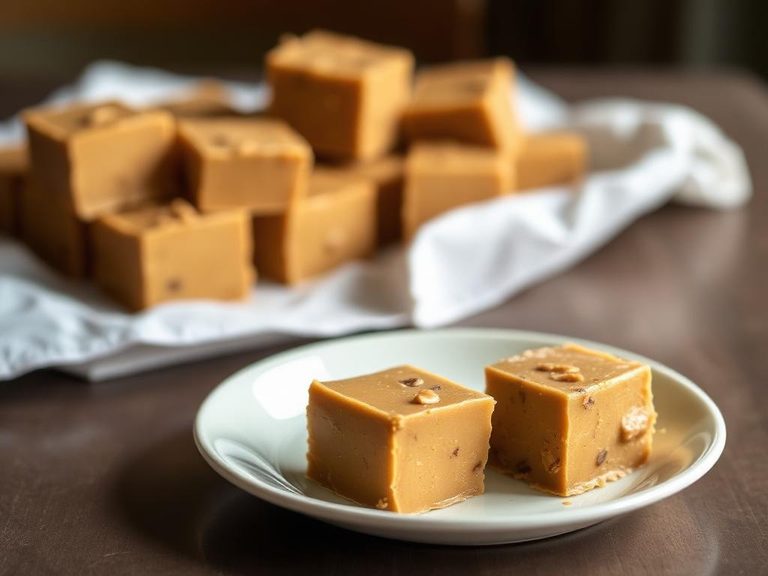
This is a dense, sweet confection where rich, roasted peanut butter is swirled into a smooth, creamy fudge base. It offers a decadent melt-in-your-mouth texture with a prominent, salty-sweet peanut flavor. Nutritionally, it's a high-energy treat, packing significant calories and sugar in a small serving.
Calorie split: 4% protein · 81% carbs · 15% fat
↓ Full nutrition💚 Why it's loved
People love it for the perfect marriage of smooth, buttery fudge and the deep, savory richness of peanut butter, creating an intensely satisfying sweet-salty flavor. It's a nostalgic, comforting treat often associated with homemade gifts, holidays, and classic American candy-making traditions.
⚠️ Watch-outs & how to enjoy it better
Due to its very high sugar and calorie density, it can cause rapid blood sugar spikes and is not suitable for those managing diabetes or seeking low-sugar diets. It also contains common allergens (peanuts, dairy) and should be consumed in strict portion control. To counteract, pair a small piece with a source of protein or fiber (like a handful of nuts or an apple) to slow sugar absorption, and be mindful of daily added sugar intake.
Key benefits
- Quick source of energy from carbohydrates and sugars
- Provides some plant-based protein from peanuts
- Contains small amounts of minerals like magnesium and potassium
- Offers a satisfying treat for sweet and salty cravings
- Simple to prepare at home with basic ingredients
🍽️ Popular dishes
🌍 Where it's eaten
💡 Did you know?
The term 'fudge' is believed to have originated in the late 19th century as a 'fudged' or muddled batch of caramels, with the first known recipe appearing in a letter from a Vassar College student in 1886.
Full nutrition (USDA data · scales with serving)
| Water | 10.9 g |
| Energy | 387 kcal |
| Energy | 1620 kj |
| Protein | 3.8 g |
| Total lipid (fat) | 6.6 g |
| Ash | 0.71 g |
| Carbohydrate, by difference | 77.8 g |
| Fiber, total dietary | 0.70 g |
| Total Sugars | 73.4 g |
| Calcium, Ca | 42.0 mg |
| Iron, Fe | 0.22 mg |
| Magnesium, Mg | 20.0 mg |
| Phosphorus, P | 68.0 mg |
| Potassium, K | 119 mg |
| Sodium, Na | 118 mg |
| Zinc, Zn | 0.48 mg |
| Copper, Cu | 0.06 mg |
| Manganese, Mn | 0.16 mg |
| Selenium, Se | 2.2 ug |
| Vitamin C, total ascorbic acid | 0.00 mg |
| Thiamin | 0.02 mg |
| Riboflavin | 0.08 mg |
| Niacin | 1.4 mg |
| Pantothenic acid | 0.23 mg |
| Vitamin B-6 | 0.07 mg |
| Folate, total | 9.0 ug |
| Folic acid | 0.00 ug |
| Folate, food | 9.0 ug |
| Folate, DFE | 9.0 ug |
| Vitamin B-12 | 0.14 ug |
| Vitamin B-12, added | 0.00 ug |
| Vitamin A, RAE | 9.0 ug |
| Retinol | 9.0 ug |
| Vitamin A, IU | 32.0 iu |
| Vitamin E (alpha-tocopherol) | 1.0 mg |
| Vitamin E, added | 0.00 mg |
| Vitamin K (phylloquinone) | 0.10 ug |
| Caffeine | 0.00 mg |
| Theobromine | 0.00 mg |
Fat & fatty acid profile (per 100g)
| Fatty acids, total saturated | 1.7 g |
| SFA 4:0 | 0.02 g |
| SFA 6:0 | 0.02 g |
| SFA 8:0 | 0.02 g |
| SFA 10:0 | 0.02 g |
| SFA 12:0 | 0.04 g |
| SFA 13:0 | 0.00 g |
| SFA 14:0 | 0.12 g |
| SFA 15:0 | 0.00 g |
| SFA 16:0 | 0.90 g |
| SFA 17:0 | 0.00 g |
| SFA 18:0 | 0.31 g |
| SFA 20:0 | 0.07 g |
| SFA 22:0 | 0.15 g |
| SFA 24:0 | 0.05 g |
| Fatty acids, total monounsaturated | 2.9 g |
| MUFA 14:1 | 0.00 g |
| MUFA 16:1 | 0.00 g |
| MUFA 18:1 | 2.8 g |
| MUFA 20:1 | 0.06 g |
| MUFA 22:1 | 0.00 g |
| Fatty acids, total polyunsaturated | 1.6 g |
| PUFA 18:2 | 1.6 g |
| PUFA 18:3 | 0.03 g |
| PUFA 18:4 | 0.00 g |
| PUFA 20:4 | 0.00 g |
| PUFA 20:5 n-3 (EPA) | 0.00 g |
| PUFA 22:5 n-3 (DPA) | 0.00 g |
| PUFA 22:6 n-3 (DHA) | 0.00 g |
| Cholesterol | 3.0 mg |
Amino acid profile (per 100g)
Estimated from Candies, honey-combed, with peanut butter — USDA does not publish this profile for Candies.
| Tryptophan | 0.09 g |
| Threonine | 0.21 g |
| Isoleucine | 0.24 g |
| Leucine | 0.61 g |
| Lysine | 0.27 g |
| Methionine | 0.10 g |
| Cystine | 0.09 g |
| Phenylalanine | 0.47 g |
| Tyrosine | 0.33 g |
| Valine | 0.31 g |
| Arginine | 1.1 g |
| Histidine | 0.22 g |
| Alanine | 0.36 g |
| Aspartic acid | 1.2 g |
| Glutamic acid | 2.0 g |
| Glycine | 0.56 g |
| Proline | 0.55 g |
| Serine | 0.58 g |
FAQ
Is this the same as peanut butter cups?
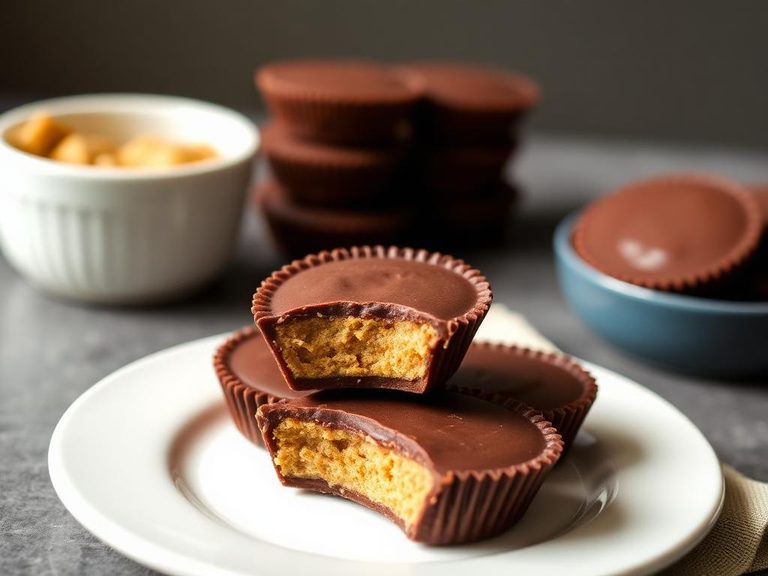
No. Peanut butter cups are a chocolate shell with a peanut butter filling. This is a fudge where peanut butter is a primary ingredient in the candy matrix itself, typically without a chocolate coating.
Why is the sugar content so high?
Traditional fudge relies on a cooked sugar syrup (sugar, milk/cream, butter) that crystallizes to create its smooth texture. The peanut butter adds more sugar, resulting in a very sweet final product.
Can I make it with natural peanut butter?
You can, but the texture may be oilier and less smooth. The added stabilizers and sugars in conventional peanut butter help create the classic, dense fudge consistency.
Nutrient density (calculated · NRF9.3)
Nutrient Rich Foods index: beneficial nutrients (protein, fiber, vitamins, minerals) minus saturated fat, added sugar & sodium, per 100 kcal.
NRF9.3 index — Fulgoni, Keast & Drewnowski, 2009. Computed from USDA nutrients.
Weight-loss friendliness (composite index)
Energy density 3.87 kcal/g · 4% calories from protein · 0.7 g fiber · 73.4 g sugar per 100 g.
Composite of energy density (Rolls et al., 1999), protein & fiber satiety, minus sugar. A calculated heuristic — ranks satiety-per-calorie, not a clinical measure.
Dietary load (calculated from USDA values)
Potential renal acid load. Positive = acid-forming, negative = alkaline-forming.
Sodium-to-potassium ratio: 0.99 (lower is better — aim for ≤ 1)
Sodium:potassium per WHO potassium guidance. Computed from USDA nutrients.