

Bratwurst, veal, cooked
Whole food · Sausages and Luncheon Meats

Photo: Wikipedia
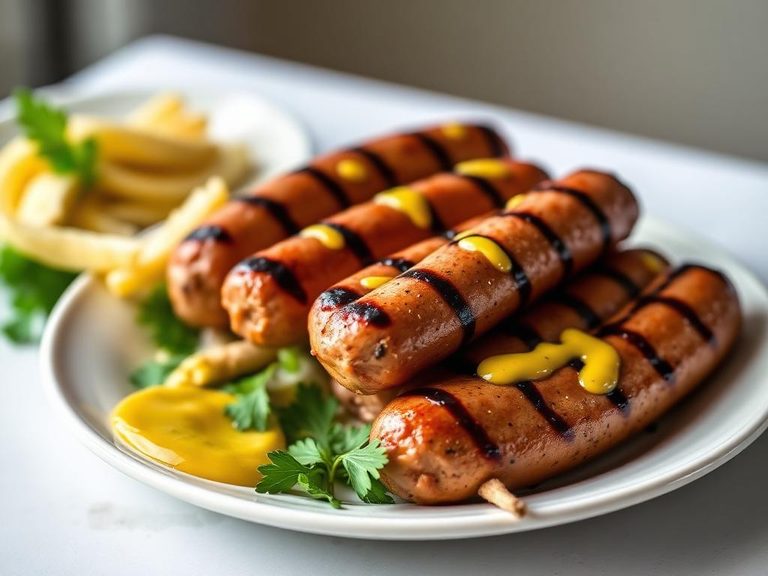
A classic German sausage made from finely ground veal, pork, and sometimes beef, seasoned with subtle spices like marjoram and nutmeg. When cooked, its texture is uniquely smooth and juicy with a satisfying snap from the natural casing. Nutritionally, it is a dense source of protein and fat, providing substantial energy with virtually no carbohydrates.
Calorie split: 16% protein · 0% carbs · 84% fat
↓ Full nutrition💚 Why it's loved
People adore its rich, savory, and mildly spiced flavor that is deeply comforting. Its versatility shines as the star of a hearty meal or as a flavorful addition to salads and stews.
⚠️ Watch-outs & how to enjoy it better
Its high saturated fat and sodium content can be a concern for heart health or blood pressure management. To counteract, practice strict portion control (stick to a single sausage) and pair it with fiber-rich sides like sauerkraut, roasted vegetables, or a large salad to add volume and nutrients without excess calories.
Key benefits
- Excellent source of high-quality protein for muscle maintenance.
- Provides essential B vitamins, particularly B12, from animal sources.
- Contains important minerals like zinc and selenium.
- A calorie-dense food useful for high-energy needs.
- Zero carbohydrates, making it suitable for ketogenic diets.
🍽️ Popular dishes
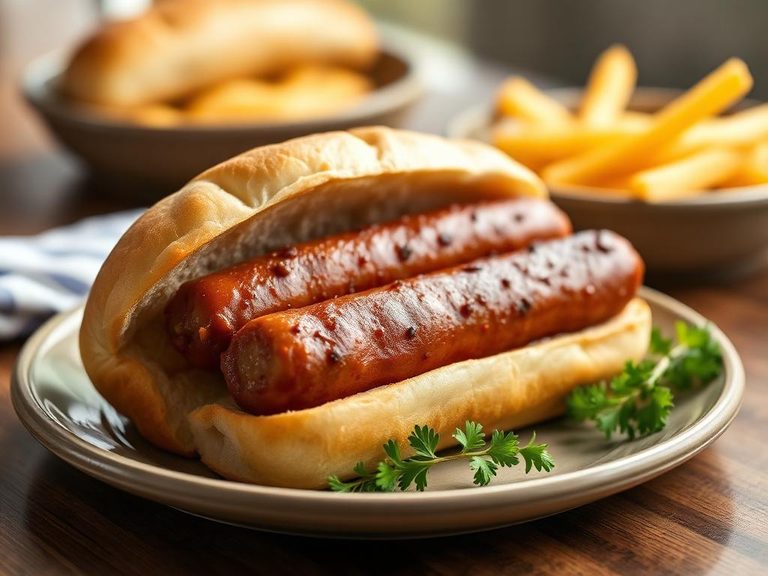
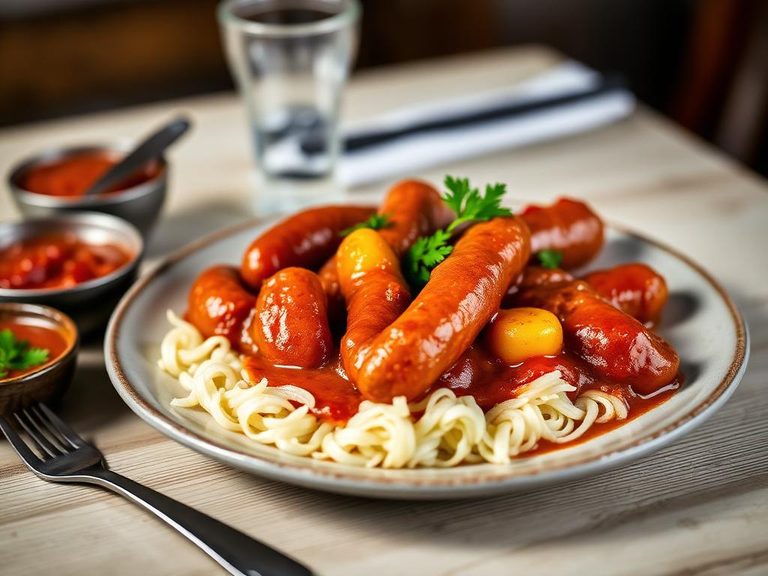
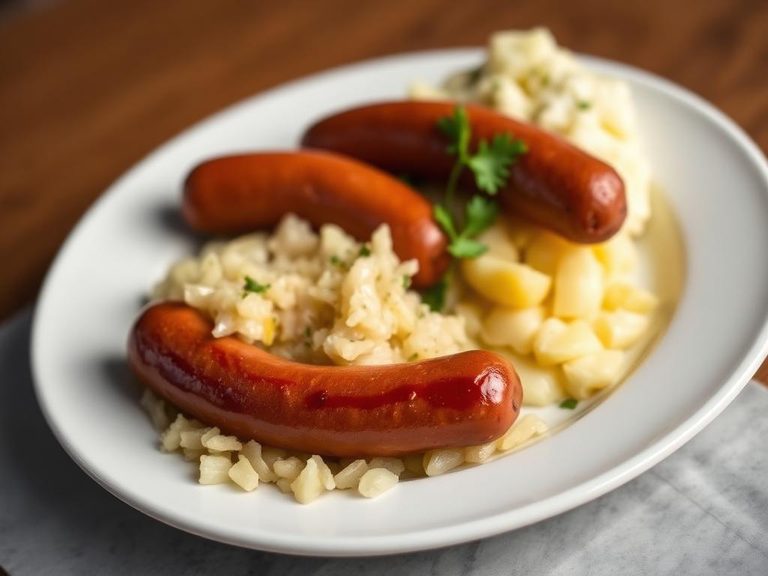
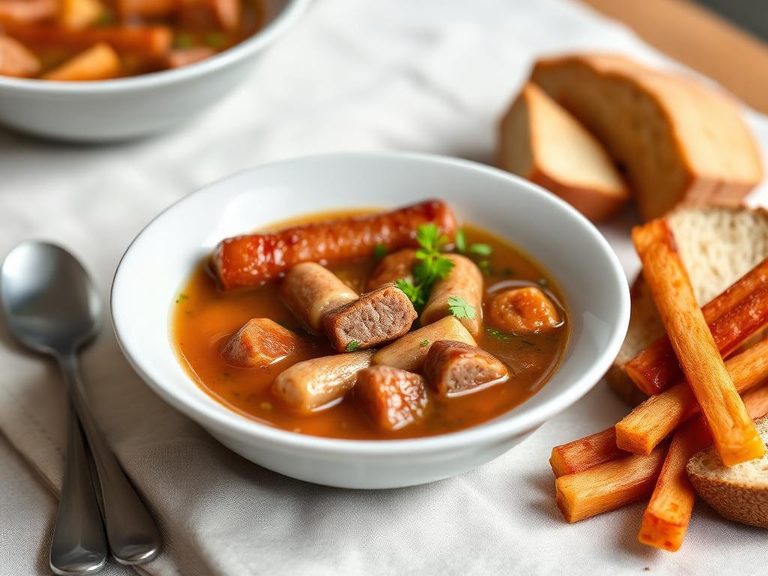
🌍 Where it's eaten
💡 Did you know?
The city of Nuremberg is so famous for its tiny, finger-sized Bratwurst (Nürnberger Rostbratwurst) that it has been granted Protected Geographical Indication (PGI) status by the EU, meaning they can only be produced in the city itself.
Full nutrition (USDA data · scales with serving)
| Water | 53.5 g |
| Energy | 341 kcal |
| Energy | 1428 kj |
| Protein | 14.0 g |
| Total lipid (fat) | 31.7 g |
| Ash | 0.80 g |
| Carbohydrate, by difference | 0.00 g |
| Fiber, total dietary | 0.00 g |
| Total Sugars | 0.00 g |
| Calcium, Ca | 11.0 mg |
| Iron, Fe | 0.74 mg |
| Magnesium, Mg | 16.0 mg |
| Phosphorus, P | 150 mg |
| Potassium, K | 231 mg |
| Sodium, Na | 60.0 mg |
| Zinc, Zn | 2.0 mg |
| Copper, Cu | 0.08 mg |
| Manganese, Mn | 0.05 mg |
| Selenium, Se | 19.2 ug |
| Vitamin C, total ascorbic acid | 0.00 mg |
| Thiamin | 0.05 mg |
| Riboflavin | 0.19 mg |
| Niacin | 5.4 mg |
| Pantothenic acid | 0.96 mg |
| Vitamin B-6 | 0.31 mg |
| Folate, total | 9.0 ug |
| Folic acid | 0.00 ug |
| Folate, food | 9.0 ug |
| Folate, DFE | 9.0 ug |
| Vitamin B-12 | 0.98 ug |
| Vitamin A, RAE | 0.00 ug |
| Retinol | 0.00 ug |
| Carotene, beta | 0.00 ug |
| Carotene, alpha | 0.00 ug |
| Cryptoxanthin, beta | 0.00 ug |
| Vitamin A, IU | 0.00 iu |
| Lycopene | 0.00 ug |
| Lutein + zeaxanthin | 0.00 ug |
| Alcohol, ethyl | 0.00 g |
| Caffeine | 0.00 mg |
| Theobromine | 0.00 mg |
Fat & fatty acid profile (per 100g)
| Fatty acids, total saturated | 14.9 g |
| SFA 4:0 | 0.00 g |
| SFA 6:0 | 0.00 g |
| SFA 8:0 | 0.00 g |
| SFA 10:0 | 0.01 g |
| SFA 12:0 | 0.03 g |
| SFA 14:0 | 0.39 g |
| SFA 16:0 | 2.3 g |
| SFA 18:0 | 4.8 g |
| Fatty acids, total monounsaturated | 13.0 g |
| MUFA 16:1 | 0.45 g |
| MUFA 18:1 | 3.4 g |
| MUFA 20:1 | 0.00 g |
| MUFA 22:1 | 0.00 g |
| Fatty acids, total polyunsaturated | 1.6 g |
| PUFA 18:2 | 0.59 g |
| PUFA 18:3 | 0.07 g |
| PUFA 18:4 | 0.00 g |
| PUFA 20:4 | 0.13 g |
| PUFA 20:5 n-3 (EPA) | 0.00 g |
| PUFA 22:5 n-3 (DPA) | 0.00 g |
| PUFA 22:6 n-3 (DHA) | 0.00 g |
| Cholesterol | 79.0 mg |
Amino acid profile (per 100g)
| Tryptophan | 0.14 g |
| Threonine | 0.61 g |
| Isoleucine | 0.69 g |
| Leucine | 1.1 g |
| Lysine | 1.2 g |
| Methionine | 0.33 g |
| Cystine | 0.16 g |
| Phenylalanine | 0.56 g |
| Tyrosine | 0.45 g |
| Valine | 0.77 g |
| Arginine | 0.82 g |
| Histidine | 0.51 g |
| Alanine | 0.83 g |
| Aspartic acid | 1.2 g |
| Glutamic acid | 2.2 g |
| Glycine | 0.72 g |
| Proline | 0.58 g |
| Serine | 0.52 g |
FAQ
What's the difference between bratwurst and other sausages?
Bratwurst is distinguished by its raw, finely ground meat (traditionally veal/pork) and specific seasoning profile, often featuring marjoram. It is always cooked before eating, unlike some fresh sausages that are pre-cooked.
How should I cook raw bratwurst for the best texture?
The best method is a two-stage cook: first simmer them gently in beer or water until just cooked through, then finish on a hot grill or pan to crisp the casing. This ensures a juicy interior and a perfect snap.
Is bratwurst gluten-free?
Traditional German recipes are often gluten-free, but many commercial versions use breadcrumbs or rusk as fillers. Always check the ingredient list if you have a gluten sensitivity or celiac disease.
Nutrient density (calculated · NRF9.3)
Nutrient Rich Foods index: beneficial nutrients (protein, fiber, vitamins, minerals) minus saturated fat, added sugar & sodium, per 100 kcal.
NRF9.3 index — Fulgoni, Keast & Drewnowski, 2009. Computed from USDA nutrients.
Weight-loss friendliness (composite index)
Energy density 3.41 kcal/g · 16% calories from protein · 0.0 g fiber · 0.0 g sugar per 100 g.
Composite of energy density (Rolls et al., 1999), protein & fiber satiety, minus sugar. A calculated heuristic — ranks satiety-per-calorie, not a clinical measure.
Dietary load (calculated from USDA values)
Potential renal acid load. Positive = acid-forming, negative = alkaline-forming.
Sodium-to-potassium ratio: 0.26 (lower is better — aim for ≤ 1)
Sodium:potassium per WHO potassium guidance. Computed from USDA nutrients.