

Bratwurst, beef and pork, smoked
Whole food · Sausages and Luncheon Meats

Photo: Wikipedia
A classic German sausage, bratwurst is a finely ground blend of beef and pork, traditionally seasoned and then smoked to develop a deep, savory flavor with a firm, juicy snap when bitten. Nutritionally, it's a high-protein, high-fat food with virtually no carbohydrates, making it a substantial centerpiece for a meal.
Calorie split: 17% protein · 3% carbs · 81% fat
↓ Full nutrition💚 Why it's loved
People adore bratwurst for its robust, smoky flavor and satisfying, meaty texture that holds up beautifully to grilling. It's a cultural staple for gatherings, embodying the hearty, convivial spirit of German beer gardens and backyard barbecues.
⚠️ Watch-outs & how to enjoy it better
Its high saturated fat and sodium content means it should be enjoyed in moderation, especially by those monitoring heart health or blood pressure. To balance a meal, pair a single bratwurst with a large portion of fibrous vegetables (like sauerkraut or roasted broccoli) and choose whole-grain buns to add fiber and slow digestion.
Key benefits
- Excellent source of complete protein
- Provides essential B vitamins like B12
- Contains minerals such as zinc and selenium
- Smoking adds unique, complex flavor without added sugar
- A filling, energy-dense food
🍽️ Popular dishes

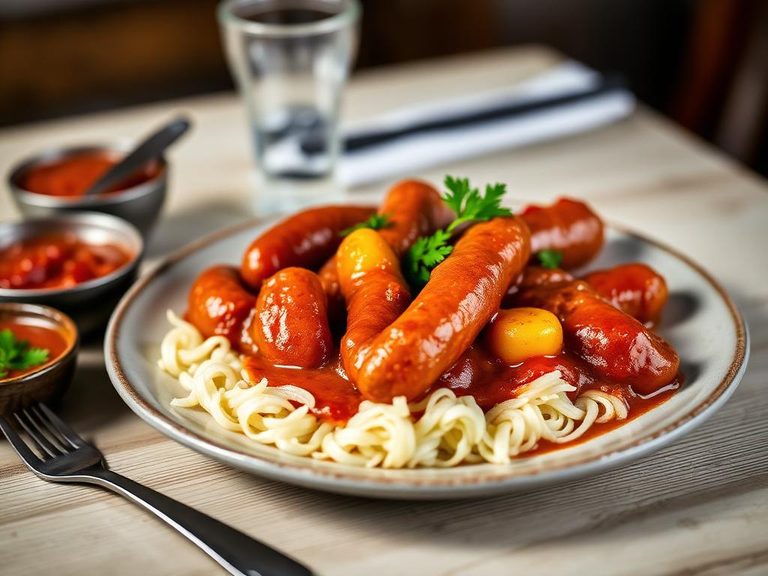
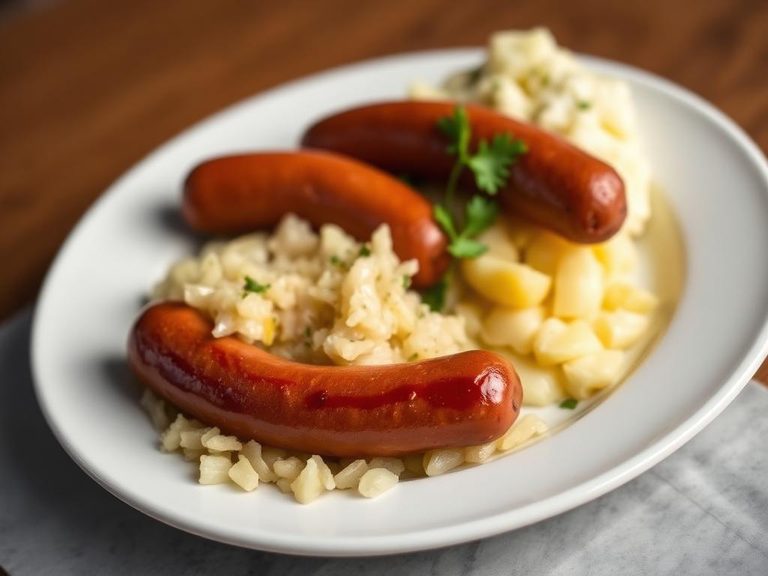
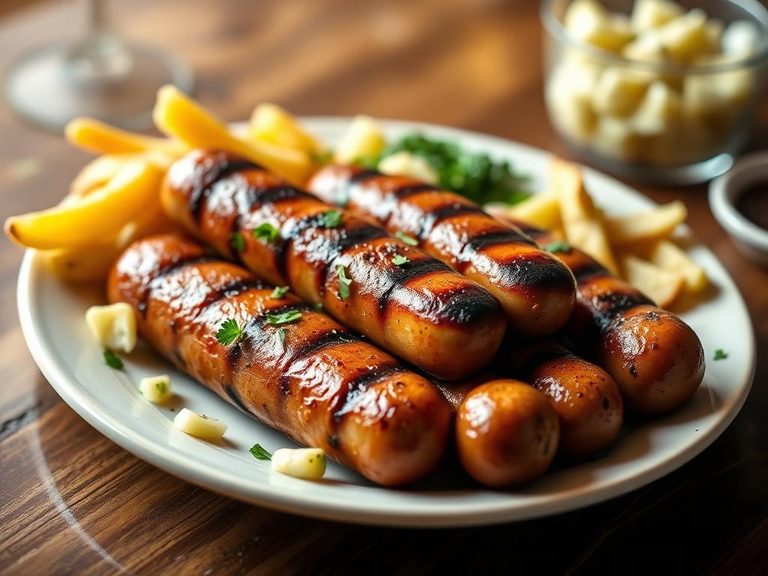
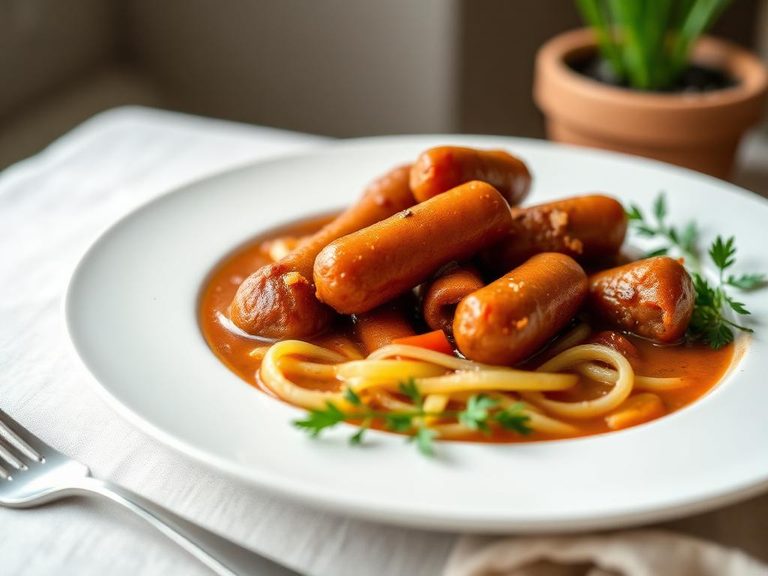
🌍 Where it's eaten
💡 Did you know?
The city of Nuremberg, Germany, is famous for its tiny 'Nürnberger Rostbratwurst,' which are so small they are traditionally served six to a roll.
Full nutrition (USDA data · scales with serving)
| Water | 56.6 g |
| Energy | 297 kcal |
| Energy | 1244 kj |
| Protein | 12.2 g |
| Total lipid (fat) | 26.3 g |
| Ash | 2.8 g |
| Carbohydrate, by difference | 2.0 g |
| Fiber, total dietary | 0.00 g |
| Total Sugars | 0.00 g |
| Calcium, Ca | 7.0 mg |
| Iron, Fe | 1.0 mg |
| Magnesium, Mg | 15.0 mg |
| Phosphorus, P | 130 mg |
| Potassium, K | 283 mg |
| Sodium, Na | 848 mg |
| Zinc, Zn | 2.5 mg |
| Copper, Cu | 0.08 mg |
| Manganese, Mn | 0.04 mg |
| Selenium, Se | 14.1 ug |
| Vitamin C, total ascorbic acid | 0.00 mg |
| Thiamin | 0.38 mg |
| Riboflavin | 0.21 mg |
| Niacin | 3.1 mg |
| Pantothenic acid | 0.69 mg |
| Vitamin B-6 | 0.20 mg |
| Folate, total | 4.0 ug |
| Folic acid | 0.00 ug |
| Folate, food | 4.0 ug |
| Folate, DFE | 4.0 ug |
| Vitamin B-12 | 2.7 ug |
| Vitamin A, RAE | 0.00 ug |
| Retinol | 0.00 ug |
| Carotene, beta | 0.00 ug |
| Carotene, alpha | 0.00 ug |
| Cryptoxanthin, beta | 0.00 ug |
| Vitamin A, IU | 0.00 iu |
| Lycopene | 0.00 ug |
| Lutein + zeaxanthin | 0.00 ug |
| Alcohol, ethyl | 0.00 g |
| Caffeine | 0.00 mg |
| Theobromine | 0.00 mg |
Fat & fatty acid profile (per 100g)
| Fatty acids, total saturated | 6.1 g |
| SFA 4:0 | 0.00 g |
| SFA 6:0 | 0.00 g |
| SFA 8:0 | 0.00 g |
| SFA 10:0 | 0.02 g |
| SFA 12:0 | 0.01 g |
| SFA 14:0 | 0.22 g |
| SFA 16:0 | 3.7 g |
| SFA 18:0 | 2.1 g |
| Fatty acids, total monounsaturated | 8.0 g |
| MUFA 16:1 | 0.66 g |
| MUFA 18:1 | 7.3 g |
| MUFA 20:1 | 0.00 g |
| MUFA 22:1 | 0.00 g |
| Fatty acids, total polyunsaturated | 1.6 g |
| PUFA 18:2 | 1.4 g |
| PUFA 18:3 | 0.18 g |
| PUFA 18:4 | 0.00 g |
| PUFA 20:4 | 0.00 g |
| PUFA 20:5 n-3 (EPA) | 0.00 g |
| PUFA 22:5 n-3 (DPA) | 0.00 g |
| PUFA 22:6 n-3 (DHA) | 0.00 g |
| Cholesterol | 78.0 mg |
Amino acid profile (per 100g)
| Tryptophan | 0.11 g |
| Threonine | 0.47 g |
| Isoleucine | 0.48 g |
| Leucine | 0.81 g |
| Lysine | 0.90 g |
| Methionine | 0.36 g |
| Cystine | 0.10 g |
| Phenylalanine | 0.41 g |
| Tyrosine | 0.39 g |
| Valine | 0.46 g |
| Arginine | 0.77 g |
| Histidine | 0.40 g |
| Alanine | 0.77 g |
| Aspartic acid | 1.1 g |
| Glutamic acid | 2.0 g |
| Glycine | 0.86 g |
| Proline | 0.67 g |
| Serine | 0.51 g |
FAQ
What's the difference between bratwurst and other sausages?
Bratwurst is distinguished by its fine grind, specific seasoning blend (often including marjoram, nutmeg, or ginger), and the fact it is typically sold raw and must be cooked before eating, unlike pre-cooked sausages.
Is smoked bratwurst already cooked?
Smoking is a cooking process, so smoked bratwurst is technically pre-cooked. However, it is almost always reheated (grilled, pan-fried, or simmered) to achieve a hot interior and a desirable browned, crispy exterior.
Can I freeze leftover bratwurst?
Yes, cooked bratwurst freezes well. Let them cool completely, then store in airtight containers or freezer bags for up to 2 months. Thaw in the refrigerator before reheating.
Nutrient density (calculated · NRF9.3)
Nutrient Rich Foods index: beneficial nutrients (protein, fiber, vitamins, minerals) minus saturated fat, added sugar & sodium, per 100 kcal.
NRF9.3 index — Fulgoni, Keast & Drewnowski, 2009. Computed from USDA nutrients.
Weight-loss friendliness (composite index)
Energy density 2.97 kcal/g · 16% calories from protein · 0.0 g fiber · 0.0 g sugar per 100 g.
Composite of energy density (Rolls et al., 1999), protein & fiber satiety, minus sugar. A calculated heuristic — ranks satiety-per-calorie, not a clinical measure.
Dietary load (calculated from USDA values)
Potential renal acid load. Positive = acid-forming, negative = alkaline-forming.
Sodium-to-potassium ratio: 3.00 (lower is better — aim for ≤ 1)
Sodium:potassium per WHO potassium guidance. Computed from USDA nutrients.