

Beef, Australian, imported, Wagyu, external fat, Aust. marble score 9, raw
Whole food · Beef Products

Photo: Wikipedia
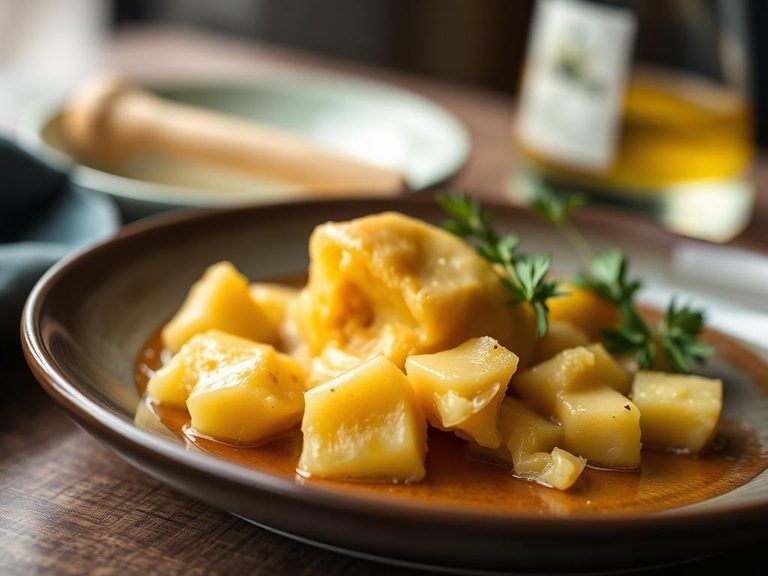
This is the prized external fat from a raw, Australian Wagyu beef carcass with an exceptionally high Australian Marble Score of 9. It appears as a thick, creamy-white layer with a firm, waxy texture and a rich, buttery, umami-forward flavor profile. Nutritionally, it is almost pure fat, providing a massive 68 grams of fat per 100g with minimal protein.
Calorie split: 3% protein · 1% carbs · 96% fat
↓ Full nutrition💚 Why it's loved
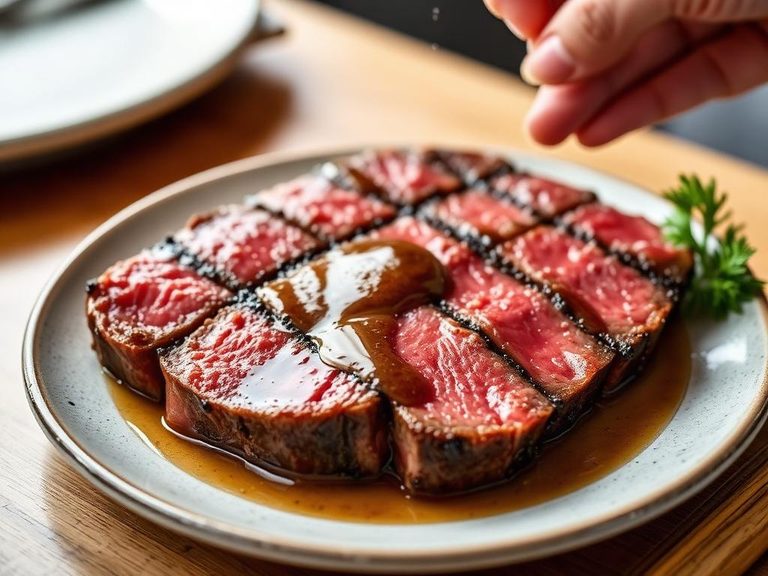
Chefs and food lovers prize it for its unparalleled ability to deliver deep, beefy flavor and luxurious mouthfeel. It's the secret behind the succulence of Wagyu, used to baste steaks, enrich sauces, or render into a uniquely flavorful cooking fat.
⚠️ Watch-outs & how to enjoy it better
This is an extremely calorie-dense, high-fat ingredient that should be used sparingly. Those monitoring saturated fat intake or managing cardiovascular health should be cautious. Tip: Use it as a flavor enhancer in small amounts, not the main component. Pair with fiber-rich vegetables to balance the meal.
Key benefits
- Extremely high in monounsaturated fats (oleic acid)
- Source of fat-soluble vitamins like Vitamin E
- Provides a rich, savory flavor base for cooking
- Can be rendered into a premium cooking fat (tallow)
- Contains conjugated linoleic acid (CLA)
🍽️ Popular dishes
🌍 Where it's eaten
💡 Did you know?
The high intramuscular fat (marbling) in Wagyu is so prized that the Japanese government once considered classifying the genetics of Wagyu cattle as a national treasure to prevent export.
Full nutrition (USDA data · scales with serving)
| Water | 25.2 g |
| Energy | 639 kcal |
| Energy | 2672 kj |
| Protein | 5.5 g |
| Total lipid (fat) | 68.1 g |
| Ash | 0.25 g |
| Carbohydrate, by difference | 0.97 g |
| Fiber, total dietary | 0.00 g |
| Total Sugars | 0.00 g |
| Sucrose | 0.00 g |
| Glucose | 0.00 g |
| Fructose | 0.00 g |
| Lactose | 0.00 g |
| Maltose | 0.00 g |
| Galactose | 0.00 g |
| Calcium, Ca | 4.0 mg |
| Iron, Fe | 0.81 mg |
| Sodium, Na | 43.0 mg |
| Vitamin C, total ascorbic acid | 0.00 mg |
| Vitamin A, RAE | 22.0 ug |
| Retinol | 22.0 ug |
| Vitamin A, IU | 74.0 iu |
Fat & fatty acid profile (per 100g)
| Fatty acids, total saturated | 22.4 g |
| SFA 10:0 | 0.02 g |
| SFA 12:0 | 0.04 g |
| SFA 14:0 | 1.7 g |
| SFA 15:0 | 0.25 g |
| SFA 16:0 | 13.6 g |
| SFA 17:0 | 0.55 g |
| SFA 18:0 | 6.1 g |
| SFA 20:0 | 0.05 g |
| SFA 22:0 | 0.01 g |
| SFA 24:0 | 0.01 g |
| Fatty acids, total monounsaturated | 35.8 g |
| MUFA 14:1 | 0.74 g |
| MUFA 16:1 | 3.0 g |
| MUFA 18:1 | 31.8 g |
| MUFA 18:1 c | 29.6 g |
| MUFA 18:1-11 t (18:1t n-7) | 1.9 g |
| MUFA 20:1 | 0.23 g |
| Fatty acids, total polyunsaturated | 2.4 g |
| PUFA 18:2 | 2.2 g |
| PUFA 18:2 n-6 c,c | 1.7 g |
| PUFA 18:3 | 0.20 g |
| PUFA 18:3 n-3 c,c,c (ALA) | 0.10 g |
| PUFA 18:3i | 0.10 g |
| PUFA 18:4 | 0.01 g |
| PUFA 20:2 n-6 c,c | 0.02 g |
| PUFA 20:3 | 0.01 g |
| PUFA 20:4 | 0.03 g |
| PUFA 20:5 n-3 (EPA) | 0.01 g |
| PUFA 22:5 n-3 (DPA) | 0.02 g |
| Fatty acids, total trans | 2.8 g |
| Fatty acids, total trans-monoenoic | 2.3 g |
| TFA 18:1 t | 2.3 g |
| TFA 18:2 t not further defined | 0.48 g |
| Fatty acids, total trans-polyenoic | 0.58 g |
| Cholesterol | 95.0 mg |
Amino acid profile (per 100g)
Estimated from Beef, variety meats and by-products, mechanically separated beef, raw — USDA does not publish this profile for Beef.
| Tryptophan | 0.17 g |
| Threonine | 0.47 g |
| Isoleucine | 0.58 g |
| Leucine | 1.2 g |
| Lysine | 1.2 g |
| Methionine | 0.43 g |
| Cystine | 0.23 g |
| Phenylalanine | 0.64 g |
| Tyrosine | 0.38 g |
| Valine | 0.92 g |
| Arginine | 1.2 g |
| Histidine | 0.44 g |
| Alanine | 1.0 g |
| Aspartic acid | 1.3 g |
| Glutamic acid | 2.1 g |
| Glycine | 1.2 g |
| Proline | 0.92 g |
| Serine | 0.57 g |
FAQ
What is the difference between Wagyu external fat and regular beef fat?
Wagyu external fat, especially from a high-marble score animal, has a higher proportion of monounsaturated fats (like oleic acid), giving it a lower melting point, softer texture, and a distinctly richer, buttery flavor compared to the harder, more neutral-tasting fat from standard beef cattle.
How do I use this raw fat in cooking?
The most common method is rendering: slowly cook the chopped fat over low heat to melt it into a clear, golden liquid (tallow). This tallow can then be used for high-heat searing, roasting vegetables, or making pastries. You can also freeze it and shave it over hot dishes.
Is this the same as 'Wagyu beef'?
No. 'Wagyu beef' typically refers to the muscle meat (steaks, roasts) prized for its internal marbling. This product is the external fat layer removed from the carcass. It's a by-product used primarily for its flavor and fat content.
Nutrient density (calculated · NRF9.3)
Nutrient Rich Foods index: beneficial nutrients (protein, fiber, vitamins, minerals) minus saturated fat, added sugar & sodium, per 100 kcal.
NRF9.3 index — Fulgoni, Keast & Drewnowski, 2009. Computed from USDA nutrients.
Weight-loss friendliness (composite index)
Energy density 6.39 kcal/g · 3% calories from protein · 0.0 g fiber · 0.0 g sugar per 100 g.
Composite of energy density (Rolls et al., 1999), protein & fiber satiety, minus sugar. A calculated heuristic — ranks satiety-per-calorie, not a clinical measure.