

Veggie burger, on bun
Common food
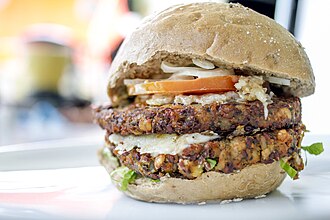
Photo: Wikipedia
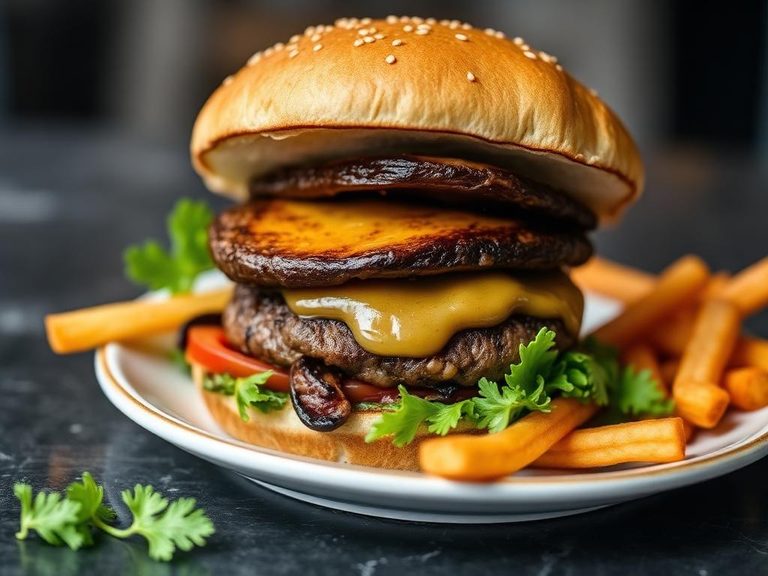
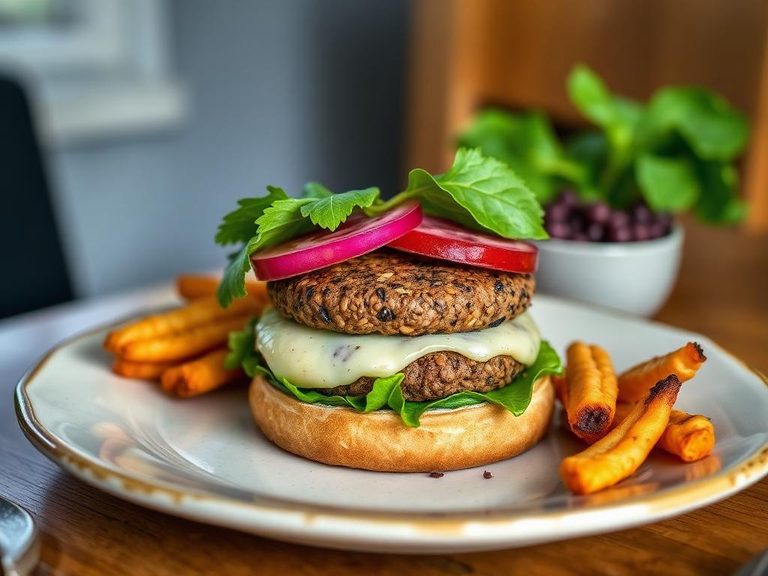
A veggie burger on a bun is a plant-based patty, typically made from soy, beans, or grains, served within a soft bread roll. It offers a hearty, savory bite with a texture ranging from firm and meaty to soft and crumbly, depending on the base ingredient. Nutritionally, it's a notable source of protein and complex carbohydrates, with a modest fat content.
Calorie split: 23% protein · 56% carbs · 21% fat
↓ Full nutrition💚 Why it's loved
People love it for its ability to deliver a satisfying, burger-like experience without meat, making it a staple for vegetarians, flexitarians, and those seeking a lighter meal. Its versatility allows it to be dressed up with classic burger toppings or incorporated into salads and bowls.
⚠️ Watch-outs & how to enjoy it better
Some veggie burgers can be high in sodium to enhance flavor, which may be a concern for those monitoring blood pressure. The carbohydrate content, especially from the bun, can cause a quicker rise in blood sugar compared to a low-carb meal. To counteract this, pair it with a side of non-starchy vegetables or a salad, and consider a whole-grain bun for more sustained energy release.
Key benefits
- Good source of plant-based protein
- Provides dietary fiber for digestive health
- Lower in saturated fat than many beef burgers
- Often fortified with vitamins like B12
- A versatile base for various flavor profiles
🍽️ Popular dishes
🌍 Where it's eaten
💡 Did you know?
The first commercially successful veggie burger, the Gardenburger, was invented in 1982 by Paul Wenner, a former restaurateur in Oregon, who originally called it the 'Garden Burger' at his restaurant.
Full nutrition (USDA data · scales with serving)
| Water | 48.8 g |
| Energy | 224 kcal |
| Protein | 13.0 g |
| Total lipid (fat) | 5.2 g |
| Carbohydrate, by difference | 30.8 g |
| Fiber, total dietary | 3.5 g |
| Total Sugars | 3.9 g |
| Calcium, Ca | 140 mg |
| Iron, Fe | 2.9 mg |
| Magnesium, Mg | 41.0 mg |
| Phosphorus, P | 158 mg |
| Potassium, K | 236 mg |
| Sodium, Na | 534 mg |
| Zinc, Zn | 1.0 mg |
| Copper, Cu | 0.16 mg |
| Selenium, Se | 24.7 ug |
| Vitamin C, total ascorbic acid | 3.0 mg |
| Thiamin | 1.7 mg |
| Riboflavin | 0.27 mg |
| Niacin | 4.0 mg |
| Vitamin B-6 | 0.19 mg |
| Folate, total | 110 ug |
| Folic acid | 24.0 ug |
| Folate, food | 86.0 ug |
| Folate, DFE | 127 ug |
| Choline, total | 17.2 mg |
| Vitamin B-12 | 1.2 ug |
| Vitamin B-12, added | 1.1 ug |
| Vitamin A, RAE | 1.0 ug |
| Retinol | 0.00 ug |
| Carotene, beta | 5.0 ug |
| Carotene, alpha | 0.00 ug |
| Cryptoxanthin, beta | 0.00 ug |
| Lycopene | 0.00 ug |
| Lutein + zeaxanthin | 3.0 ug |
| Vitamin E (alpha-tocopherol) | 0.25 mg |
| Vitamin E, added | 0.00 mg |
| Vitamin D (D2 + D3) | 0.00 ug |
| Vitamin K (phylloquinone) | 4.5 ug |
| Alcohol, ethyl | 0.00 g |
| Caffeine | 0.00 mg |
| Theobromine | 0.00 mg |
Fat & fatty acid profile (per 100g)
| Fatty acids, total saturated | 1.2 g |
| SFA 4:0 | 0.00 g |
| SFA 6:0 | 0.00 g |
| SFA 8:0 | 0.05 g |
| SFA 10:0 | 0.05 g |
| SFA 12:0 | 0.02 g |
| SFA 14:0 | 0.07 g |
| SFA 16:0 | 0.68 g |
| SFA 18:0 | 0.26 g |
| Fatty acids, total monounsaturated | 1.3 g |
| MUFA 16:1 | 0.02 g |
| MUFA 18:1 | 1.3 g |
| MUFA 20:1 | 0.02 g |
| MUFA 22:1 | 0.00 g |
| Fatty acids, total polyunsaturated | 1.9 g |
| PUFA 18:2 | 1.8 g |
| PUFA 18:3 | 0.08 g |
| PUFA 18:4 | 0.00 g |
| PUFA 20:4 | 0.00 g |
| PUFA 20:5 n-3 (EPA) | 0.00 g |
| PUFA 22:5 n-3 (DPA) | 0.00 g |
| PUFA 22:6 n-3 (DHA) | 0.00 g |
| Cholesterol | 3.0 mg |
Amino acid profile (per 100g)
Estimated from Veggie burgers or soyburgers, unprepared — USDA does not publish this profile for Veggie burger.
| Tryptophan | 0.16 g |
| Threonine | 0.60 g |
| Isoleucine | 0.78 g |
| Leucine | 1.4 g |
| Lysine | 1.0 g |
| Methionine | 0.29 g |
| Cystine | 0.26 g |
| Phenylalanine | 0.89 g |
| Tyrosine | 0.65 g |
| Valine | 0.89 g |
| Arginine | 1.0 g |
| Histidine | 0.47 g |
| Alanine | 0.73 g |
| Aspartic acid | 1.6 g |
| Glutamic acid | 4.1 g |
| Glycine | 0.66 g |
| Proline | 1.3 g |
| Serine | 0.97 g |
FAQ
Are veggie burgers a complete protein source?
It depends on the base. Burgies made from soy or quinoa typically provide all nine essential amino acids. Those based on beans or grains may need to be paired with other foods (like rice or nuts) throughout the day to form a complete protein profile.
How do I prevent a veggie burger from falling apart on the grill?
Chill the patties thoroughly before cooking. Use a well-oiled, preheated grill or pan, and avoid moving the patty until it forms a good crust. A binder like egg, flax egg, or breadcrumbs in the mix also helps hold it together.
Can I freeze leftover cooked veggie burgers?
Yes, cooked veggie burgers freeze well. Let them cool completely, wrap each patty individually in plastic wrap or foil, and place them in a freezer bag. They can be reheated from frozen in a skillet or oven.
Nutrient density (calculated · NRF9.3)
Nutrient Rich Foods index: beneficial nutrients (protein, fiber, vitamins, minerals) minus saturated fat, added sugar & sodium, per 100 kcal.
NRF9.3 index — Fulgoni, Keast & Drewnowski, 2009. Computed from USDA nutrients.
Weight-loss friendliness (composite index)
Energy density 2.24 kcal/g · 23% calories from protein · 3.5 g fiber · 3.9 g sugar per 100 g.
Composite of energy density (Rolls et al., 1999), protein & fiber satiety, minus sugar. A calculated heuristic — ranks satiety-per-calorie, not a clinical measure.
Dietary load (calculated from USDA values)
Potential renal acid load. Positive = acid-forming, negative = alkaline-forming.
Sodium-to-potassium ratio: 2.26 (lower is better — aim for ≤ 1)
Sodium:potassium per WHO potassium guidance. Computed from USDA nutrients.