

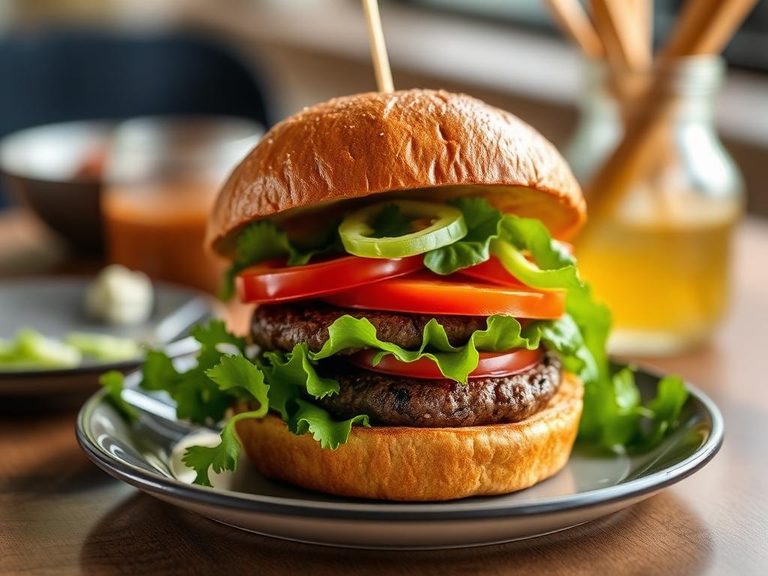
Veggie burger, on bun, with cheese
Common food

Photo: Wikipedia
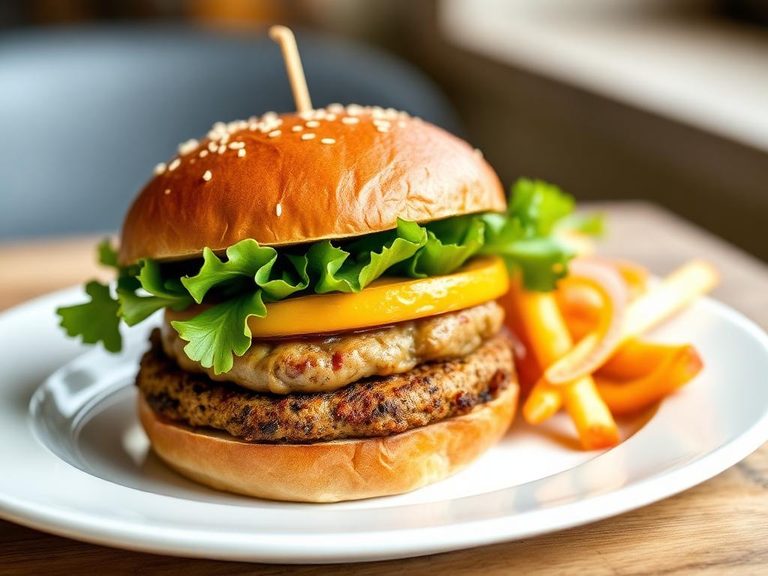
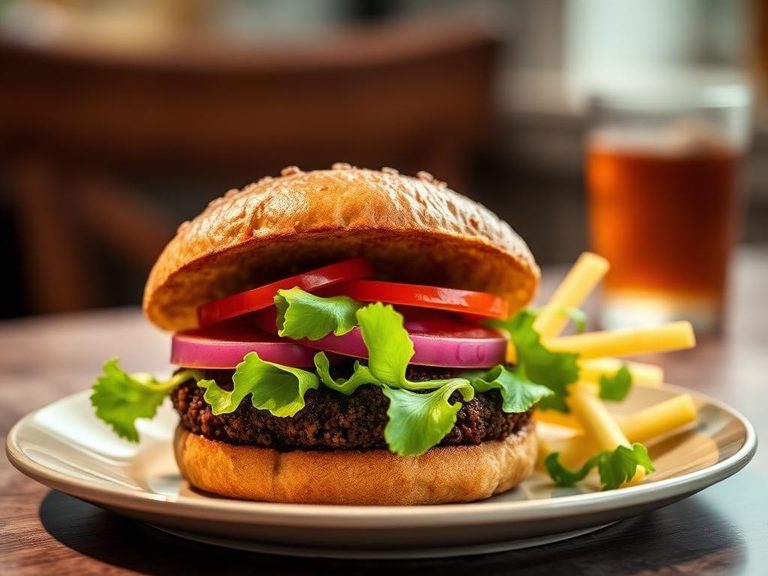
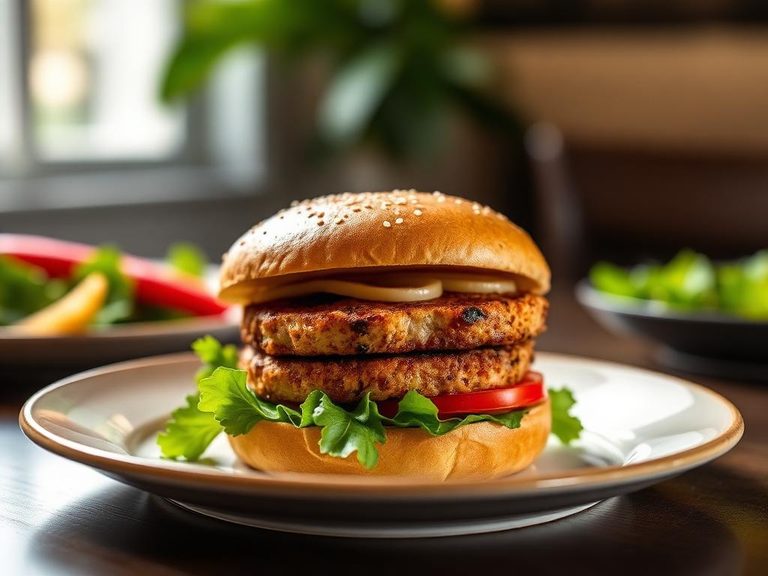
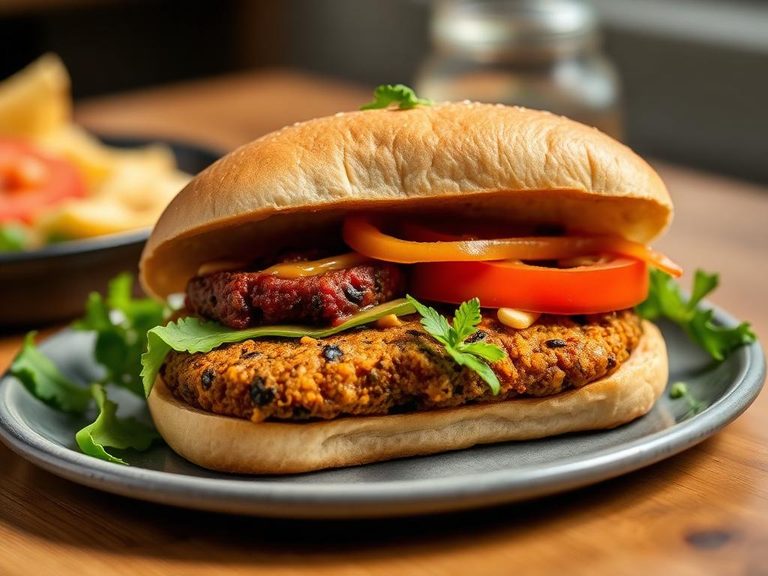
A veggie burger on a bun with cheese is a plant-based patty, typically made from soy, beans, or grains, nestled in a soft bun and topped with a slice of melted cheese. It offers a savory, slightly earthy flavor with a texture ranging from crumbly to firm, depending on the patty base. Nutritionally, it provides a solid plant-based protein boost with a moderate calorie count.
Calorie split: 23% protein · 45% carbs · 32% fat
↓ Full nutrition💚 Why it's loved
People love it for the satisfying, umami-rich experience that mimics a classic burger while being meat-free, and for its incredible versatility—it can be dressed up with gourmet toppings or kept simple for a quick, comforting meal.
⚠️ Watch-outs & how to enjoy it better
Some commercial versions can be high in sodium or contain processed ingredients, and the bun may cause blood-sugar spikes for some. To counteract, choose low-sodium patties, opt for a whole-grain bun, and pair the burger with a side of non-starchy vegetables or a salad to add fiber and slow digestion.
Key benefits
- Good source of plant-based protein (14g per 100g).
- Lower in saturated fat than many beef burgers.
- Provides dietary fiber (3g per 100g) for digestive health.
- Versatile base for various flavor profiles and toppings.
- Often suitable for vegetarian or flexitarian diets.
🍽️ Popular dishes
🌍 Where it's eaten
💡 Did you know?
The first commercially successful veggie burger, the Gardenburger, was invented in 1981 by Paul Wenner, who was trying to create a healthy entrée using leftover vegetables and grains.
Full nutrition (USDA data · scales with serving)
| Water | 47.7 g |
| Energy | 243 kcal |
| Protein | 14.0 g |
| Total lipid (fat) | 8.4 g |
| Carbohydrate, by difference | 27.2 g |
| Fiber, total dietary | 3.0 g |
| Total Sugars | 3.8 g |
| Calcium, Ca | 245 mg |
| Iron, Fe | 2.5 mg |
| Magnesium, Mg | 39.0 mg |
| Phosphorus, P | 216 mg |
| Potassium, K | 224 mg |
| Sodium, Na | 600 mg |
| Zinc, Zn | 1.3 mg |
| Copper, Cu | 0.14 mg |
| Selenium, Se | 24.4 ug |
| Vitamin C, total ascorbic acid | 2.6 mg |
| Thiamin | 1.4 mg |
| Riboflavin | 0.28 mg |
| Niacin | 3.4 mg |
| Vitamin B-6 | 0.18 mg |
| Folate, total | 97.0 ug |
| Folic acid | 21.0 ug |
| Folate, food | 76.0 ug |
| Folate, DFE | 112 ug |
| Choline, total | 17.9 mg |
| Vitamin B-12 | 1.2 ug |
| Vitamin B-12, added | 0.93 ug |
| Vitamin A, RAE | 38.0 ug |
| Retinol | 36.0 ug |
| Carotene, beta | 15.0 ug |
| Carotene, alpha | 0.00 ug |
| Cryptoxanthin, beta | 1.0 ug |
| Lycopene | 0.00 ug |
| Lutein + zeaxanthin | 5.0 ug |
| Vitamin E (alpha-tocopherol) | 0.31 mg |
| Vitamin E, added | 0.00 mg |
| Vitamin D (D2 + D3) | 0.50 ug |
| Vitamin K (phylloquinone) | 4.2 ug |
| Alcohol, ethyl | 0.00 g |
| Caffeine | 0.00 mg |
| Theobromine | 0.00 mg |
Fat & fatty acid profile (per 100g)
| Fatty acids, total saturated | 3.3 g |
| SFA 4:0 | 0.08 g |
| SFA 6:0 | 0.07 g |
| SFA 8:0 | 0.09 g |
| SFA 10:0 | 0.14 g |
| SFA 12:0 | 0.13 g |
| SFA 14:0 | 0.42 g |
| SFA 16:0 | 1.6 g |
| SFA 18:0 | 0.61 g |
| Fatty acids, total monounsaturated | 2.0 g |
| MUFA 16:1 | 0.09 g |
| MUFA 18:1 | 2.0 g |
| MUFA 20:1 | 0.03 g |
| MUFA 22:1 | 0.00 g |
| Fatty acids, total polyunsaturated | 1.8 g |
| PUFA 18:2 | 1.7 g |
| PUFA 18:3 | 0.09 g |
| PUFA 18:4 | 0.00 g |
| PUFA 20:4 | 0.01 g |
| PUFA 20:5 n-3 (EPA) | 0.00 g |
| PUFA 22:5 n-3 (DPA) | 0.00 g |
| PUFA 22:6 n-3 (DHA) | 0.00 g |
| Cholesterol | 15.0 mg |
Amino acid profile (per 100g)
Estimated from Veggie burgers or soyburgers, unprepared — USDA does not publish this profile for Veggie burger.
| Tryptophan | 0.16 g |
| Threonine | 0.60 g |
| Isoleucine | 0.78 g |
| Leucine | 1.4 g |
| Lysine | 1.0 g |
| Methionine | 0.29 g |
| Cystine | 0.26 g |
| Phenylalanine | 0.89 g |
| Tyrosine | 0.65 g |
| Valine | 0.89 g |
| Arginine | 1.0 g |
| Histidine | 0.47 g |
| Alanine | 0.73 g |
| Aspartic acid | 1.6 g |
| Glutamic acid | 4.1 g |
| Glycine | 0.66 g |
| Proline | 1.3 g |
| Serine | 0.97 g |
FAQ
Is a veggie burger healthier than a beef burger?
It can be, as it typically has less saturated fat and no cholesterol. However, it's important to check labels, as some veggie burgers can be high in sodium and processed ingredients. The overall healthiness depends on the specific product and how it's prepared.
Can I get enough protein from a veggie burger?
Yes, many veggie burgers are designed to be protein-rich, often using soy, pea protein, or beans. The one described provides 14g of protein per 100g, which is comparable to a lean beef patty.
Why does my veggie burger fall apart on the grill?
This is common due to the lack of meat binders. To prevent it, ensure the grill is very hot and well-oiled, don't flip it too early, and consider using a grill basket. Chilling the patties before cooking can also help them hold together.
Nutrient density (calculated · NRF9.3)
Nutrient Rich Foods index: beneficial nutrients (protein, fiber, vitamins, minerals) minus saturated fat, added sugar & sodium, per 100 kcal.
NRF9.3 index — Fulgoni, Keast & Drewnowski, 2009. Computed from USDA nutrients.
Weight-loss friendliness (composite index)
Energy density 2.43 kcal/g · 23% calories from protein · 3.0 g fiber · 3.8 g sugar per 100 g.
Composite of energy density (Rolls et al., 1999), protein & fiber satiety, minus sugar. A calculated heuristic — ranks satiety-per-calorie, not a clinical measure.
Dietary load (calculated from USDA values)
Potential renal acid load. Positive = acid-forming, negative = alkaline-forming.
Sodium-to-potassium ratio: 2.68 (lower is better — aim for ≤ 1)
Sodium:potassium per WHO potassium guidance. Computed from USDA nutrients.