

Turnip greens, frozen, cooked, boiled, drained, with salt
Whole food · Vegetables and Vegetable Products

Photo: Wikipedia
Frozen turnip greens, once boiled and drained, transform into a tender, earthy side with a subtle peppery bite and a silky, leafy texture. Packed with fiber and plant-based protein for just 29 calories per 100g, they are a nutrient-dense staple that delivers a satisfying, savory depth to any meal.
Calorie split: 36% protein · 54% carbs · 10% fat
↓ Full nutrition💚 Why it's loved
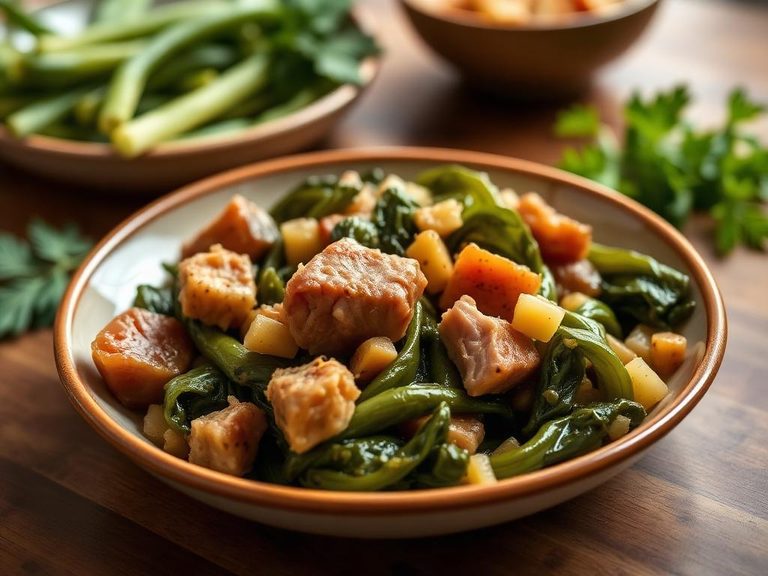
People love turnip greens for their robust, slightly bitter flavor that mellows into a savory, comforting taste when cooked, making them a beloved soul food staple. Their versatility allows them to be seasoned simply with salt pork or bacon, or dressed up with garlic and chili flakes.
⚠️ Watch-outs & how to enjoy it better
The high vitamin K content can interact with blood-thinning medications, and they contain oxalates which may contribute to kidney stones in susceptible individuals. To mitigate, ensure consistent vitamin K intake if on medication and pair with calcium-rich foods like cheese or yogurt to help bind oxalates.
Key benefits
- Excellent source of dietary fiber (3.4g per 100g)
- High in plant-based protein (3.35g per 100g)
- Very low in calories (29 kcal per 100g)
- Rich in vitamins A, C, and K
- Good source of minerals like calcium and manganese
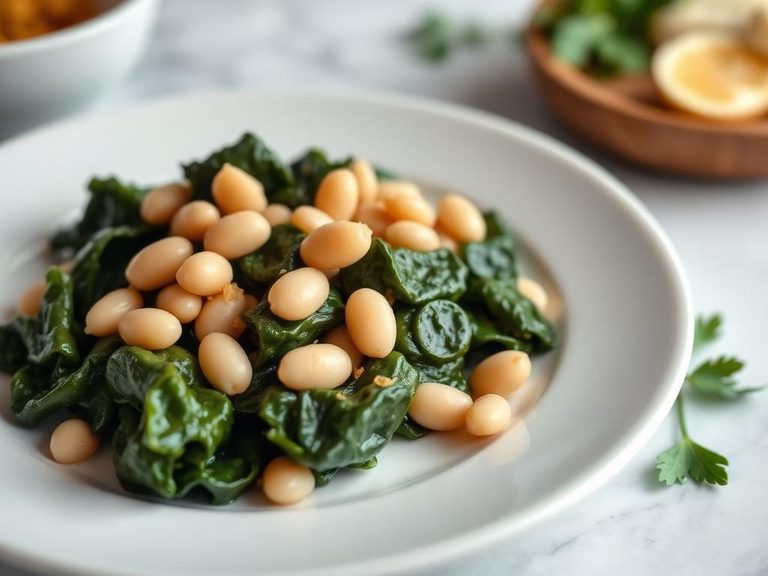
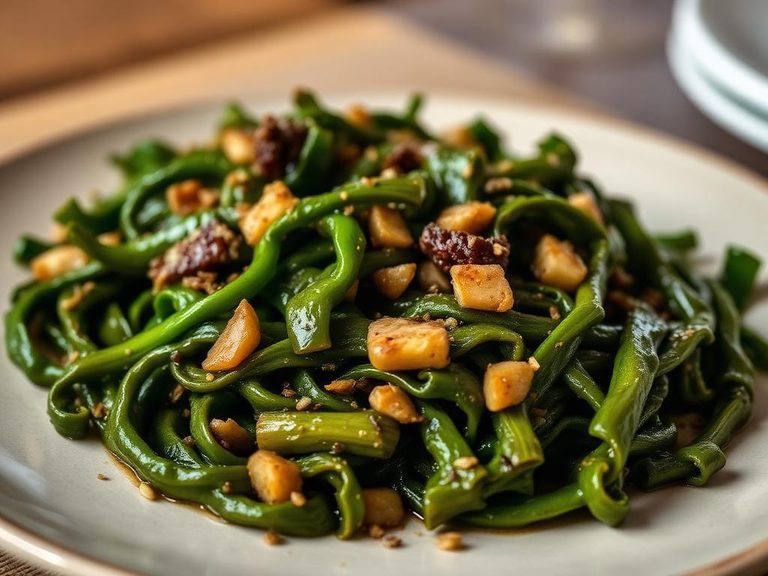
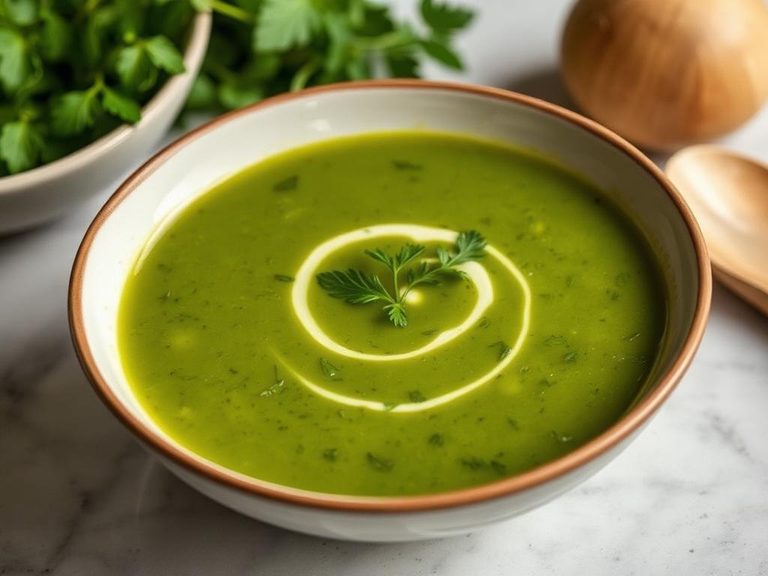
🍽️ Popular dishes

🌍 Where it's eaten
💡 Did you know?
The entire turnip plant is edible; the greens are actually more nutrient-dense than the root itself, containing significantly more vitamin C and calcium.
Full nutrition (USDA data · scales with serving)
| Water | 90.4 g |
| Energy | 29.0 kcal |
| Energy | 123 kj |
| Protein | 3.4 g |
| Total lipid (fat) | 0.42 g |
| Ash | 0.85 g |
| Carbohydrate, by difference | 5.0 g |
| Fiber, total dietary | 3.4 g |
| Total Sugars | 0.75 g |
| Calcium, Ca | 152 mg |
| Iron, Fe | 1.9 mg |
| Magnesium, Mg | 26.0 mg |
| Phosphorus, P | 34.0 mg |
| Potassium, K | 224 mg |
| Sodium, Na | 251 mg |
| Zinc, Zn | 0.41 mg |
| Copper, Cu | 0.15 mg |
| Manganese, Mn | 0.47 mg |
| Selenium, Se | 1.2 ug |
| Vitamin C, total ascorbic acid | 21.8 mg |
| Thiamin | 0.05 mg |
| Riboflavin | 0.07 mg |
| Niacin | 0.47 mg |
| Pantothenic acid | 0.07 mg |
| Vitamin B-6 | 0.07 mg |
| Folate, total | 39.0 ug |
| Folic acid | 0.00 ug |
| Folate, food | 39.0 ug |
| Folate, DFE | 39.0 ug |
| Choline, total | 0.50 mg |
| Vitamin B-12 | 0.00 ug |
| Vitamin B-12, added | 0.00 ug |
| Vitamin A, RAE | 538 ug |
| Retinol | 0.00 ug |
| Carotene, beta | 6459 ug |
| Carotene, alpha | 0.00 ug |
| Cryptoxanthin, beta | 0.00 ug |
| Vitamin A, IU | 10765 iu |
| Lycopene | 0.00 ug |
| Lutein + zeaxanthin | 11915 ug |
| Vitamin E (alpha-tocopherol) | 2.7 mg |
| Vitamin E, added | 0.00 mg |
| Vitamin D (D2 + D3), International Units | 0.00 iu |
| Vitamin D (D2 + D3) | 0.00 ug |
| Vitamin K (phylloquinone) | 519 ug |
| Caffeine | 0.00 mg |
| Theobromine | 0.00 mg |
Fat & fatty acid profile (per 100g)
| Fatty acids, total saturated | 0.10 g |
| SFA 8:0 | 0.00 g |
| SFA 10:0 | 0.00 g |
| SFA 12:0 | 0.00 g |
| SFA 14:0 | 0.00 g |
| SFA 16:0 | 0.08 g |
| SFA 18:0 | 0.01 g |
| Fatty acids, total monounsaturated | 0.03 g |
| MUFA 16:1 | 0.02 g |
| MUFA 18:1 | 0.01 g |
| Fatty acids, total polyunsaturated | 0.17 g |
| PUFA 18:2 | 0.05 g |
| PUFA 18:3 | 0.12 g |
| Fatty acids, total trans | 0.00 g |
| Cholesterol | 0.00 mg |
Amino acid profile (per 100g)
| Tryptophan | 0.06 g |
| Threonine | 0.18 g |
| Isoleucine | 0.17 g |
| Leucine | 0.31 g |
| Lysine | 0.22 g |
| Methionine | 0.08 g |
| Cystine | 0.04 g |
| Phenylalanine | 0.21 g |
| Tyrosine | 0.13 g |
| Valine | 0.23 g |
| Arginine | 0.21 g |
| Histidine | 0.08 g |
| Alanine | 0.23 g |
| Aspartic acid | 0.35 g |
| Glutamic acid | 0.46 g |
| Glycine | 0.20 g |
| Proline | 0.16 g |
| Serine | 0.14 g |
FAQ
How do I reduce the bitterness of turnip greens?
A common method is to blanch them in boiling water for a few minutes, then discard the water before the final cooking. Alternatively, a small amount of sugar or an acidic ingredient like lemon juice or vinegar can help balance the bitterness.
Are frozen turnip greens as nutritious as fresh?
Yes, often more so. Flash-freezing shortly after harvest locks in nutrients, so frozen greens can retain more vitamins than 'fresh' greens that have traveled long distances and sat on shelves.
What's the best way to season boiled turnip greens?
A classic Southern approach uses smoked meat like bacon, ham hocks, or turkey legs for depth. For a simpler version, sauté with garlic, red pepper flakes, and a splash of apple cider vinegar after boiling.
Nutrient density (calculated · NRF9.3)
Nutrient Rich Foods index: beneficial nutrients (protein, fiber, vitamins, minerals) minus saturated fat, added sugar & sodium, per 100 kcal.
NRF9.3 index — Fulgoni, Keast & Drewnowski, 2009. Computed from USDA nutrients.
Weight-loss friendliness (composite index)
Energy density 0.29 kcal/g · 46% calories from protein · 3.4 g fiber · 0.8 g sugar per 100 g.
Composite of energy density (Rolls et al., 1999), protein & fiber satiety, minus sugar. A calculated heuristic — ranks satiety-per-calorie, not a clinical measure.
Dietary load (calculated from USDA values)
Potential renal acid load. Positive = acid-forming, negative = alkaline-forming.
Sodium-to-potassium ratio: 1.12 (lower is better — aim for ≤ 1)
Sodium:potassium per WHO potassium guidance. Computed from USDA nutrients.