

Sweet and sour shrimp
Common food
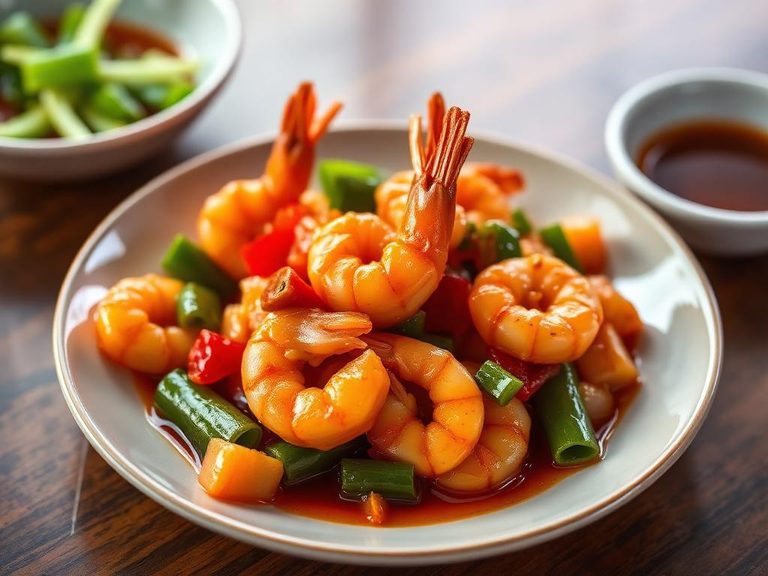
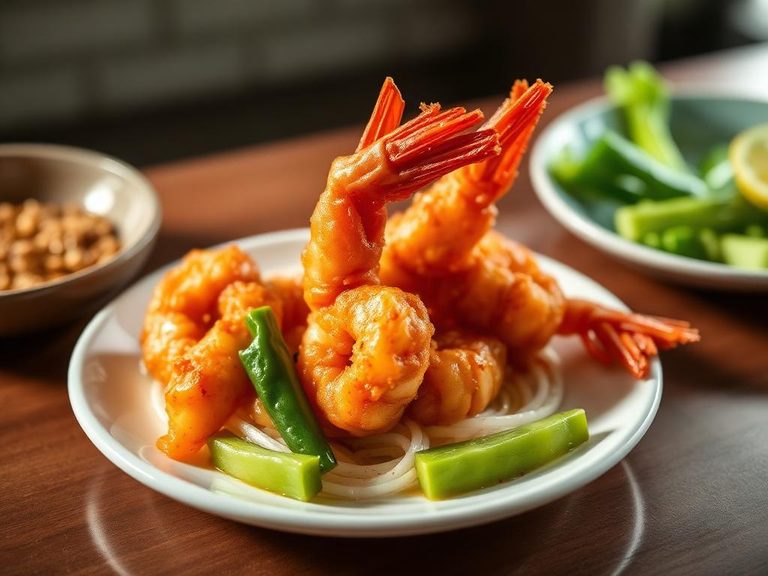
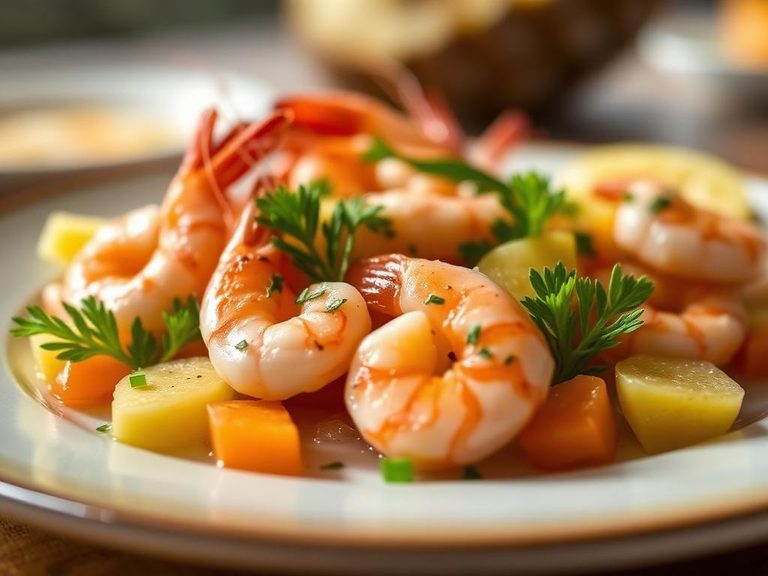
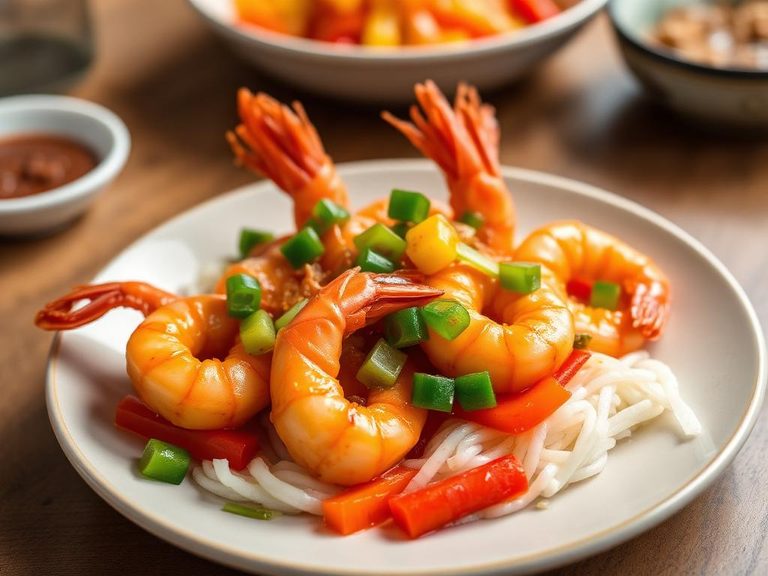
Sweet and sour shrimp is a vibrant dish where tender, battered shrimp are tossed in a glossy, tangy-sweet sauce, often with colorful bell peppers and pineapple. The texture is a delightful contrast between the crispy coating and the succulent shrimp inside. Nutritionally, it provides a good protein source but is higher in carbohydrates and sugars from the sauce and batter.
Calorie split: 14% protein · 38% carbs · 48% fat
↓ Full nutrition💚 Why it's loved
People love it for the perfect balance of tangy and sweet flavors, the satisfying crunch of the batter, and its visual appeal with bright colors. It's a staple in Chinese-American cuisine, evoking comfort and celebration.
⚠️ Watch-outs & how to enjoy it better
The dish can be high in sodium, added sugars, and refined carbohydrates from the batter and sauce, which may cause blood sugar spikes. Those with shellfish allergies must avoid it. To mitigate, opt for a lighter batter (like cornstarch), use less sauce, and serve with steamed vegetables or brown rice to add fiber and balance the meal.
Key benefits
- Good source of high-quality protein
- Contains selenium from shrimp, an important antioxidant
- Provides vitamin B12 for nerve function
- Quick-cooking and versatile for weeknight meals
🍽️ Popular dishes
🌍 Where it's eaten
💡 Did you know?
The iconic bright red color in many restaurant versions often comes from a small amount of ketchup or food coloring, not just the natural color of the shrimp or tomatoes.
Full nutrition (USDA data · scales with serving)
| Water | 66.9 g |
| Energy | 172 kcal |
| Protein | 5.9 g |
| Total lipid (fat) | 9.2 g |
| Carbohydrate, by difference | 16.2 g |
| Fiber, total dietary | 0.60 g |
| Total Sugars | 8.4 g |
| Calcium, Ca | 33.0 mg |
| Iron, Fe | 0.73 mg |
| Magnesium, Mg | 16.0 mg |
| Phosphorus, P | 104 mg |
| Potassium, K | 136 mg |
| Sodium, Na | 347 mg |
| Zinc, Zn | 0.47 mg |
| Copper, Cu | 0.11 mg |
| Selenium, Se | 11.5 ug |
| Vitamin C, total ascorbic acid | 12.0 mg |
| Thiamin | 0.08 mg |
| Riboflavin | 0.06 mg |
| Niacin | 1.2 mg |
| Vitamin B-6 | 0.11 mg |
| Folate, total | 18.0 ug |
| Folic acid | 7.0 ug |
| Folate, food | 12.0 ug |
| Folate, DFE | 23.0 ug |
| Choline, total | 33.3 mg |
| Vitamin B-12 | 0.28 ug |
| Vitamin B-12, added | 0.00 ug |
| Vitamin A, RAE | 20.0 ug |
| Retinol | 18.0 ug |
| Carotene, beta | 33.0 ug |
| Carotene, alpha | 2.0 ug |
| Cryptoxanthin, beta | 1.0 ug |
| Lycopene | 399 ug |
| Lutein + zeaxanthin | 41.0 ug |
| Vitamin E (alpha-tocopherol) | 2.2 mg |
| Vitamin E, added | 0.00 mg |
| Vitamin D (D2 + D3) | 0.00 ug |
| Vitamin K (phylloquinone) | 9.8 ug |
| Alcohol, ethyl | 0.00 g |
| Caffeine | 0.00 mg |
| Theobromine | 0.00 mg |
Fat & fatty acid profile (per 100g)
| Fatty acids, total saturated | 1.3 g |
| SFA 4:0 | 0.00 g |
| SFA 6:0 | 0.00 g |
| SFA 8:0 | 0.00 g |
| SFA 10:0 | 0.00 g |
| SFA 12:0 | 0.00 g |
| SFA 14:0 | 0.01 g |
| SFA 16:0 | 0.91 g |
| SFA 18:0 | 0.29 g |
| Fatty acids, total monounsaturated | 3.7 g |
| MUFA 16:1 | 0.04 g |
| MUFA 18:1 | 3.6 g |
| MUFA 20:1 | 0.06 g |
| MUFA 22:1 | 0.00 g |
| Fatty acids, total polyunsaturated | 3.5 g |
| PUFA 18:2 | 3.0 g |
| PUFA 18:3 | 0.39 g |
| PUFA 18:4 | 0.00 g |
| PUFA 20:4 | 0.01 g |
| PUFA 20:5 n-3 (EPA) | 0.02 g |
| PUFA 22:5 n-3 (DPA) | 0.00 g |
| PUFA 22:6 n-3 (DHA) | 0.02 g |
| Cholesterol | 45.0 mg |
Amino acid profile (per 100g)
Estimated from Restaurant, Chinese, sweet and sour chicken — USDA does not publish this profile for Sweet and sour shrimp.
| Tryptophan | 0.11 g |
| Threonine | 0.39 g |
| Isoleucine | 0.40 g |
| Leucine | 0.73 g |
| Lysine | 0.69 g |
| Methionine | 0.23 g |
| Cystine | 0.13 g |
| Phenylalanine | 0.37 g |
| Tyrosine | 0.26 g |
| Valine | 0.42 g |
| Arginine | 0.55 g |
| Histidine | 0.29 g |
| Alanine | 0.49 g |
| Aspartic acid | 0.81 g |
| Glutamic acid | 1.9 g |
| Glycine | 0.39 g |
| Proline | 0.47 g |
| Serine | 0.38 g |
FAQ
Is sweet and sour shrimp healthy?
It can be part of a balanced diet. The shrimp provides lean protein, but the batter and sauce add calories, sugar, and sodium. Making it at home allows you to control these elements for a healthier version.
What is the sauce made of?
The classic sauce is a blend of vinegar (often rice vinegar), sugar, ketchup, soy sauce, and sometimes pineapple juice, thickened with a cornstarch slurry.
Can I make it gluten-free?
Yes, by using a gluten-free batter (like rice flour or cornstarch) and ensuring all sauce ingredients (like soy sauce) are certified gluten-free.
Nutrient density (calculated · NRF9.3)
Nutrient Rich Foods index: beneficial nutrients (protein, fiber, vitamins, minerals) minus saturated fat, added sugar & sodium, per 100 kcal.
NRF9.3 index — Fulgoni, Keast & Drewnowski, 2009. Computed from USDA nutrients.
Weight-loss friendliness (composite index)
Energy density 1.72 kcal/g · 14% calories from protein · 0.6 g fiber · 8.4 g sugar per 100 g.
Composite of energy density (Rolls et al., 1999), protein & fiber satiety, minus sugar. A calculated heuristic — ranks satiety-per-calorie, not a clinical measure.
Dietary load (calculated from USDA values)
Potential renal acid load. Positive = acid-forming, negative = alkaline-forming.
Sodium-to-potassium ratio: 2.55 (lower is better — aim for ≤ 1)
Sodium:potassium per WHO potassium guidance. Computed from USDA nutrients.