

Rice, white, with carrots, dark green vegetables, and tomatoes and/or tomato-based sauce, no added fat
Common food
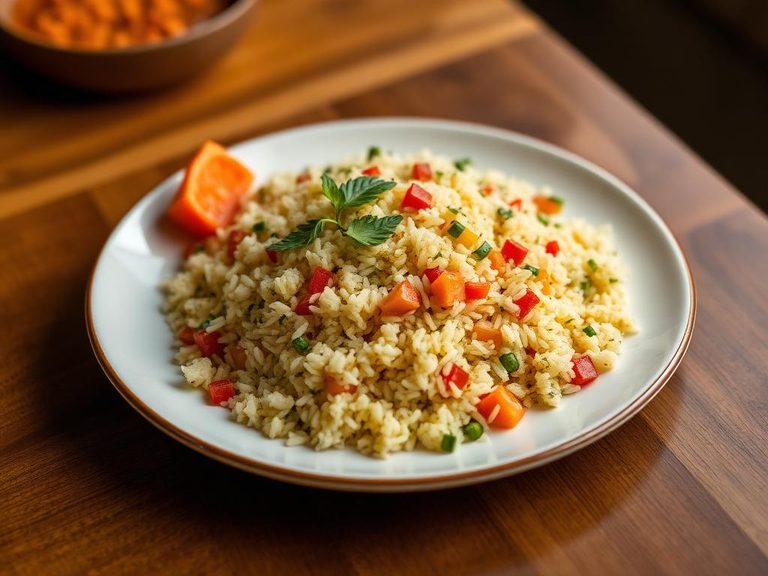
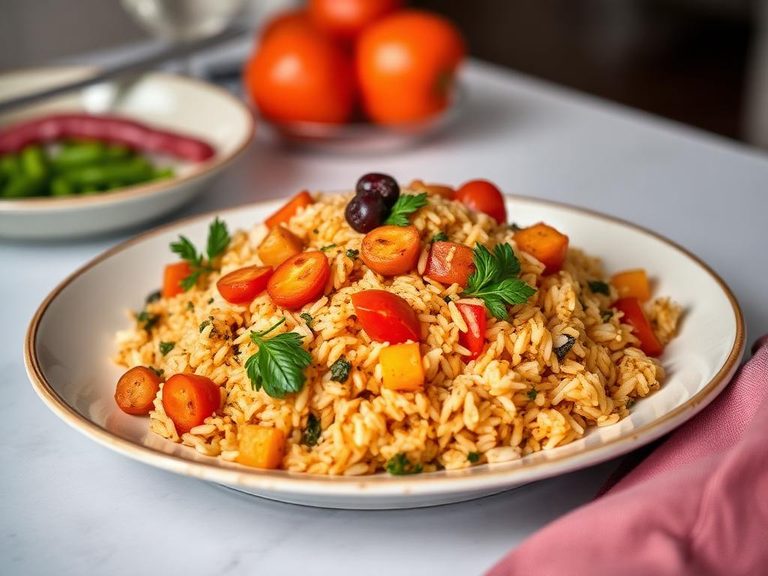
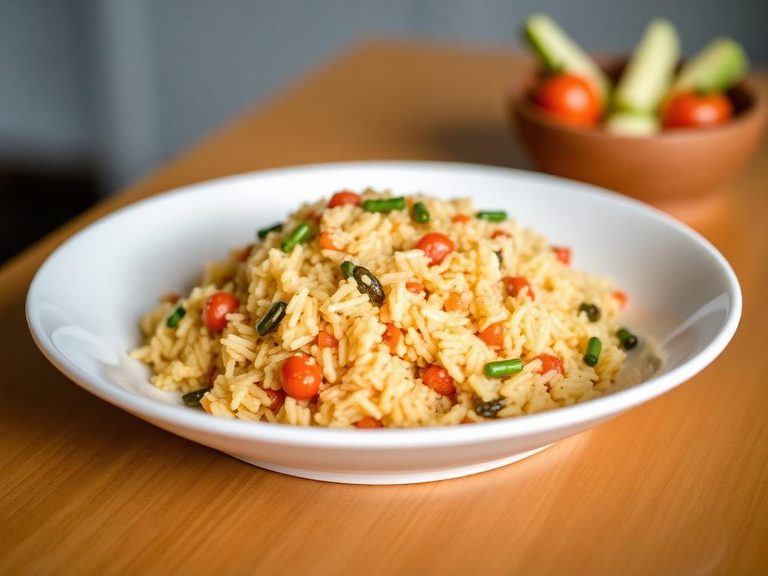
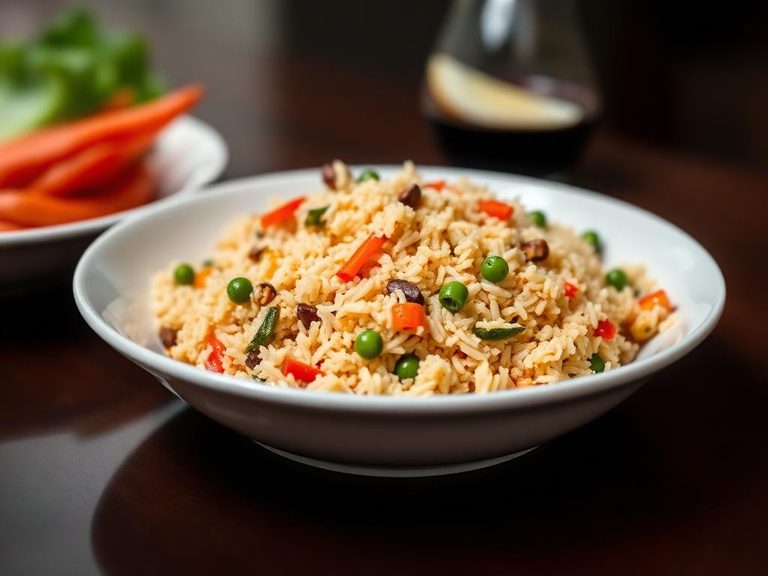
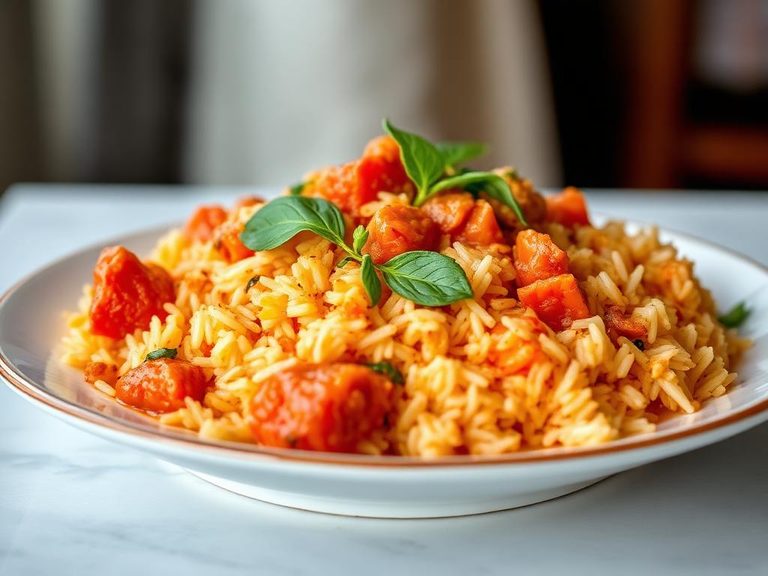
This is a simple, comforting dish of fluffy white rice tossed with tender-crisp carrots, dark leafy greens like spinach or kale, and sweet tomatoes or a tangy tomato sauce. The texture is soft with a pleasant bite from the vegetables, and the flavor is mild, savory, and subtly sweet from the tomatoes. Nutritionally, it's a very low-fat, low-calorie base providing quick energy from carbs and a modest boost of fiber and vitamins.
Calorie split: 9% protein · 88% carbs · 2% fat
↓ Full nutrition💚 Why it's loved
People love it for its comforting, home-style simplicity and the way it lets the natural sweetness of the carrots and tomatoes shine. It's an incredibly versatile base that can be customized with different greens and spices, making it a familiar and satisfying staple in many cuisines.
⚠️ Watch-outs & how to enjoy it better
The high carbohydrate content can cause blood sugar spikes, especially for those with diabetes or insulin resistance. To counteract this, pair it with a source of protein (like beans, chicken, or tofu) and a small amount of healthy fat to slow digestion. Also, if using a commercial tomato sauce, check for hidden sodium and added sugars.
Key benefits
- Very low in fat and calories, suitable for weight management.
- Provides quick-release carbohydrates for energy.
- Contains fiber from vegetables and tomatoes.
- A good source of vitamins A and C from the colorful vegetables.
- Naturally low in sodium if prepared without added salt.
🍽️ Popular dishes
🌍 Where it's eaten
💡 Did you know?
The combination of rice and tomatoes is a relatively modern pairing in many cuisines, as tomatoes were only introduced to Asia and Africa from the Americas in the 16th century.
Full nutrition (USDA data · scales with serving)
| Water | 74.7 g |
| Energy | 101 kcal |
| Protein | 2.3 g |
| Total lipid (fat) | 0.27 g |
| Carbohydrate, by difference | 21.8 g |
| Fiber, total dietary | 0.90 g |
| Total Sugars | 0.73 g |
| Calcium, Ca | 17.0 mg |
| Iron, Fe | 1.0 mg |
| Magnesium, Mg | 12.0 mg |
| Phosphorus, P | 41.0 mg |
| Potassium, K | 91.0 mg |
| Sodium, Na | 198 mg |
| Zinc, Zn | 0.42 mg |
| Copper, Cu | 0.06 mg |
| Selenium, Se | 5.7 ug |
| Vitamin C, total ascorbic acid | 8.1 mg |
| Thiamin | 0.20 mg |
| Riboflavin | 0.03 mg |
| Niacin | 1.2 mg |
| Vitamin B-6 | 0.11 mg |
| Folate, total | 48.0 ug |
| Folic acid | 40.0 ug |
| Folate, food | 9.0 ug |
| Folate, DFE | 76.0 ug |
| Choline, total | 4.5 mg |
| Vitamin B-12 | 0.00 ug |
| Vitamin B-12, added | 0.00 ug |
| Vitamin A, RAE | 70.0 ug |
| Retinol | 0.00 ug |
| Carotene, beta | 693 ug |
| Carotene, alpha | 297 ug |
| Cryptoxanthin, beta | 0.00 ug |
| Lycopene | 307 ug |
| Lutein + zeaxanthin | 121 ug |
| Vitamin E (alpha-tocopherol) | 0.19 mg |
| Vitamin E, added | 0.00 mg |
| Vitamin D (D2 + D3) | 0.00 ug |
| Vitamin K (phylloquinone) | 9.6 ug |
| Alcohol, ethyl | 0.00 g |
| Caffeine | 0.00 mg |
| Theobromine | 0.00 mg |
Fat & fatty acid profile (per 100g)
| Fatty acids, total saturated | 0.07 g |
| SFA 4:0 | 0.00 g |
| SFA 6:0 | 0.00 g |
| SFA 8:0 | 0.00 g |
| SFA 10:0 | 0.00 g |
| SFA 12:0 | 0.00 g |
| SFA 14:0 | 0.00 g |
| SFA 16:0 | 0.06 g |
| SFA 18:0 | 0.01 g |
| Fatty acids, total monounsaturated | 0.07 g |
| MUFA 16:1 | 0.00 g |
| MUFA 18:1 | 0.07 g |
| MUFA 20:1 | 0.00 g |
| MUFA 22:1 | 0.00 g |
| Fatty acids, total polyunsaturated | 0.07 g |
| PUFA 18:2 | 0.07 g |
| PUFA 18:3 | 0.01 g |
| PUFA 18:4 | 0.00 g |
| PUFA 20:4 | 0.00 g |
| PUFA 20:5 n-3 (EPA) | 0.00 g |
| PUFA 22:5 n-3 (DPA) | 0.00 g |
| PUFA 22:6 n-3 (DHA) | 0.00 g |
| Cholesterol | 0.00 mg |
Amino acid profile (per 100g)
Estimated from Snacks, rice cakes, brown rice, sesame seed — USDA does not publish this profile for Rice.
| Tryptophan | 0.10 g |
| Threonine | 0.28 g |
| Isoleucine | 0.32 g |
| Leucine | 0.63 g |
| Lysine | 0.29 g |
| Methionine | 0.17 g |
| Cystine | 0.09 g |
| Phenylalanine | 0.39 g |
| Tyrosine | 0.29 g |
| Valine | 0.44 g |
| Arginine | 0.59 g |
| Histidine | 0.19 g |
| Alanine | 0.44 g |
| Aspartic acid | 0.71 g |
| Glutamic acid | 1.6 g |
| Glycine | 0.38 g |
| Proline | 0.35 g |
| Serine | 0.39 g |
FAQ
Is this dish gluten-free?
Yes, the core ingredients (rice, carrots, greens, tomatoes) are naturally gluten-free. However, always check if any pre-made sauces or seasonings used contain gluten.
Can I add protein to make it a complete meal?
Absolutely. It pairs perfectly with lentils (dal), chickpeas, grilled chicken, tofu, or a fried egg to boost protein content and make it more satiating.
What are the best dark green vegetables to use?
Spinach, kale, Swiss chard, collard greens, or bok chai are all excellent choices. Hardy greens like kale should be added earlier to soften, while delicate greens like spinach can be stirred in at the very end.
Nutrient density (calculated · NRF9.3)
Nutrient Rich Foods index: beneficial nutrients (protein, fiber, vitamins, minerals) minus saturated fat, added sugar & sodium, per 100 kcal.
NRF9.3 index — Fulgoni, Keast & Drewnowski, 2009. Computed from USDA nutrients.
Weight-loss friendliness (composite index)
Energy density 1.01 kcal/g · 9% calories from protein · 0.9 g fiber · 0.7 g sugar per 100 g.
Composite of energy density (Rolls et al., 1999), protein & fiber satiety, minus sugar. A calculated heuristic — ranks satiety-per-calorie, not a clinical measure.
Dietary load (calculated from USDA values)
Potential renal acid load. Positive = acid-forming, negative = alkaline-forming.
Sodium-to-potassium ratio: 2.18 (lower is better — aim for ≤ 1)
Sodium:potassium per WHO potassium guidance. Computed from USDA nutrients.