

Rice, white, with carrots and dark green vegetables, fat added
Common food
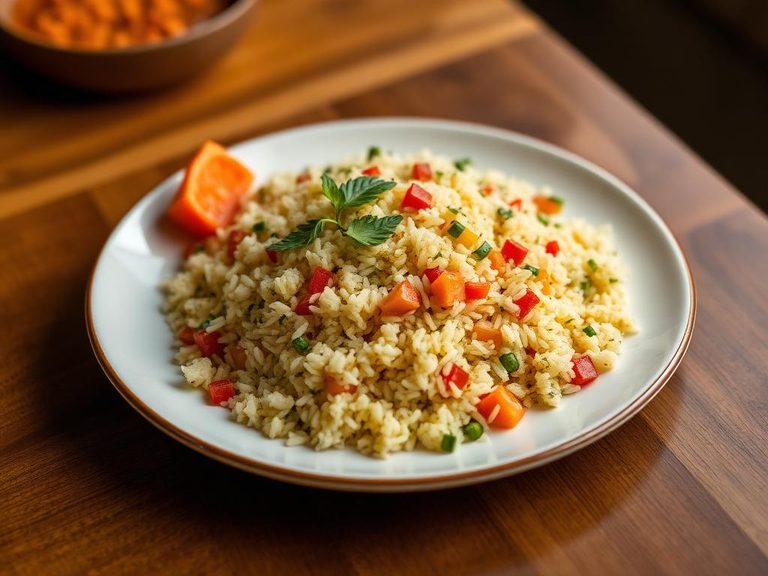
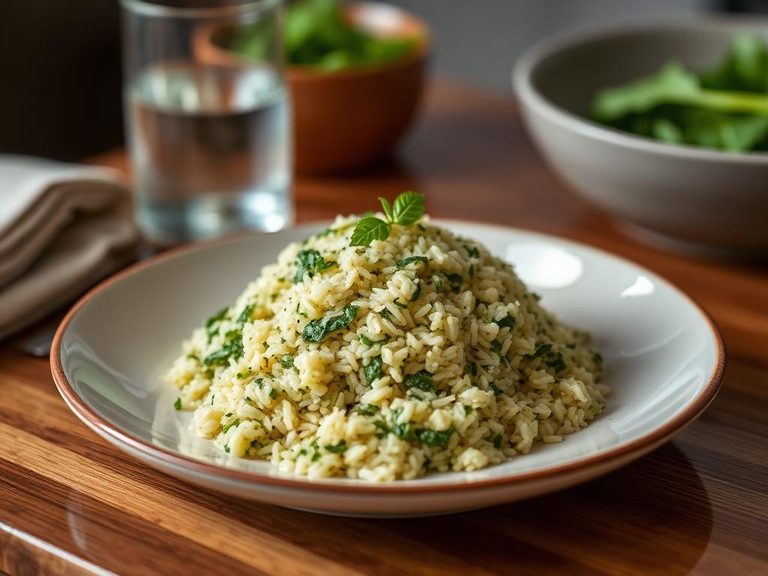
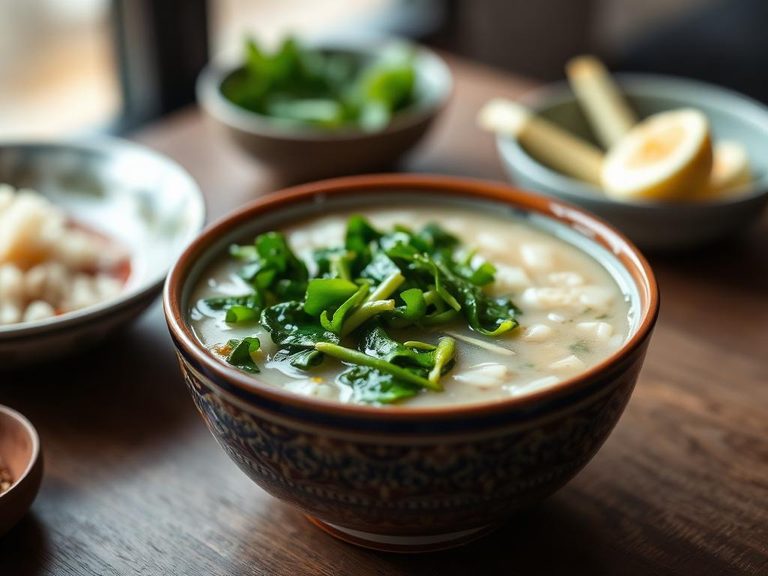
This is a comforting, savory rice dish where tender white rice is studded with sweet, earthy carrots and vibrant dark greens like spinach or kale. The added fat, often butter or oil, creates a subtle richness that coats each grain, while the vegetables provide a pleasant, soft contrast to the fluffy rice. It's a nutritionally balanced one-pot meal, offering a good source of carbohydrates for energy with a notable boost of vitamins A and K from the colorful vegetables.
Calorie split: 8% protein · 74% carbs · 18% fat
↓ Full nutrition💚 Why it's loved
People love it for its comforting, familiar warmth and the way it turns plain rice into a complete, colorful side or light main. It's a versatile canvas that absorbs the flavors of the cooking fat and any seasonings, making it a beloved staple in many home kitchens.
⚠️ Watch-outs & how to enjoy it better
As a white rice dish, it can cause quicker blood sugar spikes compared to whole grains, which is a consideration for those managing diabetes. The added fat, while enhancing flavor and nutrient absorption, also increases calorie density. To counteract this, pair it with a lean protein (like grilled chicken or lentils) and extra non-starchy vegetables to slow digestion and balance the meal.
Key benefits
- Provides quick-release energy from white rice carbohydrates.
- Carrots contribute beta-carotene (vitamin A precursor) for eye health.
- Dark greens are a source of iron, calcium, and vitamins K and C.
- The added fat helps absorb fat-soluble vitamins (A, D, E, K) from the vegetables.
- A simple, adaptable base for adding proteins like chicken, tofu, or beans.
🍽️ Popular dishes
🌍 Where it's eaten
💡 Did you know?
The technique of sautéing rice in fat before adding liquid, common in pilafs, isn't just for flavor—it helps each grain stay separate and fluffy by coating it in a hydrophobic layer.
Full nutrition (USDA data · scales with serving)
| Water | 71.7 g |
| Energy | 124 kcal |
| Protein | 2.4 g |
| Total lipid (fat) | 2.4 g |
| Carbohydrate, by difference | 22.5 g |
| Fiber, total dietary | 0.90 g |
| Total Sugars | 0.62 g |
| Calcium, Ca | 17.0 mg |
| Iron, Fe | 1.0 mg |
| Magnesium, Mg | 13.0 mg |
| Phosphorus, P | 43.0 mg |
| Potassium, K | 91.0 mg |
| Sodium, Na | 193 mg |
| Zinc, Zn | 0.44 mg |
| Copper, Cu | 0.06 mg |
| Selenium, Se | 5.8 ug |
| Vitamin C, total ascorbic acid | 9.9 mg |
| Thiamin | 0.14 mg |
| Riboflavin | 0.03 mg |
| Niacin | 1.2 mg |
| Vitamin B-6 | 0.11 mg |
| Folate, total | 51.0 ug |
| Folic acid | 40.0 ug |
| Folate, food | 11.0 ug |
| Folate, DFE | 80.0 ug |
| Choline, total | 4.9 mg |
| Vitamin B-12 | 0.00 ug |
| Vitamin B-12, added | 0.00 ug |
| Vitamin A, RAE | 104 ug |
| Retinol | 0.00 ug |
| Carotene, beta | 1019 ug |
| Carotene, alpha | 457 ug |
| Cryptoxanthin, beta | 0.00 ug |
| Lycopene | 0.00 ug |
| Lutein + zeaxanthin | 169 ug |
| Vitamin E (alpha-tocopherol) | 0.58 mg |
| Vitamin E, added | 0.00 mg |
| Vitamin D (D2 + D3) | 0.00 ug |
| Vitamin K (phylloquinone) | 16.2 ug |
| Alcohol, ethyl | 0.00 g |
| Caffeine | 0.00 mg |
| Theobromine | 0.00 mg |
Fat & fatty acid profile (per 100g)
| Fatty acids, total saturated | 0.36 g |
| SFA 4:0 | 0.00 g |
| SFA 6:0 | 0.00 g |
| SFA 8:0 | 0.00 g |
| SFA 10:0 | 0.00 g |
| SFA 12:0 | 0.00 g |
| SFA 14:0 | 0.00 g |
| SFA 16:0 | 0.27 g |
| SFA 18:0 | 0.07 g |
| Fatty acids, total monounsaturated | 0.99 g |
| MUFA 16:1 | 0.01 g |
| MUFA 18:1 | 0.96 g |
| MUFA 20:1 | 0.01 g |
| MUFA 22:1 | 0.00 g |
| Fatty acids, total polyunsaturated | 0.90 g |
| PUFA 18:2 | 0.80 g |
| PUFA 18:3 | 0.11 g |
| PUFA 18:4 | 0.00 g |
| PUFA 20:4 | 0.00 g |
| PUFA 20:5 n-3 (EPA) | 0.00 g |
| PUFA 22:5 n-3 (DPA) | 0.00 g |
| PUFA 22:6 n-3 (DHA) | 0.00 g |
| Cholesterol | 0.00 mg |
Amino acid profile (per 100g)
Estimated from Snacks, rice cakes, brown rice, sesame seed — USDA does not publish this profile for Rice.
| Tryptophan | 0.10 g |
| Threonine | 0.28 g |
| Isoleucine | 0.32 g |
| Leucine | 0.63 g |
| Lysine | 0.29 g |
| Methionine | 0.17 g |
| Cystine | 0.09 g |
| Phenylalanine | 0.39 g |
| Tyrosine | 0.29 g |
| Valine | 0.44 g |
| Arginine | 0.59 g |
| Histidine | 0.19 g |
| Alanine | 0.44 g |
| Aspartic acid | 0.71 g |
| Glutamic acid | 1.6 g |
| Glycine | 0.38 g |
| Proline | 0.35 g |
| Serine | 0.39 g |
FAQ
Can I use brown rice instead of white?
Yes, absolutely. Brown rice will increase the fiber and nutrient content significantly, but it will have a chewier texture and take longer to cook. You may need to adjust the liquid and cooking time accordingly.
What are the best dark green vegetables to use?
Spinach, kale, Swiss chard, and collard greens are excellent choices. Spinach wilts quickly and is mild, while kale and chard hold their texture better and add a slightly earthier flavor. Add heartier greens earlier in cooking and delicate ones like spinach at the very end.
How can I reduce the fat content without sacrificing taste?
You can use a minimal amount of a flavorful oil like sesame or olive oil, or replace some of the fat with a splash of low-sodium broth for sautéing. Using non-stick cookware also helps. The vegetables and any added herbs or spices will still provide plenty of flavor.
Nutrient density (calculated · NRF9.3)
Nutrient Rich Foods index: beneficial nutrients (protein, fiber, vitamins, minerals) minus saturated fat, added sugar & sodium, per 100 kcal.
NRF9.3 index — Fulgoni, Keast & Drewnowski, 2009. Computed from USDA nutrients.
Weight-loss friendliness (composite index)
Energy density 1.24 kcal/g · 8% calories from protein · 0.9 g fiber · 0.6 g sugar per 100 g.
Composite of energy density (Rolls et al., 1999), protein & fiber satiety, minus sugar. A calculated heuristic — ranks satiety-per-calorie, not a clinical measure.
Dietary load (calculated from USDA values)
Potential renal acid load. Positive = acid-forming, negative = alkaline-forming.
Sodium-to-potassium ratio: 2.12 (lower is better — aim for ≤ 1)
Sodium:potassium per WHO potassium guidance. Computed from USDA nutrients.