

Pretzels, hard, plain, lightly salted
Common food

Photo: Wikipedia
A hard, dry pretzel stick baked to a deep brown, offering a satisfyingly crisp snap and a malty, wheaty flavor with a whisper of salt. Its nutritional profile is dominated by carbohydrates, providing a quick energy source, with a modest amount of protein and very little fat.
Calorie split: 10% protein · 83% carbs · 7% fat
↓ Full nutrition💚 Why it's loved
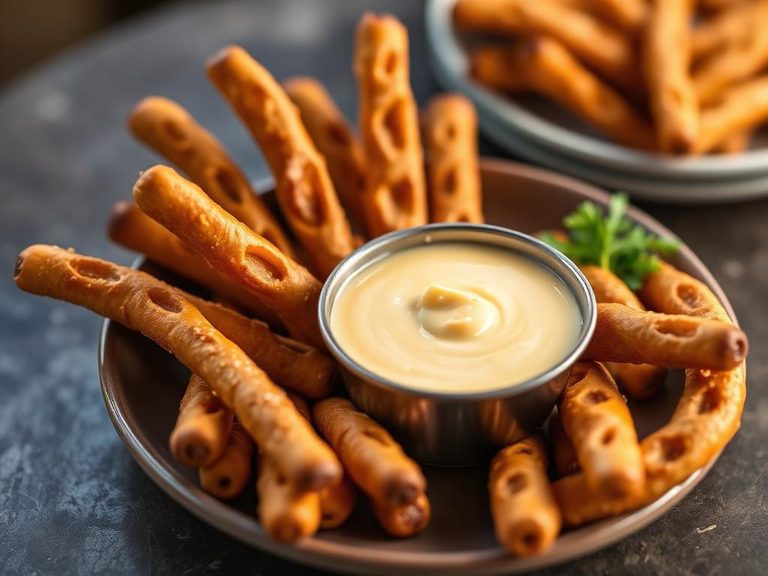
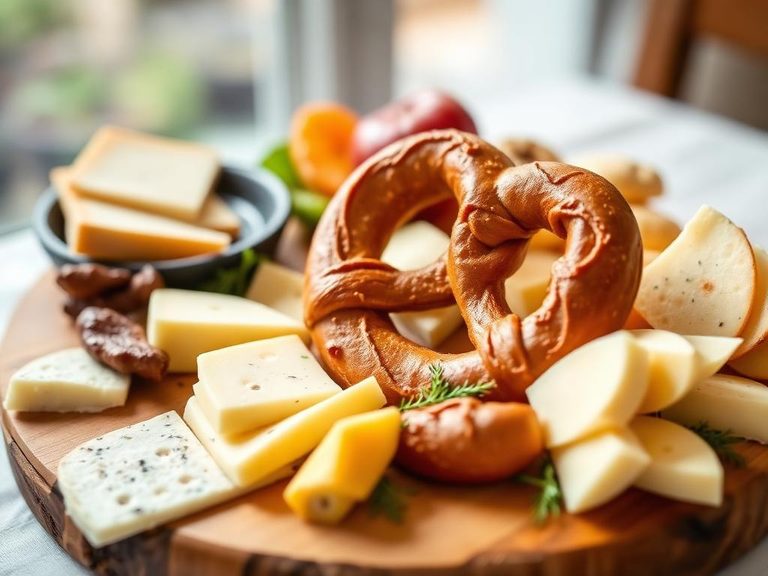
People love the addictive combination of its crunchy texture and savory, toasted wheat flavor, making it a perfect, non-messy snack. Its neutral taste makes it a versatile companion for dips, cheeses, or just on its own.
⚠️ Watch-outs & how to enjoy it better
Its high glycemic index can cause rapid blood-sugar spikes, which is a concern for diabetics or those managing energy levels. The added salt contributes to sodium intake, and it's a common wheat allergen. To counteract, pair it with a protein or fat like hummus, cheese, or nut butter to slow digestion, and practice strict portion control.
Key benefits
- Excellent source of quick, easily digestible energy.
- Low in fat and cholesterol-free.
- Provides a small but useful amount of plant-based protein.
- The hard texture can promote a feeling of fullness.
🍽️ Popular dishes

🌍 Where it's eaten
💡 Did you know?
The distinctive dark brown, shiny crust of a traditional pretzel is created by dipping the dough in a lye (sodium hydroxide) solution before baking, a process called 'pretzeling'.
Full nutrition (USDA data · scales with serving)
| Water | 3.2 g |
| Energy | 382 kcal |
| Protein | 9.6 g |
| Total lipid (fat) | 3.2 g |
| Carbohydrate, by difference | 79.8 g |
| Fiber, total dietary | 3.1 g |
| Total Sugars | 2.2 g |
| Calcium, Ca | 32.0 mg |
| Iron, Fe | 4.5 mg |
| Magnesium, Mg | 32.0 mg |
| Phosphorus, P | 120 mg |
| Potassium, K | 184 mg |
| Sodium, Na | 685 mg |
| Zinc, Zn | 0.94 mg |
| Copper, Cu | 0.21 mg |
| Selenium, Se | 5.1 ug |
| Vitamin C, total ascorbic acid | 1.0 mg |
| Thiamin | 0.44 mg |
| Riboflavin | 0.48 mg |
| Niacin | 5.3 mg |
| Vitamin B-6 | 0.10 mg |
| Folate, total | 171 ug |
| Folic acid | 88.0 ug |
| Folate, food | 83.0 ug |
| Folate, DFE | 233 ug |
| Choline, total | 26.5 mg |
| Vitamin B-12 | 0.00 ug |
| Vitamin B-12, added | 0.00 ug |
| Vitamin A, RAE | 0.00 ug |
| Retinol | 0.00 ug |
| Carotene, beta | 0.00 ug |
| Carotene, alpha | 0.00 ug |
| Cryptoxanthin, beta | 0.00 ug |
| Lycopene | 0.00 ug |
| Lutein + zeaxanthin | 4.0 ug |
| Vitamin E (alpha-tocopherol) | 0.41 mg |
| Vitamin E, added | 0.00 mg |
| Vitamin D (D2 + D3) | 0.00 ug |
| Vitamin K (phylloquinone) | 1.8 ug |
| Alcohol, ethyl | 0.00 g |
| Caffeine | 0.00 mg |
| Theobromine | 0.00 mg |
Fat & fatty acid profile (per 100g)
| Fatty acids, total saturated | 0.57 g |
| SFA 4:0 | 0.00 g |
| SFA 6:0 | 0.00 g |
| SFA 8:0 | 0.01 g |
| SFA 10:0 | 0.01 g |
| SFA 12:0 | 0.02 g |
| SFA 14:0 | 0.01 g |
| SFA 16:0 | 0.40 g |
| SFA 18:0 | 0.13 g |
| Fatty acids, total monounsaturated | 1.0 g |
| MUFA 16:1 | 0.01 g |
| MUFA 18:1 | 1.0 g |
| MUFA 20:1 | 0.01 g |
| MUFA 22:1 | 0.00 g |
| Fatty acids, total polyunsaturated | 1.3 g |
| PUFA 18:2 | 1.2 g |
| PUFA 18:3 | 0.06 g |
| PUFA 18:4 | 0.00 g |
| PUFA 20:4 | 0.00 g |
| PUFA 20:5 n-3 (EPA) | 0.00 g |
| PUFA 22:5 n-3 (DPA) | 0.00 g |
| PUFA 22:6 n-3 (DHA) | 0.00 g |
| Cholesterol | 0.00 mg |
Amino acid profile (per 100g)
Estimated from Snacks, pretzels, hard, confectioner's coating, chocolate-flavor — USDA does not publish this profile for Pretzels.
| Tryptophan | 0.10 g |
| Threonine | 0.25 g |
| Isoleucine | 0.29 g |
| Leucine | 0.53 g |
| Lysine | 0.25 g |
| Methionine | 0.13 g |
| Cystine | 0.15 g |
| Phenylalanine | 0.36 g |
| Tyrosine | 0.23 g |
| Valine | 0.33 g |
| Arginine | 0.31 g |
| Histidine | 0.16 g |
| Alanine | 0.27 g |
| Aspartic acid | 0.42 g |
| Glutamic acid | 2.2 g |
| Glycine | 0.27 g |
| Proline | 0.74 g |
| Serine | 0.36 g |
FAQ
Are hard pretzels healthier than soft pretzels?
Generally, yes. Hard pretzels are lower in calories, fat, and sodium per gram because they contain less water and no added butter or oil in the dough. However, both are primarily refined carbohydrates.
Why do hard pretzels have so few ingredients?
Traditional hard pretzels are a simple baked good made from just flour, water, yeast, salt, and sometimes a small amount of malt or sugar. Their long shelf life comes from the baking process removing almost all moisture.
Can I eat hard pretzels on a gluten-free diet?
No, standard hard pretzels are made from wheat flour and contain gluten. You must seek out specially formulated gluten-free versions made from alternative flours like rice or corn.
Nutrient density (calculated · NRF9.3)
Nutrient Rich Foods index: beneficial nutrients (protein, fiber, vitamins, minerals) minus saturated fat, added sugar & sodium, per 100 kcal.
NRF9.3 index — Fulgoni, Keast & Drewnowski, 2009. Computed from USDA nutrients.
Weight-loss friendliness (composite index)
Energy density 3.82 kcal/g · 10% calories from protein · 3.1 g fiber · 2.2 g sugar per 100 g.
Composite of energy density (Rolls et al., 1999), protein & fiber satiety, minus sugar. A calculated heuristic — ranks satiety-per-calorie, not a clinical measure.
Dietary load (calculated from USDA values)
Potential renal acid load. Positive = acid-forming, negative = alkaline-forming.
Sodium-to-potassium ratio: 3.72 (lower is better — aim for ≤ 1)
Sodium:potassium per WHO potassium guidance. Computed from USDA nutrients.