

Snacks, pretzels, hard, whole-wheat including both salted and unsalted
Whole food · Snacks
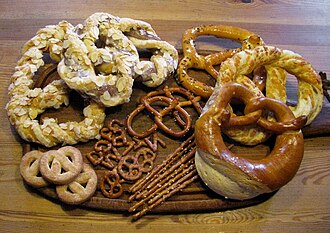
Photo: Wikipedia
A hard, crunchy, baked breadstick made from whole-wheat flour, offering a satisfying snap and a deep, toasty, slightly nutty flavor. Its texture is dense and dry, perfect for dipping or enjoying plain. Nutritionally, it's a high-carb, low-fat snack with a notable fiber boost from the whole grain.
Calorie split: 11% protein · 83% carbs · 6% fat
↓ Full nutrition💚 Why it's loved
People love pretzels for their iconic, salty crunch and the satisfying ritual of twisting and snapping them. They are a versatile, portable snack that pairs perfectly with mustard, cheese dip, or a cold beverage.
⚠️ Watch-outs & how to enjoy it better
The dense, dry texture can be challenging for those with dental issues or dry mouth. As a high-carb snack, it may cause blood-sugar spikes if eaten alone, and salted varieties contribute significant sodium. To counteract, pair with protein (like hummus or cheese) or fat (like nut butter) to slow digestion, and choose unsalted versions or rinse lightly if sodium is a concern.
Key benefits
- Good source of dietary fiber from whole wheat
- Low in fat, especially saturated fat
- Provides a steady energy release from complex carbs
- Satisfying crunch can promote mindful eating
- Simple, few-ingredient base
🍽️ Popular dishes




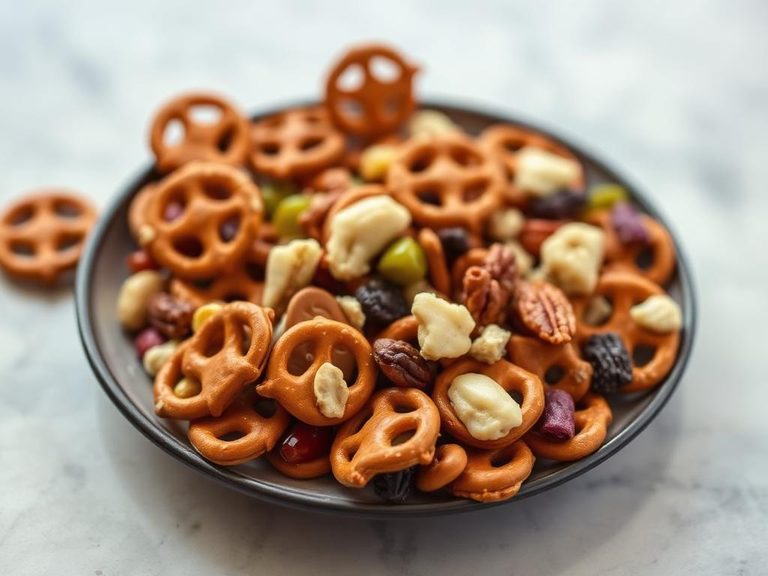
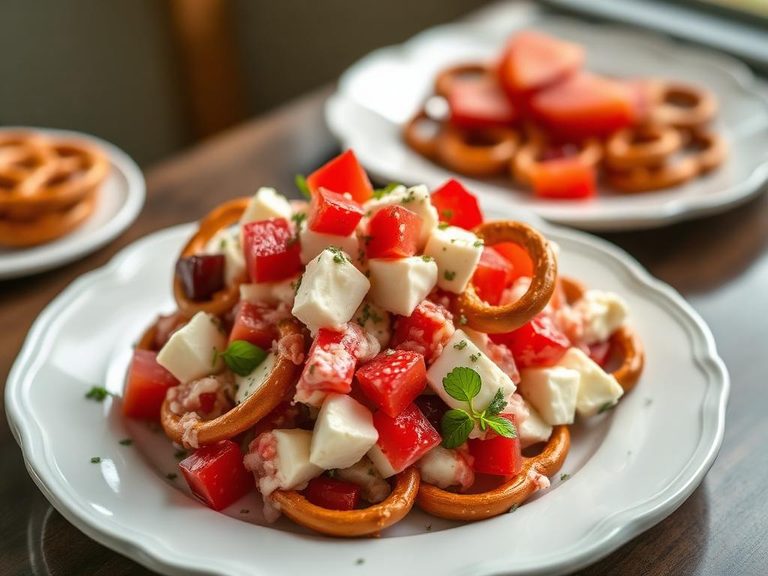
🌍 Where it's eaten
💡 Did you know?
The traditional pretzel's knotted shape is said to represent a child's arms folded in prayer, leading to its original Latin name 'pretiola' meaning 'little reward'.
Full nutrition (USDA data · scales with serving)
| Water | 3.9 g |
| Energy | 362 kcal |
| Energy | 1514 kj |
| Protein | 11.1 g |
| Total lipid (fat) | 2.6 g |
| Ash | 1.1 g |
| Carbohydrate, by difference | 81.3 g |
| Fiber, total dietary | 7.7 g |
| Calcium, Ca | 28.0 mg |
| Iron, Fe | 2.7 mg |
| Magnesium, Mg | 30.0 mg |
| Phosphorus, P | 125 mg |
| Potassium, K | 430 mg |
| Sodium, Na | 203 mg |
| Zinc, Zn | 0.62 mg |
| Copper, Cu | 0.28 mg |
| Manganese, Mn | 2.7 mg |
| Vitamin C, total ascorbic acid | 1.0 mg |
| Thiamin | 0.44 mg |
| Riboflavin | 0.29 mg |
| Niacin | 6.5 mg |
| Pantothenic acid | 0.81 mg |
| Vitamin B-6 | 0.27 mg |
| Folate, total | 54.0 ug |
| Folic acid | 0.00 ug |
| Folate, food | 54.0 ug |
| Folate, DFE | 54.0 ug |
| Vitamin B-12 | 0.00 ug |
| Vitamin A, RAE | 0.00 ug |
| Retinol | 0.00 ug |
| Vitamin A, IU | 0.00 iu |
Fat & fatty acid profile (per 100g)
| Fatty acids, total saturated | 0.56 g |
| SFA 8:0 | 0.00 g |
| SFA 10:0 | 0.00 g |
| SFA 12:0 | 0.03 g |
| SFA 14:0 | 0.02 g |
| SFA 16:0 | 0.34 g |
| SFA 18:0 | 0.17 g |
| Fatty acids, total monounsaturated | 1.0 g |
| MUFA 18:1 | 1.0 g |
| Fatty acids, total polyunsaturated | 0.83 g |
| PUFA 18:2 | 0.79 g |
| PUFA 18:3 | 0.04 g |
| Cholesterol | 0.00 mg |
Amino acid profile (per 100g)
| Tryptophan | 0.17 g |
| Threonine | 0.33 g |
| Isoleucine | 0.41 g |
| Leucine | 0.75 g |
| Lysine | 0.31 g |
| Methionine | 0.18 g |
| Cystine | 0.25 g |
| Phenylalanine | 0.52 g |
| Tyrosine | 0.33 g |
| Valine | 0.50 g |
| Arginine | 0.56 g |
| Histidine | 0.26 g |
| Alanine | 0.40 g |
| Aspartic acid | 0.59 g |
| Glutamic acid | 3.4 g |
| Glycine | 0.46 g |
| Proline | 1.1 g |
| Serine | 0.52 g |
FAQ
What is the difference between a pretzel and a breadstick?
While both are baked bread products, pretzels are traditionally boiled in a baking soda solution before baking, which creates their distinctive dark, shiny crust and chewy texture. Breadsticks are typically not boiled and have a more uniform, bread-like texture.
Why are pretzels often associated with German and Pennsylvania Dutch cuisine?
Pretzels originated in Europe, likely in monasteries, and were brought to America by German immigrants, particularly the Pennsylvania Dutch. They became a staple in these communities and a symbol of the region's food culture.
Can hard pretzels be used in cooking beyond just snacking?
Absolutely. They are crushed to make a crunchy coating for meats like chicken or fish, used as a base for dessert crusts (like pretzel pie), or incorporated into snack mixes and party mixes for added texture.
Nutrient density (calculated · NRF9.3)
Nutrient Rich Foods index: beneficial nutrients (protein, fiber, vitamins, minerals) minus saturated fat, added sugar & sodium, per 100 kcal.
NRF9.3 index — Fulgoni, Keast & Drewnowski, 2009. Computed from USDA nutrients.
Weight-loss friendliness (composite index)
Energy density 3.62 kcal/g · 12% calories from protein · 7.7 g fiber · 0.0 g sugar per 100 g.
Composite of energy density (Rolls et al., 1999), protein & fiber satiety, minus sugar. A calculated heuristic — ranks satiety-per-calorie, not a clinical measure.
Dietary load (calculated from USDA values)
Potential renal acid load. Positive = acid-forming, negative = alkaline-forming.
Sodium-to-potassium ratio: 0.47 (lower is better — aim for ≤ 1)
Sodium:potassium per WHO potassium guidance. Computed from USDA nutrients.