

Potato, scalloped, from dry mix, with meat
Common food

Photo: Wikipedia
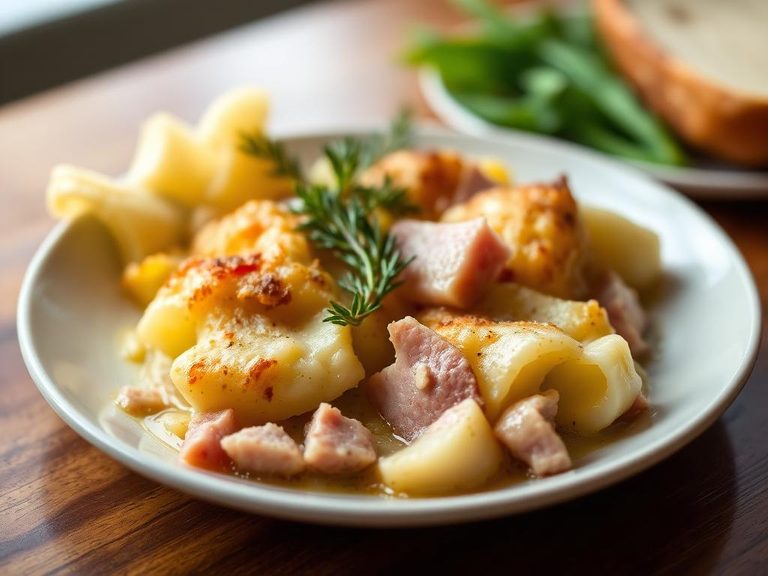
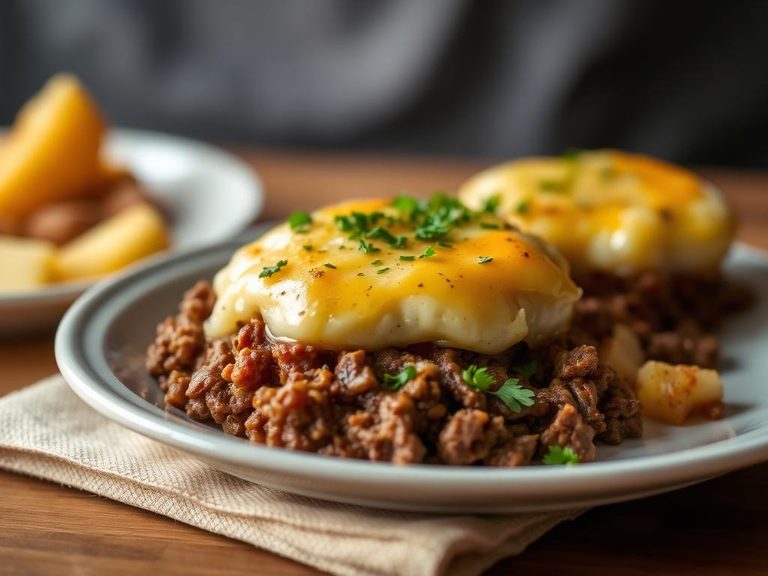
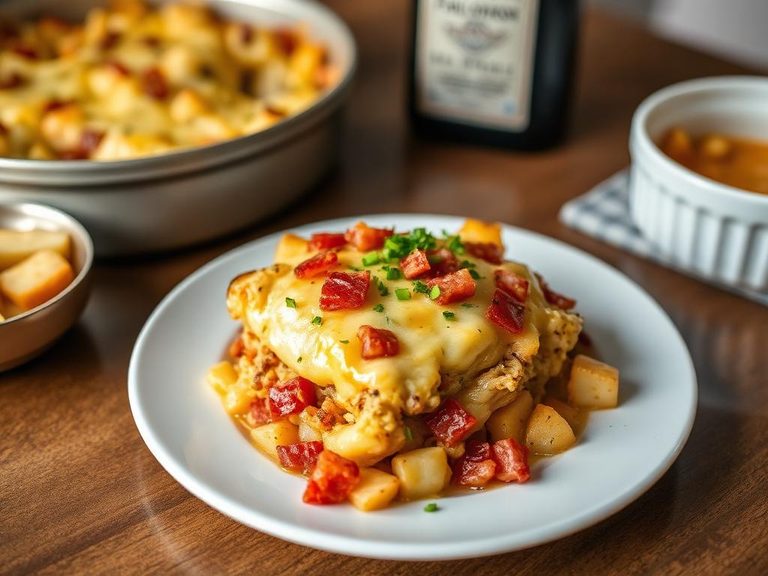
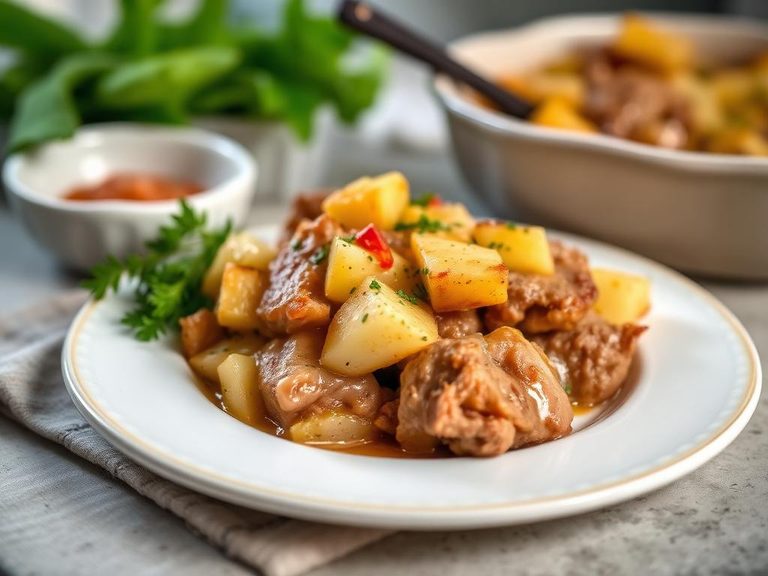
This is a creamy, comforting casserole of thinly sliced potatoes baked in a rich, savory sauce, often featuring tender bits of meat like ham or ground beef. The texture is soft and yielding, with a slightly crisp top from the cheese or breadcrumbs. Nutritionally, it's a calorie-dense dish, providing a significant amount of fat and protein alongside its carbohydrate base.
Calorie split: 17% protein · 31% carbs · 51% fat
↓ Full nutrition💚 Why it's loved
People adore it for its ultimate comfort-food appeal—a warm, creamy, and savory hug in a dish. It's also loved for its versatility, as it can be easily adapted with different meats, cheeses, and herbs to suit family tastes.
⚠️ Watch-outs & how to enjoy it better
The dish can be high in sodium, saturated fat, and refined carbs, which may cause blood-sugar spikes. To counteract this, pair a smaller portion with a large side of non-starchy vegetables like steamed broccoli or a green salad to add fiber and volume.
Key benefits
- Provides a good source of energy from carbohydrates and fats.
- Contains protein from both the potatoes and added meat.
- Offers potassium and vitamin B6 from the potatoes.
- A satisfying, complete meal in one dish.
- Can be a good way to use leftover cooked meat.
🍽️ Popular dishes
🌍 Where it's eaten
💡 Did you know?
The term 'scalloped' likely comes from the Old French word 'escalope,' meaning a thin slice of meat, which was later applied to thinly sliced potatoes baked in a sauce.
Full nutrition (USDA data · scales with serving)
| Water | 67.8 g |
| Energy | 167 kcal |
| Protein | 7.3 g |
| Total lipid (fat) | 9.6 g |
| Carbohydrate, by difference | 13.1 g |
| Fiber, total dietary | 0.70 g |
| Total Sugars | 2.2 g |
| Calcium, Ca | 178 mg |
| Iron, Fe | 0.34 mg |
| Magnesium, Mg | 21.0 mg |
| Phosphorus, P | 153 mg |
| Potassium, K | 245 mg |
| Sodium, Na | 442 mg |
| Zinc, Zn | 1.1 mg |
| Copper, Cu | 0.11 mg |
| Selenium, Se | 7.9 ug |
| Vitamin C, total ascorbic acid | 5.7 mg |
| Thiamin | 0.09 mg |
| Riboflavin | 0.15 mg |
| Niacin | 1.00 mg |
| Vitamin B-6 | 0.20 mg |
| Folate, total | 10.0 ug |
| Folic acid | 2.0 ug |
| Folate, food | 8.0 ug |
| Folate, DFE | 12.0 ug |
| Choline, total | 15.8 mg |
| Vitamin B-12 | 0.21 ug |
| Vitamin B-12, added | 0.00 ug |
| Vitamin A, RAE | 100 ug |
| Retinol | 99.0 ug |
| Carotene, beta | 10.0 ug |
| Carotene, alpha | 0.00 ug |
| Cryptoxanthin, beta | 0.00 ug |
| Lycopene | 0.00 ug |
| Lutein + zeaxanthin | 0.00 ug |
| Vitamin E (alpha-tocopherol) | 0.38 mg |
| Vitamin E, added | 0.00 mg |
| Vitamin D (D2 + D3) | 0.50 ug |
| Vitamin K (phylloquinone) | 1.8 ug |
| Alcohol, ethyl | 0.00 g |
| Caffeine | 0.00 mg |
| Theobromine | 0.00 mg |
Fat & fatty acid profile (per 100g)
| Fatty acids, total saturated | 5.1 g |
| SFA 4:0 | 0.17 g |
| SFA 6:0 | 0.14 g |
| SFA 8:0 | 0.09 g |
| SFA 10:0 | 0.21 g |
| SFA 12:0 | 0.25 g |
| SFA 14:0 | 0.79 g |
| SFA 16:0 | 2.4 g |
| SFA 18:0 | 0.92 g |
| Fatty acids, total monounsaturated | 2.2 g |
| MUFA 16:1 | 0.13 g |
| MUFA 18:1 | 2.2 g |
| MUFA 20:1 | 0.02 g |
| MUFA 22:1 | 0.00 g |
| Fatty acids, total polyunsaturated | 0.62 g |
| PUFA 18:2 | 0.57 g |
| PUFA 18:3 | 0.06 g |
| PUFA 18:4 | 0.00 g |
| PUFA 20:4 | 0.01 g |
| PUFA 20:5 n-3 (EPA) | 0.00 g |
| PUFA 22:5 n-3 (DPA) | 0.01 g |
| PUFA 22:6 n-3 (DHA) | 0.00 g |
| Cholesterol | 28.0 mg |
Amino acid profile (per 100g)
Estimated from Snacks, potato chips, made from dried potatoes, reduced fat — USDA does not publish this profile for Potato.
| Tryptophan | 0.04 g |
| Threonine | 0.24 g |
| Isoleucine | 0.25 g |
| Leucine | 0.37 g |
| Lysine | 0.35 g |
| Methionine | 0.07 g |
| Cystine | 0.07 g |
| Phenylalanine | 0.26 g |
| Tyrosine | 0.22 g |
| Valine | 0.33 g |
| Arginine | 0.27 g |
| Histidine | 0.13 g |
| Alanine | 0.20 g |
| Aspartic acid | 1.1 g |
| Glutamic acid | 0.94 g |
| Glycine | 0.19 g |
| Proline | 0.20 g |
| Serine | 0.23 g |
FAQ
What's the difference between scalloped and au gratin potatoes?
Traditionally, scalloped potatoes are baked in a cream or milk sauce, while au gratin potatoes are topped with cheese and/or breadcrumbs, creating a browned crust. In practice, especially with dry mixes, the terms are often used interchangeably.
Can I make this dish without meat?
Absolutely. Simply omit the meat for a vegetarian version. You can boost the protein and flavor by adding more cheese, sautéed mushrooms, or white beans.
Why does my scalloped potato dish sometimes turn out watery?
This often happens if the potatoes release too much moisture during baking. Using a starchy potato like a Russet, slicing them uniformly thin, and ensuring the sauce is thick enough can help prevent a watery result.
Nutrient density (calculated · NRF9.3)
Nutrient Rich Foods index: beneficial nutrients (protein, fiber, vitamins, minerals) minus saturated fat, added sugar & sodium, per 100 kcal.
NRF9.3 index — Fulgoni, Keast & Drewnowski, 2009. Computed from USDA nutrients.
Weight-loss friendliness (composite index)
Energy density 1.67 kcal/g · 17% calories from protein · 0.7 g fiber · 2.2 g sugar per 100 g.
Composite of energy density (Rolls et al., 1999), protein & fiber satiety, minus sugar. A calculated heuristic — ranks satiety-per-calorie, not a clinical measure.
Dietary load (calculated from USDA values)
Potential renal acid load. Positive = acid-forming, negative = alkaline-forming.
Sodium-to-potassium ratio: 1.80 (lower is better — aim for ≤ 1)
Sodium:potassium per WHO potassium guidance. Computed from USDA nutrients.