

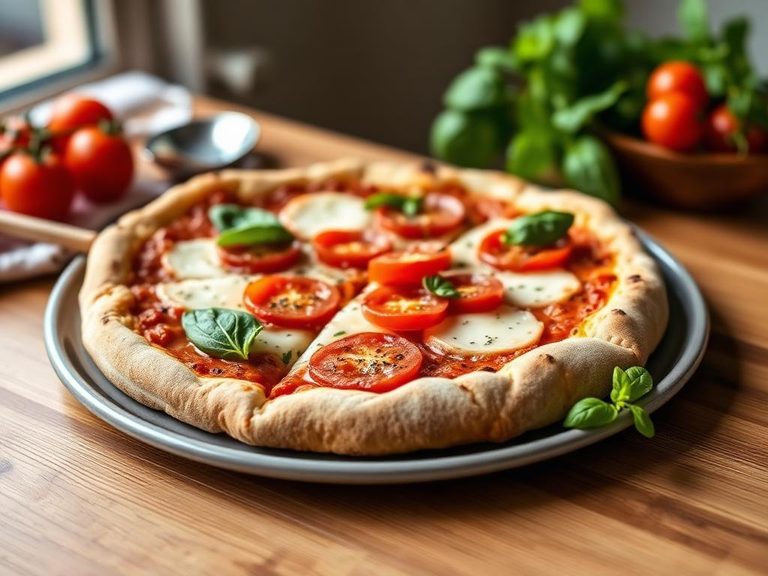
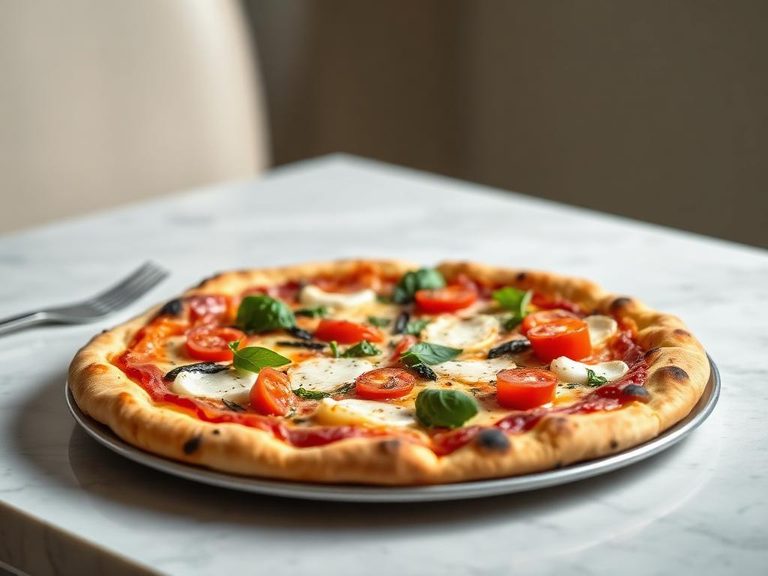
Pizza, cheese and vegetables, gluten-free thick crust
Common food

Photo: Wikipedia
This is a hearty, satisfying pizza with a thick, gluten-free crust that offers a chewy, bread-like foundation. It's generously topped with melted cheese and a colorful medley of vegetables, creating a savory, slightly tangy flavor profile. Nutritionally, it provides a balanced mix of protein and fats to help slow the absorption of its carbohydrate-rich crust.
Calorie split: 12% protein · 47% carbs · 41% fat
↓ Full nutrition💚 Why it's loved
People love it for delivering the classic, comforting experience of a thick-crust pizza without the gluten. It's a versatile meal that satisfies cravings for something cheesy, savory, and substantial.
⚠️ Watch-outs & how to enjoy it better
The thick, gluten-free crust can be denser and higher in carbohydrates than thinner options, potentially causing blood sugar spikes if not paired wisely. To counteract this, enjoy a moderate portion alongside a large, leafy green salad with a protein-rich dressing, or add a side of grilled chicken to increase satiety and slow digestion.
Key benefits
- Gluten-free alternative for those with celiac disease or gluten sensitivity
- Provides a source of protein from cheese
- Contains dietary fiber from vegetable toppings
- Offers a balanced macronutrient profile for a meal
- Vegetable toppings add vitamins and minerals
🍽️ Popular dishes
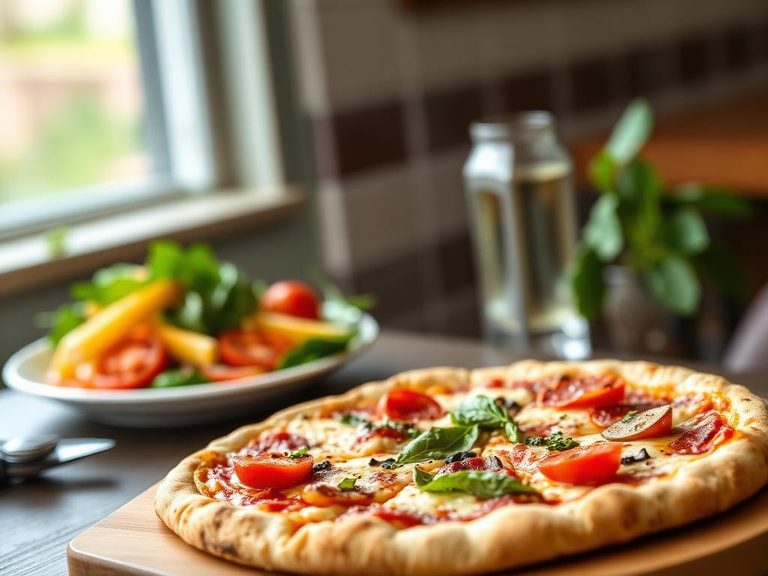
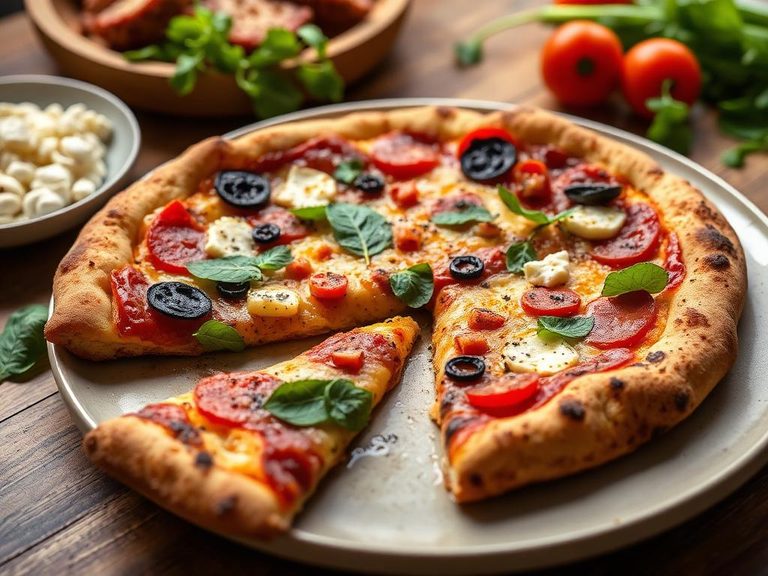
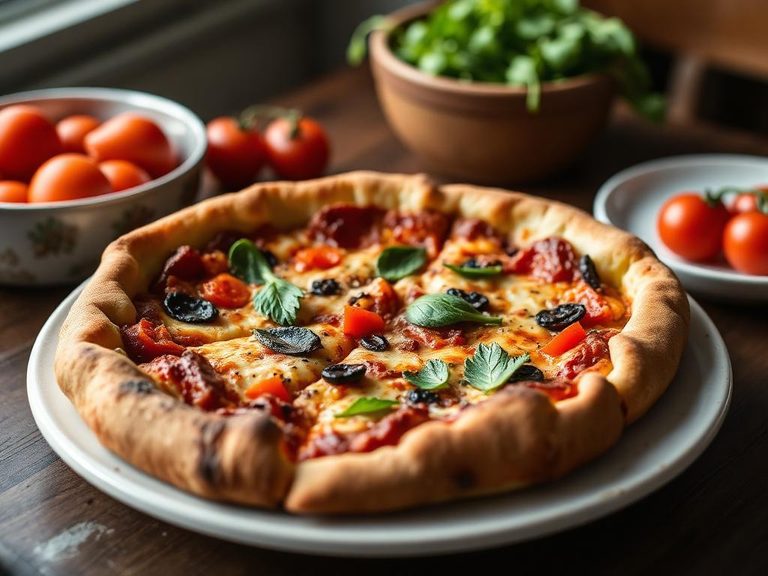
🌍 Where it's eaten
💡 Did you know?
The thick, gluten-free crust is often made from a blend of rice flour, tapioca starch, and potato starch, which creates a texture that mimics traditional wheat dough but requires different handling to avoid becoming gummy.
Full nutrition (USDA data · scales with serving)
| Water | 54.2 g |
| Energy | 228 kcal |
| Protein | 6.7 g |
| Total lipid (fat) | 10.5 g |
| Carbohydrate, by difference | 26.7 g |
| Fiber, total dietary | 2.7 g |
| Total Sugars | 3.2 g |
| Calcium, Ca | 202 mg |
| Iron, Fe | 1.9 mg |
| Magnesium, Mg | 14.0 mg |
| Phosphorus, P | 126 mg |
| Potassium, K | 111 mg |
| Sodium, Na | 439 mg |
| Zinc, Zn | 0.93 mg |
| Copper, Cu | 0.07 mg |
| Selenium, Se | 5.1 ug |
| Vitamin C, total ascorbic acid | 4.2 mg |
| Thiamin | 0.17 mg |
| Riboflavin | 0.34 mg |
| Niacin | 1.9 mg |
| Vitamin B-6 | 0.09 mg |
| Folate, total | 23.0 ug |
| Folic acid | 0.00 ug |
| Folate, food | 23.0 ug |
| Folate, DFE | 23.0 ug |
| Choline, total | 11.1 mg |
| Vitamin B-12 | 0.16 ug |
| Vitamin B-12, added | 0.00 ug |
| Vitamin A, RAE | 41.0 ug |
| Retinol | 35.0 ug |
| Carotene, beta | 66.0 ug |
| Carotene, alpha | 1.0 ug |
| Cryptoxanthin, beta | 0.00 ug |
| Lycopene | 1323 ug |
| Lutein + zeaxanthin | 72.0 ug |
| Vitamin E (alpha-tocopherol) | 1.5 mg |
| Vitamin E, added | 0.00 mg |
| Vitamin D (D2 + D3) | 0.10 ug |
| Vitamin K (phylloquinone) | 3.4 ug |
| Alcohol, ethyl | 0.00 g |
| Caffeine | 0.00 mg |
| Theobromine | 0.00 mg |
Fat & fatty acid profile (per 100g)
| Fatty acids, total saturated | 3.2 g |
| SFA 4:0 | 0.07 g |
| SFA 6:0 | 0.06 g |
| SFA 8:0 | 0.05 g |
| SFA 10:0 | 0.10 g |
| SFA 12:0 | 0.11 g |
| SFA 14:0 | 0.35 g |
| SFA 16:0 | 1.8 g |
| SFA 18:0 | 0.54 g |
| Fatty acids, total monounsaturated | 4.7 g |
| MUFA 16:1 | 0.11 g |
| MUFA 18:1 | 4.2 g |
| MUFA 20:1 | 0.02 g |
| MUFA 22:1 | 0.00 g |
| Fatty acids, total polyunsaturated | 0.82 g |
| PUFA 18:2 | 0.78 g |
| PUFA 18:3 | 0.05 g |
| PUFA 18:4 | 0.00 g |
| PUFA 20:4 | 0.01 g |
| PUFA 20:5 n-3 (EPA) | 0.00 g |
| PUFA 22:5 n-3 (DPA) | 0.00 g |
| PUFA 22:6 n-3 (DHA) | 0.00 g |
| Cholesterol | 11.0 mg |
Amino acid profile (per 100g)
Estimated from Fast Food, Pizza Chain, 14" pizza, cheese topping, stuffed crust — USDA does not publish this profile for Pizza.
| Tryptophan | 0.12 g |
| Threonine | 0.39 g |
| Isoleucine | 0.57 g |
| Leucine | 1.1 g |
| Lysine | 0.59 g |
| Methionine | 0.27 g |
| Phenylalanine | 0.64 g |
| Tyrosine | 0.40 g |
| Valine | 0.71 g |
| Arginine | 0.44 g |
| Histidine | 0.32 g |
| Alanine | 0.38 g |
| Aspartic acid | 0.81 g |
| Glutamic acid | 3.4 g |
| Glycine | 0.31 g |
| Proline | 1.7 g |
| Serine | 0.58 g |
| Hydroxyproline | 0.00 g |
FAQ
Is gluten-free pizza crust healthier than regular crust?
Not necessarily. It's a necessary alternative for those avoiding gluten, but it can be similar or higher in calories and carbs. The healthiness depends on the specific ingredients and toppings.
Why is the crust so thick?
Thick crusts are common in gluten-free baking because they help provide structure and a satisfying, bread-like texture that can be harder to achieve with gluten-free flours.
Can I freeze leftover slices?
Yes. Wrap slices tightly in plastic wrap and foil, then freeze for up to 2 months. Reheat in an oven or toaster oven to help restore crispness.
Nutrient density (calculated · NRF9.3)
Nutrient Rich Foods index: beneficial nutrients (protein, fiber, vitamins, minerals) minus saturated fat, added sugar & sodium, per 100 kcal.
NRF9.3 index — Fulgoni, Keast & Drewnowski, 2009. Computed from USDA nutrients.
Weight-loss friendliness (composite index)
Energy density 2.28 kcal/g · 12% calories from protein · 2.7 g fiber · 3.2 g sugar per 100 g.
Composite of energy density (Rolls et al., 1999), protein & fiber satiety, minus sugar. A calculated heuristic — ranks satiety-per-calorie, not a clinical measure.
Dietary load (calculated from USDA values)
Potential renal acid load. Positive = acid-forming, negative = alkaline-forming.
Sodium-to-potassium ratio: 3.95 (lower is better — aim for ≤ 1)
Sodium:potassium per WHO potassium guidance. Computed from USDA nutrients.