

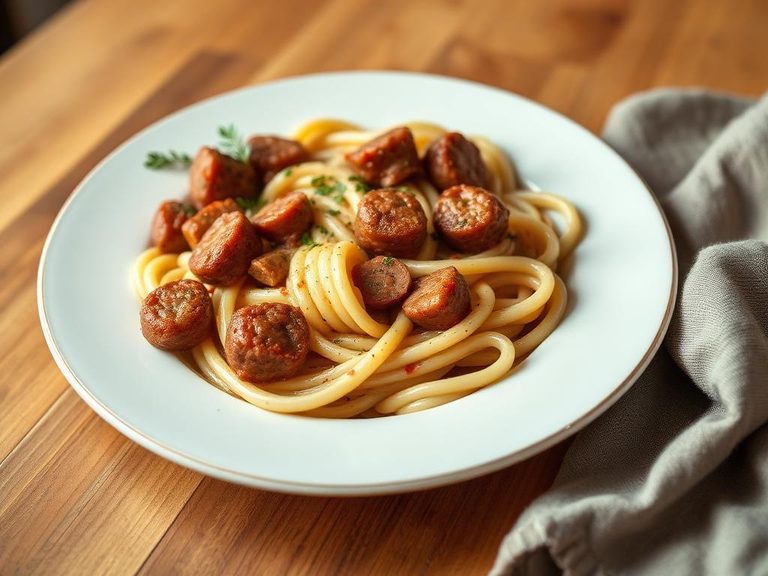
Pasta, whole grain, with cream sauce, meat, and added vegetables, restaurant
Common food

Photo: Wikipedia
A hearty, comforting dish of whole wheat pasta tossed in a rich, velvety cream sauce with savory meat and vibrant vegetables. The whole grain pasta offers a slightly nutty, chewy texture that contrasts beautifully with the smooth sauce and tender bits of meat. It's a calorie-dense meal that provides a good balance of protein and fats for sustained energy.
Calorie split: 11% protein · 30% carbs · 59% fat
↓ Full nutrition💚 Why it's loved
People love it for its ultimate comfort-food appeal, combining the familiar, creamy richness of the sauce with the satisfying chew of whole grain pasta and savory meat. It's a versatile one-bowl meal that feels indulgent yet can be packed with hidden vegetables.
⚠️ Watch-outs & how to enjoy it better
The cream sauce and meat can make it high in saturated fat and calories, which may be a concern for those monitoring their intake. To counteract this, consider a smaller portion size, ask for the sauce on the side to control the amount, or pair it with a large, vinegar-dressed side salad to add volume and fiber.
Key benefits
- Whole grain pasta provides more fiber and nutrients than refined pasta.
- The protein and fat content help promote satiety and fullness.
- The inclusion of vegetables adds vitamins and minerals.
- A convenient way to combine protein, carbs, and vegetables in one dish.
🍽️ Popular dishes
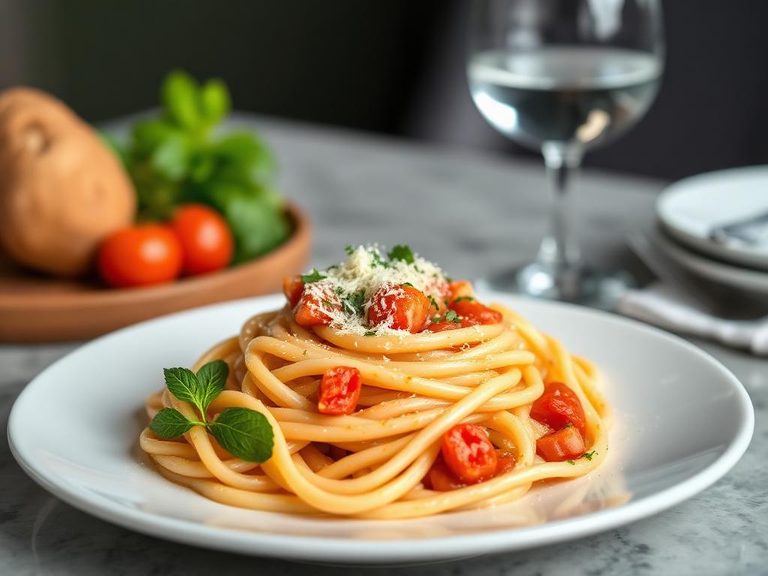
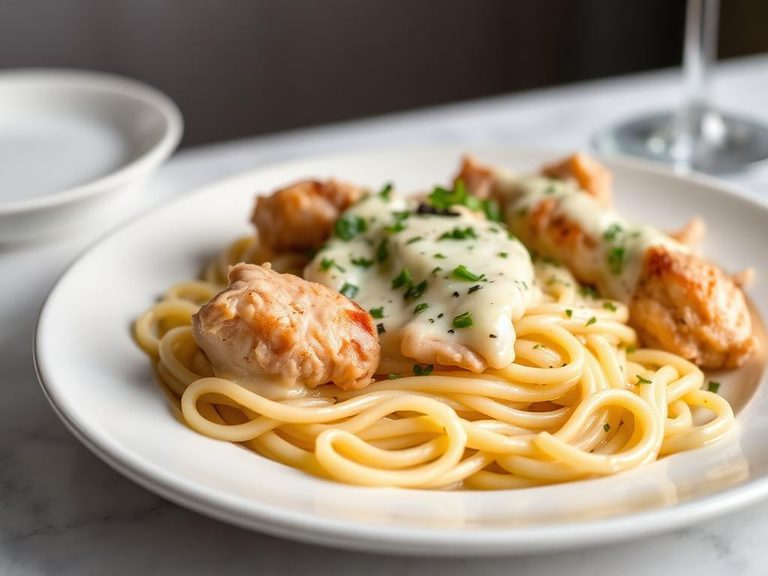
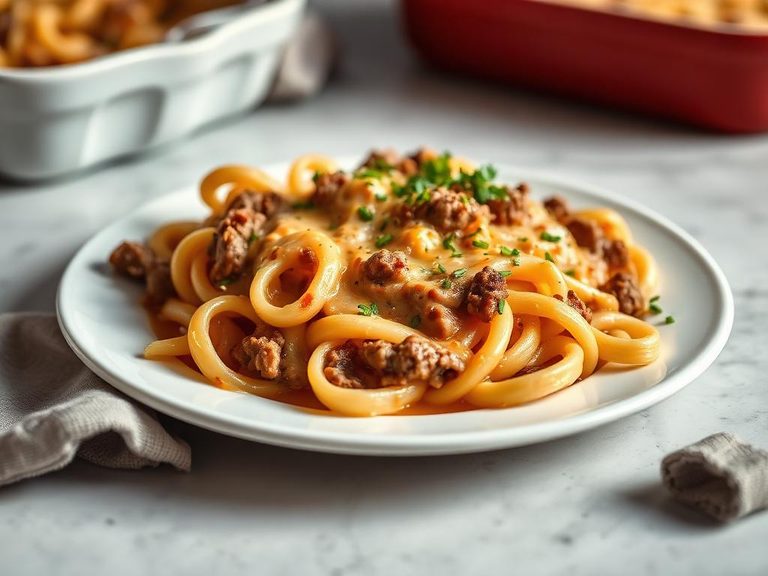
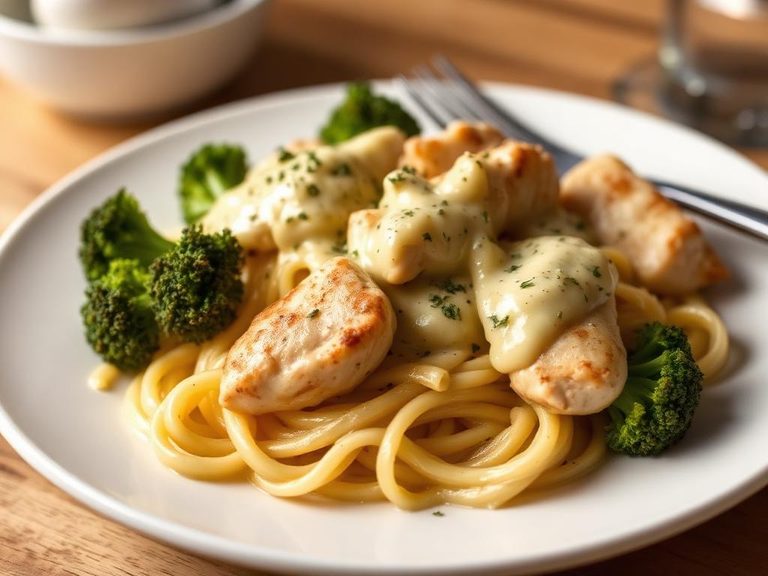
🌍 Where it's eaten
💡 Did you know?
The 'cream sauce' in many restaurant dishes is often a 'béchamel' base—a simple white sauce of butter, flour, and milk—rather than pure heavy cream, which helps it cling to pasta better.
Full nutrition (USDA data · scales with serving)
| Water | 64.0 g |
| Energy | 199 kcal |
| Protein | 5.7 g |
| Total lipid (fat) | 13.2 g |
| Carbohydrate, by difference | 15.3 g |
| Fiber, total dietary | 2.0 g |
| Total Sugars | 0.88 g |
| Calcium, Ca | 28.0 mg |
| Iron, Fe | 1.1 mg |
| Magnesium, Mg | 30.0 mg |
| Phosphorus, P | 95.0 mg |
| Potassium, K | 108 mg |
| Sodium, Na | 517 mg |
| Zinc, Zn | 1.3 mg |
| Copper, Cu | 0.13 mg |
| Selenium, Se | 20.5 ug |
| Vitamin C, total ascorbic acid | 3.9 mg |
| Thiamin | 0.09 mg |
| Riboflavin | 0.10 mg |
| Niacin | 2.1 mg |
| Vitamin B-6 | 0.09 mg |
| Folate, total | 14.0 ug |
| Folic acid | 0.00 ug |
| Folate, food | 14.0 ug |
| Folate, DFE | 14.0 ug |
| Choline, total | 12.6 mg |
| Vitamin B-12 | 0.24 ug |
| Vitamin B-12, added | 0.00 ug |
| Vitamin A, RAE | 41.0 ug |
| Retinol | 38.0 ug |
| Carotene, beta | 36.0 ug |
| Carotene, alpha | 1.0 ug |
| Cryptoxanthin, beta | 8.0 ug |
| Lycopene | 0.00 ug |
| Lutein + zeaxanthin | 89.0 ug |
| Vitamin E (alpha-tocopherol) | 1.5 mg |
| Vitamin E, added | 0.00 mg |
| Vitamin D (D2 + D3) | 0.10 ug |
| Vitamin K (phylloquinone) | 8.0 ug |
| Alcohol, ethyl | 0.00 g |
| Caffeine | 0.00 mg |
| Theobromine | 0.00 mg |
Fat & fatty acid profile (per 100g)
| Fatty acids, total saturated | 3.9 g |
| SFA 4:0 | 0.09 g |
| SFA 6:0 | 0.07 g |
| SFA 8:0 | 0.04 g |
| SFA 10:0 | 0.10 g |
| SFA 12:0 | 0.12 g |
| SFA 14:0 | 0.43 g |
| SFA 16:0 | 2.1 g |
| SFA 18:0 | 0.75 g |
| Fatty acids, total monounsaturated | 4.5 g |
| MUFA 16:1 | 0.14 g |
| MUFA 18:1 | 4.3 g |
| MUFA 20:1 | 0.06 g |
| MUFA 22:1 | 0.00 g |
| Fatty acids, total polyunsaturated | 3.1 g |
| PUFA 18:2 | 2.7 g |
| PUFA 18:3 | 0.34 g |
| PUFA 18:4 | 0.00 g |
| PUFA 20:4 | 0.01 g |
| PUFA 20:5 n-3 (EPA) | 0.00 g |
| PUFA 22:5 n-3 (DPA) | 0.00 g |
| PUFA 22:6 n-3 (DHA) | 0.00 g |
| Cholesterol | 19.0 mg |
Amino acid profile (per 100g)
Estimated from Restaurant, Italian, chicken parmesan without pasta — USDA does not publish this profile for Pasta.
| Tryptophan | 0.20 g |
| Threonine | 0.66 g |
| Isoleucine | 0.72 g |
| Leucine | 1.3 g |
| Lysine | 1.3 g |
| Methionine | 0.41 g |
| Cystine | 0.20 g |
| Phenylalanine | 1.1 g |
| Tyrosine | 0.53 g |
| Valine | 0.81 g |
| Arginine | 0.93 g |
| Histidine | 0.50 g |
| Alanine | 0.79 g |
| Aspartic acid | 1.4 g |
| Glutamic acid | 2.8 g |
| Glycine | 0.61 g |
| Proline | 1.3 g |
| Serine | 0.70 g |
| Hydroxyproline | 0.04 g |
FAQ
Is whole grain pasta healthier than regular pasta?
Yes, whole grain pasta retains the bran and germ, offering more fiber, vitamins, and minerals than refined white pasta, which can aid digestion and provide a slower release of energy.
How can I make this dish lighter at home?
You can substitute the cream with a blend of low-fat milk and pureed cauliflower or white beans for a creamy texture with less fat. Using lean turkey or chicken and loading up on extra vegetables also reduces the overall calorie density.
Why does restaurant cream sauce taste so rich?
Restaurants often use generous amounts of butter and heavy cream, and may finish the sauce with cheese like Parmesan, significantly boosting the fat and calorie content compared to a typical home recipe.
Nutrient density (calculated · NRF9.3)
Nutrient Rich Foods index: beneficial nutrients (protein, fiber, vitamins, minerals) minus saturated fat, added sugar & sodium, per 100 kcal.
NRF9.3 index — Fulgoni, Keast & Drewnowski, 2009. Computed from USDA nutrients.
Weight-loss friendliness (composite index)
Energy density 1.99 kcal/g · 12% calories from protein · 2.0 g fiber · 0.9 g sugar per 100 g.
Composite of energy density (Rolls et al., 1999), protein & fiber satiety, minus sugar. A calculated heuristic — ranks satiety-per-calorie, not a clinical measure.
Dietary load (calculated from USDA values)
Potential renal acid load. Positive = acid-forming, negative = alkaline-forming.
Sodium-to-potassium ratio: 4.79 (lower is better — aim for ≤ 1)
Sodium:potassium per WHO potassium guidance. Computed from USDA nutrients.