

Pancakes, plain, fast food / restaurant
Common food
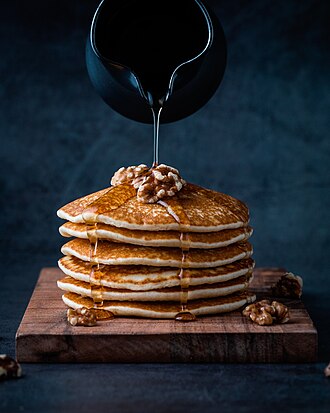
Photo: Wikipedia
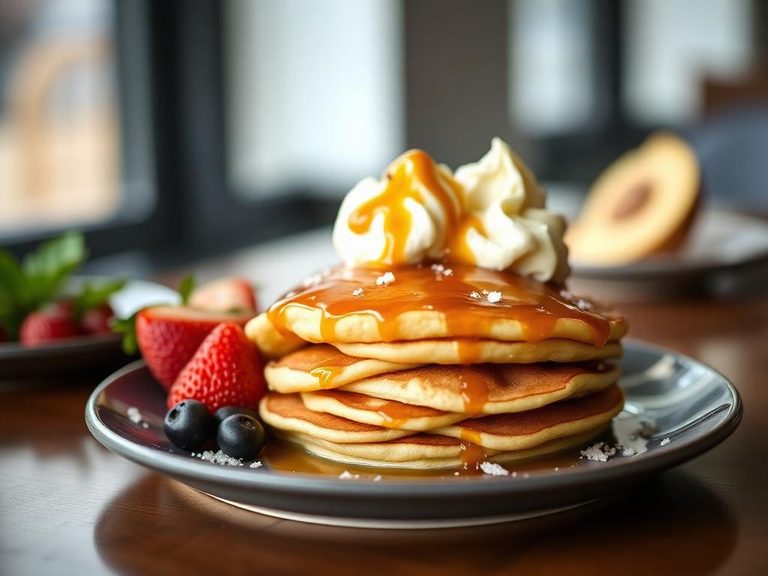
Fast-food or restaurant-style plain pancakes are soft, fluffy, and spongy disks with a mild, sweet, buttery flavor and a slightly crisp exterior. Nutritionally, they are a dense source of energy, primarily from refined carbohydrates and fats, with a modest amount of protein.
Calorie split: 9% protein · 45% carbs · 46% fat
↓ Full nutrition💚 Why it's loved
People love them for their comforting, mild sweetness and satisfying texture, which acts as a perfect canvas for a wide array of toppings from classic maple syrup to fresh berries.
⚠️ Watch-outs & how to enjoy it better
The refined flour and added sugars can cause rapid blood-sugar spikes, and the high fat content from cooking oil can make them heavy. To counteract this, pair them with protein and fiber-rich toppings like Greek yogurt, nuts, or berries, and practice portion control.
Key benefits
- Quick and convenient source of energy
- Provides some protein from milk and eggs in the batter
- Can be a vehicle for nutrient-rich toppings like fruit
- Comfort food that is widely accessible
🍽️ Popular dishes
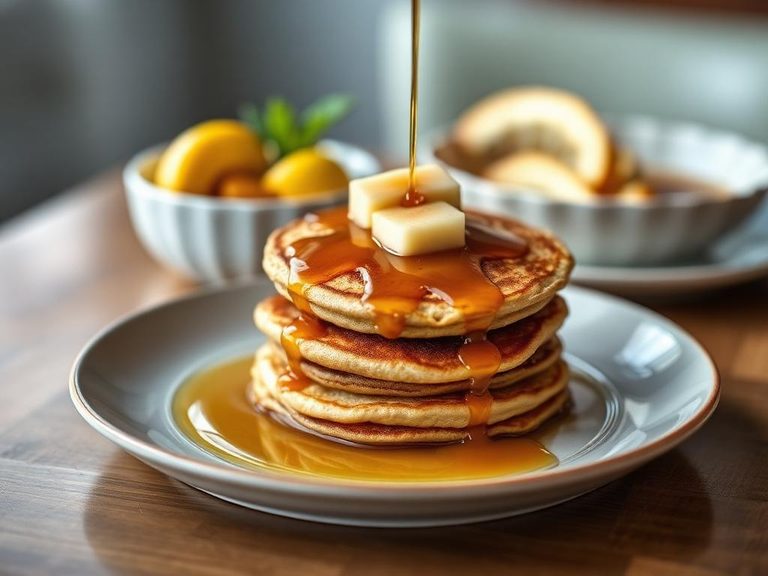
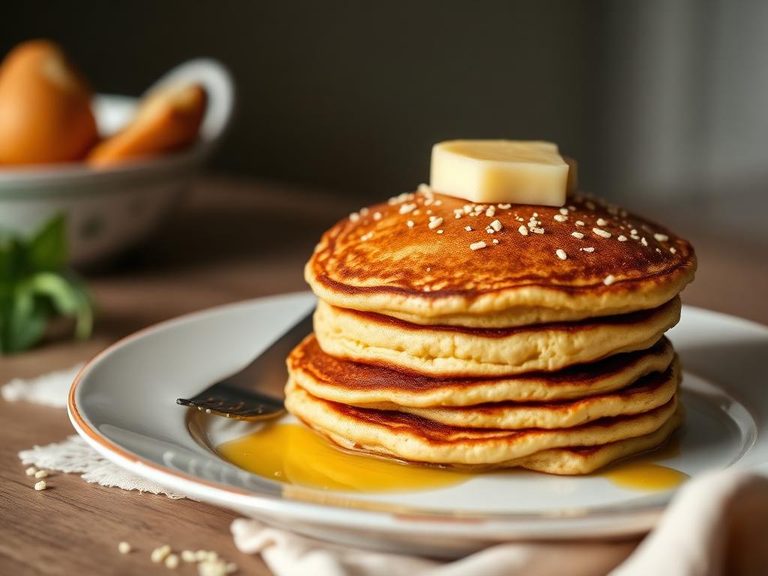
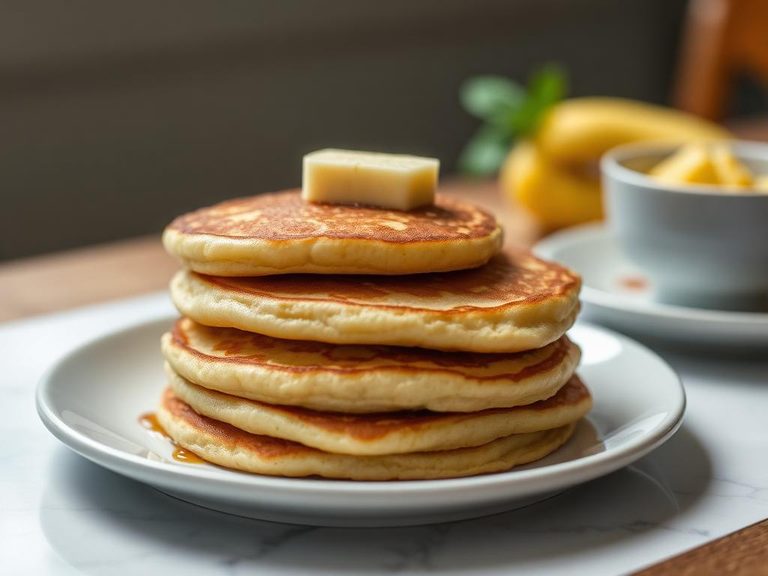

🌍 Where it's eaten
💡 Did you know?
The term 'short stack' for two pancakes is believed to derive from an old printing term where a 'short' run of a newspaper edition was a smaller, quicker batch.
Full nutrition (USDA data · scales with serving)
| Water | 40.4 g |
| Energy | 307 kcal |
| Protein | 7.2 g |
| Total lipid (fat) | 15.5 g |
| Carbohydrate, by difference | 34.1 g |
| Fiber, total dietary | 2.1 g |
| Total Sugars | 6.8 g |
| Calcium, Ca | 199 mg |
| Iron, Fe | 1.4 mg |
| Magnesium, Mg | 19.0 mg |
| Phosphorus, P | 315 mg |
| Potassium, K | 168 mg |
| Sodium, Na | 544 mg |
| Zinc, Zn | 0.70 mg |
| Copper, Cu | 0.04 mg |
| Selenium, Se | 10.1 ug |
| Vitamin C, total ascorbic acid | 0.00 mg |
| Thiamin | 0.22 mg |
| Riboflavin | 0.25 mg |
| Niacin | 1.3 mg |
| Vitamin B-6 | 0.13 mg |
| Folate, total | 44.0 ug |
| Folic acid | 34.0 ug |
| Folate, food | 10.0 ug |
| Folate, DFE | 68.0 ug |
| Choline, total | 48.4 mg |
| Vitamin B-12 | 0.37 ug |
| Vitamin B-12, added | 0.00 ug |
| Vitamin A, RAE | 74.0 ug |
| Retinol | 73.0 ug |
| Carotene, beta | 12.0 ug |
| Carotene, alpha | 0.00 ug |
| Cryptoxanthin, beta | 2.0 ug |
| Lycopene | 0.00 ug |
| Lutein + zeaxanthin | 95.0 ug |
| Vitamin E (alpha-tocopherol) | 2.5 mg |
| Vitamin E, added | 0.00 mg |
| Vitamin D (D2 + D3) | 0.90 ug |
| Vitamin K (phylloquinone) | 12.0 ug |
| Alcohol, ethyl | 0.00 g |
| Caffeine | 0.00 mg |
| Theobromine | 0.00 mg |
Fat & fatty acid profile (per 100g)
| Fatty acids, total saturated | 3.4 g |
| SFA 4:0 | 0.06 g |
| SFA 6:0 | 0.04 g |
| SFA 8:0 | 0.03 g |
| SFA 10:0 | 0.06 g |
| SFA 12:0 | 0.07 g |
| SFA 14:0 | 0.23 g |
| SFA 16:0 | 2.1 g |
| SFA 18:0 | 0.69 g |
| Fatty acids, total monounsaturated | 5.8 g |
| MUFA 16:1 | 0.10 g |
| MUFA 18:1 | 5.6 g |
| MUFA 20:1 | 0.07 g |
| MUFA 22:1 | 0.00 g |
| Fatty acids, total polyunsaturated | 4.9 g |
| PUFA 18:2 | 4.3 g |
| PUFA 18:3 | 0.50 g |
| PUFA 18:4 | 0.00 g |
| PUFA 20:4 | 0.00 g |
| PUFA 20:5 n-3 (EPA) | 0.00 g |
| PUFA 22:5 n-3 (DPA) | 0.00 g |
| PUFA 22:6 n-3 (DHA) | 0.00 g |
| Cholesterol | 64.0 mg |
Amino acid profile (per 100g)
Estimated from Pancakes, buttermilk, prepared from recipe — USDA does not publish this profile for Pancakes.
| Tryptophan | 0.08 g |
| Threonine | 0.25 g |
| Isoleucine | 0.32 g |
| Leucine | 0.55 g |
| Lysine | 0.35 g |
| Methionine | 0.15 g |
| Cystine | 0.12 g |
| Phenylalanine | 0.34 g |
| Tyrosine | 0.25 g |
| Valine | 0.36 g |
| Arginine | 0.29 g |
| Histidine | 0.16 g |
| Alanine | 0.26 g |
| Aspartic acid | 0.45 g |
| Glutamic acid | 1.6 g |
| Glycine | 0.21 g |
| Proline | 0.61 g |
| Serine | 0.38 g |
FAQ
Are plain pancakes a good source of protein?
They provide a moderate amount of protein (about 7g per 100g) from the eggs and milk in the batter, but they are not considered a high-protein food. Pairing them with eggs, yogurt, or nut butter significantly boosts the protein content.
Why are restaurant pancakes often fluffier than homemade ones?
Restaurants frequently use commercial batter mixes containing extra leavening agents like sodium aluminum phosphate and monocalcium phosphate, which create a more pronounced and consistent rise than standard baking powder.
Can I make a healthier version at home?
Yes. You can substitute part of the all-purpose flour with whole wheat or oat flour, add mashed banana or applesauce for natural sweetness, and cook them in a non-stick pan with minimal oil. Topping with fruit instead of syrup also improves the nutrition profile.
Nutrient density (calculated · NRF9.3)
Nutrient Rich Foods index: beneficial nutrients (protein, fiber, vitamins, minerals) minus saturated fat, added sugar & sodium, per 100 kcal.
NRF9.3 index — Fulgoni, Keast & Drewnowski, 2009. Computed from USDA nutrients.
Weight-loss friendliness (composite index)
Energy density 3.07 kcal/g · 9% calories from protein · 2.1 g fiber · 6.8 g sugar per 100 g.
Composite of energy density (Rolls et al., 1999), protein & fiber satiety, minus sugar. A calculated heuristic — ranks satiety-per-calorie, not a clinical measure.
Dietary load (calculated from USDA values)
Potential renal acid load. Positive = acid-forming, negative = alkaline-forming.
Sodium-to-potassium ratio: 3.24 (lower is better — aim for ≤ 1)
Sodium:potassium per WHO potassium guidance. Computed from USDA nutrients.