

Pancakes, fruit, fast food / restaurant
Common food

Photo: Wikipedia
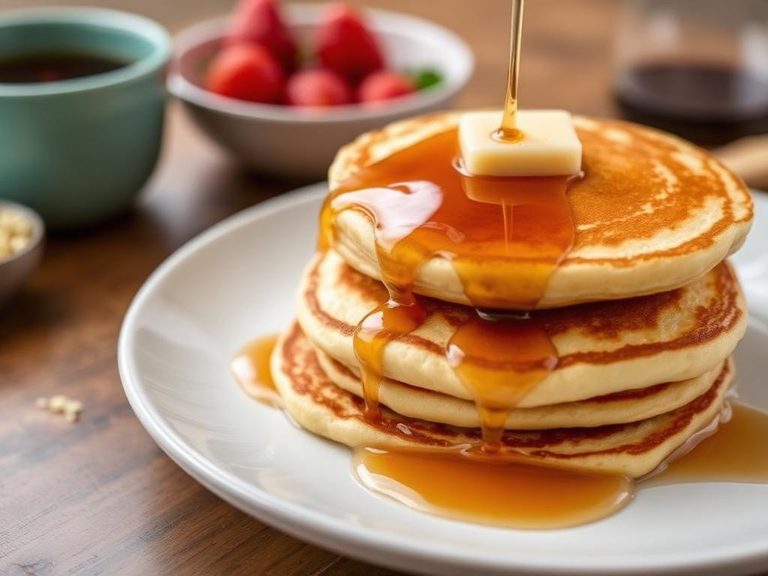
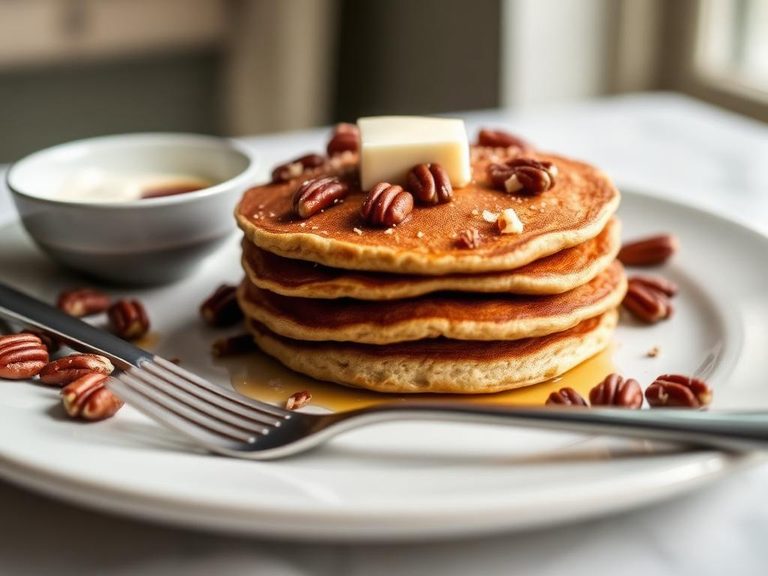
A classic breakfast staple, pancakes are soft, fluffy, and slightly sweet, often served in a stack with butter and maple syrup. Nutritionally, they are a carbohydrate-dense energy source, providing quick fuel but with a moderate protein content from the eggs and milk in the batter.
Calorie split: 9% protein · 47% carbs · 44% fat
↓ Full nutrition💚 Why it's loved
People love pancakes for their comforting, nostalgic flavor and the endless customization they offer, from blueberries in the batter to a mountain of whipped cream on top. They are a centerpiece of weekend brunch culture and a symbol of a leisurely, special meal.
⚠️ Watch-outs & how to enjoy it better
A stack of pancakes with syrup can cause a rapid blood-sugar spike due to the refined flour and high sugar content, and they are often high in calories. To counteract this, pair them with a source of protein and fat like eggs, Greek yogurt, or nuts, and use fruit or a modest amount of syrup instead of drowning them.
Key benefits
- Quick source of energy from carbohydrates
- Contains some protein from eggs and milk
- Can be a vehicle for nutrient-rich toppings like fruit
- Comfort food with cultural significance in many countries
- Versatile base for both sweet and savory dishes
🍽️ Popular dishes
🌍 Where it's eaten
💡 Did you know?
The world's largest pancake breakfast was held in flipping Massachusetts, where over 7,000 people were served a single, record-breaking pancake measuring 100 feet in diameter.
Full nutrition (USDA data · scales with serving)
| Water | 49.9 g |
| Energy | 253 kcal |
| Protein | 5.7 g |
| Total lipid (fat) | 12.3 g |
| Carbohydrate, by difference | 29.8 g |
| Fiber, total dietary | 2.3 g |
| Total Sugars | 7.5 g |
| Calcium, Ca | 158 mg |
| Iron, Fe | 1.1 mg |
| Magnesium, Mg | 16.0 mg |
| Phosphorus, P | 249 mg |
| Potassium, K | 144 mg |
| Sodium, Na | 426 mg |
| Zinc, Zn | 0.57 mg |
| Copper, Cu | 0.04 mg |
| Selenium, Se | 7.9 ug |
| Vitamin C, total ascorbic acid | 0.50 mg |
| Thiamin | 0.18 mg |
| Riboflavin | 0.20 mg |
| Niacin | 1.2 mg |
| Vitamin B-6 | 0.12 mg |
| Folate, total | 36.0 ug |
| Folic acid | 27.0 ug |
| Folate, food | 9.0 ug |
| Folate, DFE | 54.0 ug |
| Choline, total | 39.2 mg |
| Vitamin B-12 | 0.29 ug |
| Vitamin B-12, added | 0.00 ug |
| Vitamin A, RAE | 58.0 ug |
| Retinol | 57.0 ug |
| Carotene, beta | 15.0 ug |
| Carotene, alpha | 0.00 ug |
| Cryptoxanthin, beta | 1.0 ug |
| Lycopene | 0.00 ug |
| Lutein + zeaxanthin | 89.0 ug |
| Vitamin E (alpha-tocopherol) | 2.1 mg |
| Vitamin E, added | 0.00 mg |
| Vitamin D (D2 + D3) | 0.70 ug |
| Vitamin K (phylloquinone) | 13.6 ug |
| Alcohol, ethyl | 0.00 g |
| Caffeine | 0.00 mg |
| Theobromine | 0.00 mg |
Fat & fatty acid profile (per 100g)
| Fatty acids, total saturated | 2.7 g |
| SFA 4:0 | 0.04 g |
| SFA 6:0 | 0.03 g |
| SFA 8:0 | 0.02 g |
| SFA 10:0 | 0.05 g |
| SFA 12:0 | 0.06 g |
| SFA 14:0 | 0.18 g |
| SFA 16:0 | 1.7 g |
| SFA 18:0 | 0.55 g |
| Fatty acids, total monounsaturated | 4.5 g |
| MUFA 16:1 | 0.08 g |
| MUFA 18:1 | 4.4 g |
| MUFA 20:1 | 0.06 g |
| MUFA 22:1 | 0.00 g |
| Fatty acids, total polyunsaturated | 3.9 g |
| PUFA 18:2 | 3.4 g |
| PUFA 18:3 | 0.42 g |
| PUFA 18:4 | 0.00 g |
| PUFA 20:4 | 0.00 g |
| PUFA 20:5 n-3 (EPA) | 0.00 g |
| PUFA 22:5 n-3 (DPA) | 0.00 g |
| PUFA 22:6 n-3 (DHA) | 0.00 g |
| Cholesterol | 50.0 mg |
Amino acid profile (per 100g)
Estimated from Pancakes, buttermilk, prepared from recipe — USDA does not publish this profile for Pancakes.
| Tryptophan | 0.08 g |
| Threonine | 0.25 g |
| Isoleucine | 0.32 g |
| Leucine | 0.55 g |
| Lysine | 0.35 g |
| Methionine | 0.15 g |
| Cystine | 0.12 g |
| Phenylalanine | 0.34 g |
| Tyrosine | 0.25 g |
| Valine | 0.36 g |
| Arginine | 0.29 g |
| Histidine | 0.16 g |
| Alanine | 0.26 g |
| Aspartic acid | 0.45 g |
| Glutamic acid | 1.6 g |
| Glycine | 0.21 g |
| Proline | 0.61 g |
| Serine | 0.38 g |
FAQ
Why are my pancakes not fluffy?
The most common reasons are overmixing the batter, which develops too much gluten and makes them tough, or using old baking powder. Mix just until combined and ensure your leavening agent is fresh.
Can I make pancakes healthier?
Yes, you can substitute some all-purpose flour with whole wheat or oat flour, add protein powder or mashed banana to the batter, and top them with fresh fruit and a dollop of yogurt instead of syrup.
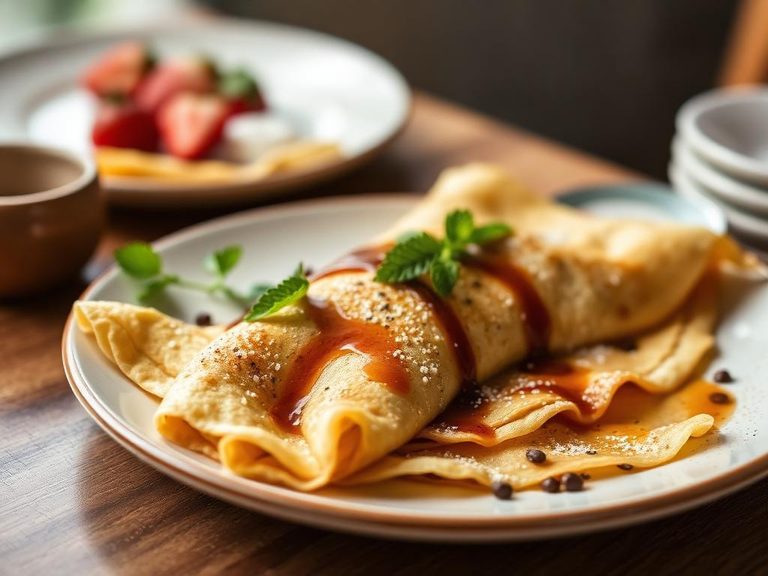
What is the difference between pancakes and crêpes?
Pancakes are thicker and fluffier due to a leavening agent like baking powder, while crêpes are very thin and delicate, made from a runnier batter without leavening.
Nutrient density (calculated · NRF9.3)
Nutrient Rich Foods index: beneficial nutrients (protein, fiber, vitamins, minerals) minus saturated fat, added sugar & sodium, per 100 kcal.
NRF9.3 index — Fulgoni, Keast & Drewnowski, 2009. Computed from USDA nutrients.
Weight-loss friendliness (composite index)
Energy density 2.53 kcal/g · 9% calories from protein · 2.3 g fiber · 7.5 g sugar per 100 g.
Composite of energy density (Rolls et al., 1999), protein & fiber satiety, minus sugar. A calculated heuristic — ranks satiety-per-calorie, not a clinical measure.
Dietary load (calculated from USDA values)
Potential renal acid load. Positive = acid-forming, negative = alkaline-forming.
Sodium-to-potassium ratio: 2.96 (lower is better — aim for ≤ 1)
Sodium:potassium per WHO potassium guidance. Computed from USDA nutrients.