

Nachos, beef or pork, with beans
Common food
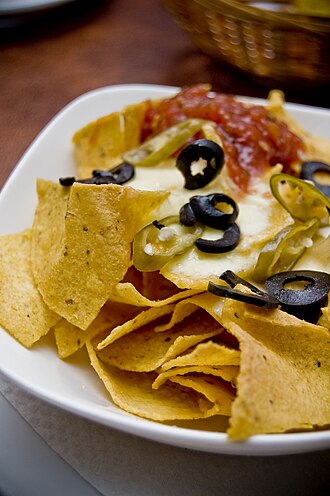
Photo: Wikipedia
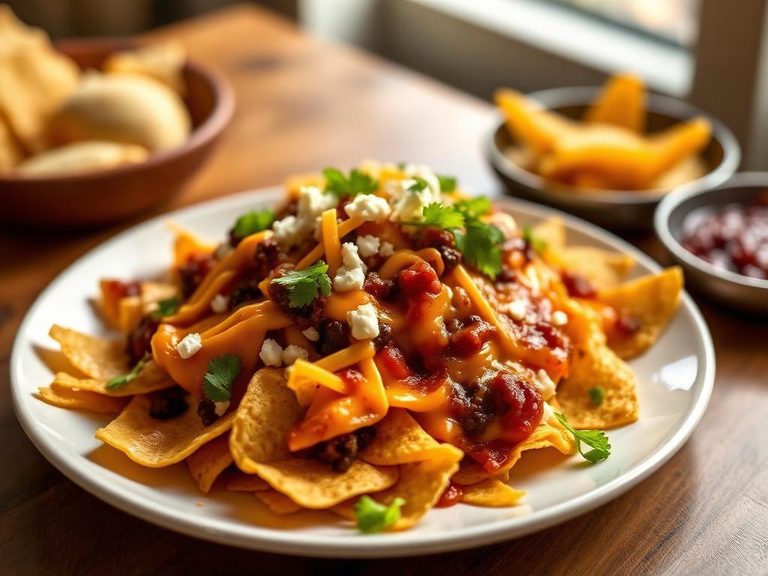
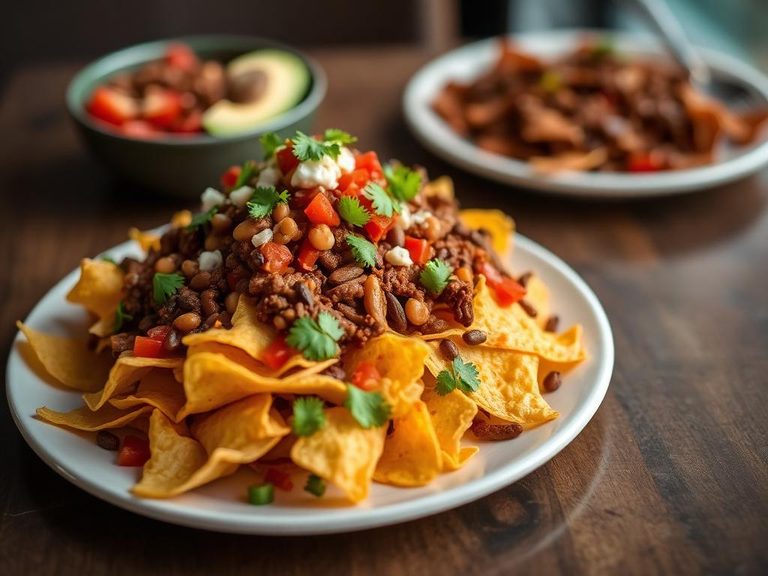
A pile of crispy corn tortilla chips blanketed in savory, spiced ground beef or pork and hearty beans, often melted with cheese. The experience is a satisfying crunch giving way to a warm, savory, and slightly creamy filling. Nutritionally, it's a calorie-dense dish where the protein from meat and beans is balanced by a significant fat and carbohydrate load from chips and cheese.
Calorie split: 17% protein · 33% carbs · 50% fat
↓ Full nutrition💚 Why it's loved
People adore nachos for their customizable, shareable nature and the perfect contrast of textures—crunchy, gooey, and savory. They are deeply tied to casual social gatherings, sports events, and Tex-Mex comfort food culture.
⚠️ Watch-outs & how to enjoy it better
The dish is often high in sodium, saturated fat, and refined carbohydrates, which can cause energy spikes and crashes. To mitigate this, opt for a smaller portion, choose lean ground meat, load up on fresh toppings like pico de gallo, jalapeños, and avocado, and pair with a side salad to increase volume and fiber.
Key benefits
- Good source of complete protein from meat and beans
- Provides dietary fiber from beans and tortilla chips
- Contains iron and B vitamins from the meat component
- Offers a quick, energy-dense meal or snack
🍽️ Popular dishes


🌍 Where it's eaten
💡 Did you know?
Nachos were invented in 1943 by Ignacio Anaya García, a maître d' at a restaurant in Piedras Negras, Mexico, just over the border from Texas. He named them 'Nacho's Especiales' after his nickname, Ignacio.
Full nutrition (USDA data · scales with serving)
| Water | 58.2 g |
| Energy | 220 kcal |
| Protein | 9.3 g |
| Total lipid (fat) | 12.4 g |
| Carbohydrate, by difference | 18.3 g |
| Fiber, total dietary | 2.0 g |
| Total Sugars | 0.38 g |
| Calcium, Ca | 56.0 mg |
| Iron, Fe | 1.4 mg |
| Magnesium, Mg | 30.0 mg |
| Phosphorus, P | 127 mg |
| Potassium, K | 188 mg |
| Sodium, Na | 424 mg |
| Zinc, Zn | 1.9 mg |
| Copper, Cu | 0.07 mg |
| Selenium, Se | 8.4 ug |
| Vitamin C, total ascorbic acid | 0.20 mg |
| Thiamin | 0.09 mg |
| Riboflavin | 0.10 mg |
| Niacin | 1.6 mg |
| Vitamin B-6 | 0.15 mg |
| Folate, total | 16.0 ug |
| Folic acid | 4.0 ug |
| Folate, food | 12.0 ug |
| Folate, DFE | 19.0 ug |
| Choline, total | 28.6 mg |
| Vitamin B-12 | 0.58 ug |
| Vitamin B-12, added | 0.00 ug |
| Vitamin A, RAE | 7.0 ug |
| Retinol | 7.0 ug |
| Carotene, beta | 0.00 ug |
| Carotene, alpha | 0.00 ug |
| Cryptoxanthin, beta | 0.00 ug |
| Lycopene | 0.00 ug |
| Lutein + zeaxanthin | 2.0 ug |
| Vitamin E (alpha-tocopherol) | 1.4 mg |
| Vitamin E, added | 0.00 mg |
| Vitamin D (D2 + D3) | 0.00 ug |
| Vitamin K (phylloquinone) | 8.4 ug |
| Alcohol, ethyl | 0.00 g |
| Caffeine | 0.00 mg |
| Theobromine | 0.00 mg |
Fat & fatty acid profile (per 100g)
| Fatty acids, total saturated | 3.1 g |
| SFA 4:0 | 0.03 g |
| SFA 6:0 | 0.01 g |
| SFA 8:0 | 0.01 g |
| SFA 10:0 | 0.02 g |
| SFA 12:0 | 0.04 g |
| SFA 14:0 | 0.21 g |
| SFA 16:0 | 1.9 g |
| SFA 18:0 | 0.74 g |
| Fatty acids, total monounsaturated | 4.5 g |
| MUFA 16:1 | 0.18 g |
| MUFA 18:1 | 4.2 g |
| MUFA 20:1 | 0.05 g |
| MUFA 22:1 | 0.00 g |
| Fatty acids, total polyunsaturated | 3.6 g |
| PUFA 18:2 | 3.3 g |
| PUFA 18:3 | 0.27 g |
| PUFA 18:4 | 0.00 g |
| PUFA 20:4 | 0.01 g |
| PUFA 20:5 n-3 (EPA) | 0.00 g |
| PUFA 22:5 n-3 (DPA) | 0.00 g |
| PUFA 22:6 n-3 (DHA) | 0.00 g |
| Cholesterol | 22.0 mg |
Amino acid profile (per 100g)
Estimated from Fast foods, nachos, with cheese — USDA does not publish this profile for Nachos.
| Tryptophan | 0.04 g |
| Threonine | 0.16 g |
| Isoleucine | 0.19 g |
| Leucine | 0.52 g |
| Lysine | 0.16 g |
| Methionine | 0.09 g |
| Phenylalanine | 0.23 g |
| Tyrosine | 0.14 g |
| Valine | 0.25 g |
| Arginine | 0.21 g |
| Histidine | 0.14 g |
| Alanine | 0.29 g |
| Aspartic acid | 0.34 g |
| Glutamic acid | 0.92 g |
| Glycine | 0.15 g |
| Proline | 0.53 g |
| Serine | 0.22 g |
| Hydroxyproline | 0.00 g |
FAQ
Are nachos a complete meal?
They can be, as they provide carbohydrates, protein, and fat. To make it a more balanced meal, add fresh vegetables like tomatoes, onions, and lettuce, and consider a side of fruit or a simple salad.
What's the difference between nachos and tostadas?
Nachos use tortilla chips (fried or baked triangles) as a base, while tostadas use a whole, flat, fried corn tortilla. Nachos are typically piled high and shared, whereas tostadas are individual, open-faced sandwiches.
Can I make nachos healthier?
Yes. Use baked tortilla chips, lean ground turkey or chicken, low-fat cheese, and load them with beans, corn, peppers, and fresh salsa. Avoid heavy, creamy sauces and excessive sour cream.
Nutrient density (calculated · NRF9.3)
Nutrient Rich Foods index: beneficial nutrients (protein, fiber, vitamins, minerals) minus saturated fat, added sugar & sodium, per 100 kcal.
NRF9.3 index — Fulgoni, Keast & Drewnowski, 2009. Computed from USDA nutrients.
Weight-loss friendliness (composite index)
Energy density 2.20 kcal/g · 17% calories from protein · 2.0 g fiber · 0.4 g sugar per 100 g.
Composite of energy density (Rolls et al., 1999), protein & fiber satiety, minus sugar. A calculated heuristic — ranks satiety-per-calorie, not a clinical measure.
Dietary load (calculated from USDA values)
Potential renal acid load. Positive = acid-forming, negative = alkaline-forming.
Sodium-to-potassium ratio: 2.26 (lower is better — aim for ≤ 1)
Sodium:potassium per WHO potassium guidance. Computed from USDA nutrients.