

Hot dog, beef
Common food
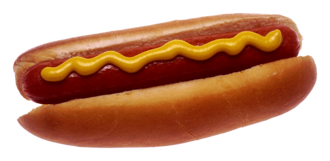
Photo: Wikipedia
A hot dog, beef, is a cooked, smoked sausage typically made from beef trimmings and spices, encased in a thin, edible skin. It offers a savory, salty, and slightly smoky flavor with a tender, juicy, and sometimes snappy texture when bitten. Nutritionally, it is a high-fat, high-protein food with minimal carbohydrates, providing a dense source of calories.
Calorie split: 15% protein · 4% carbs · 81% fat
↓ Full nutrition💚 Why it's loved
People love beef hot dogs for their deeply savory, smoky, and salty flavor profile that is both comforting and satisfying. Their versatility makes them a staple at barbecues, ballparks, and quick weeknight meals, often customized with a wide array of toppings.
⚠️ Watch-outs & how to enjoy it better
Beef hot dogs are typically high in sodium and saturated fat, which can be a concern for heart health and blood pressure. They are also a processed meat, so individuals monitoring their intake of nitrates or preservatives should be cautious. To mitigate, pair with fiber-rich sides like sauerkraut or a fresh salad, and practice portion control by enjoying one dog as part of a balanced plate.
Key benefits
- High in complete protein for muscle maintenance
- Provides energy-dense calories from fat
- Source of B vitamins like B12 and niacin
- Contains minerals such as zinc and selenium
- Offers a quick, convenient meal option
🍽️ Popular dishes





🌍 Where it's eaten
💡 Did you know?
The term 'hot dog' may have originated from a cartoonist who couldn't spell 'dachshund' and wrote 'hot dog' instead, or from vendors calling out 'Get your hot dachshund sausages!' at baseball games.
Full nutrition (USDA data · scales with serving)
| Water | 54.6 g |
| Energy | 310 kcal |
| Protein | 11.7 g |
| Total lipid (fat) | 28.0 g |
| Carbohydrate, by difference | 2.9 g |
| Fiber, total dietary | 0.00 g |
| Total Sugars | 1.3 g |
| Calcium, Ca | 15.0 mg |
| Iron, Fe | 1.1 mg |
| Magnesium, Mg | 11.0 mg |
| Phosphorus, P | 122 mg |
| Potassium, K | 326 mg |
| Sodium, Na | 828 mg |
| Zinc, Zn | 2.1 mg |
| Copper, Cu | 0.05 mg |
| Selenium, Se | 10.3 ug |
| Vitamin C, total ascorbic acid | 0.00 mg |
| Thiamin | 0.03 mg |
| Riboflavin | 0.15 mg |
| Niacin | 2.0 mg |
| Vitamin B-6 | 0.10 mg |
| Folate, total | 0.00 ug |
| Folic acid | 0.00 ug |
| Folate, food | 0.00 ug |
| Folate, DFE | 0.00 ug |
| Choline, total | 31.9 mg |
| Vitamin B-12 | 0.82 ug |
| Vitamin B-12, added | 0.00 ug |
| Vitamin A, RAE | 3.0 ug |
| Retinol | 3.0 ug |
| Carotene, beta | 0.00 ug |
| Carotene, alpha | 0.00 ug |
| Cryptoxanthin, beta | 0.00 ug |
| Lycopene | 0.00 ug |
| Lutein + zeaxanthin | 0.00 ug |
| Vitamin E (alpha-tocopherol) | 0.51 mg |
| Vitamin E, added | 0.00 mg |
| Vitamin D (D2 + D3) | 0.90 ug |
| Vitamin K (phylloquinone) | 1.8 ug |
| Alcohol, ethyl | 0.00 g |
| Caffeine | 0.00 mg |
| Theobromine | 0.00 mg |
Fat & fatty acid profile (per 100g)
| Fatty acids, total saturated | 11.4 g |
| SFA 4:0 | 0.00 g |
| SFA 6:0 | 0.00 g |
| SFA 8:0 | 0.01 g |
| SFA 10:0 | 0.01 g |
| SFA 12:0 | 0.02 g |
| SFA 14:0 | 0.84 g |
| SFA 16:0 | 6.3 g |
| SFA 18:0 | 3.7 g |
| Fatty acids, total monounsaturated | 12.1 g |
| MUFA 16:1 | 1.1 g |
| MUFA 18:1 | 11.8 g |
| MUFA 20:1 | 0.12 g |
| MUFA 22:1 | 0.06 g |
| Fatty acids, total polyunsaturated | 0.95 g |
| PUFA 18:2 | 0.93 g |
| PUFA 18:3 | 0.09 g |
| PUFA 18:4 | 0.00 g |
| PUFA 20:4 | 0.03 g |
| PUFA 20:5 n-3 (EPA) | 0.00 g |
| PUFA 22:5 n-3 (DPA) | 0.01 g |
| PUFA 22:6 n-3 (DHA) | 0.00 g |
| Cholesterol | 58.0 mg |
Amino acid profile (per 100g)
Estimated from Pickle relish, hot dog — USDA does not publish this profile for Hot dog.
| Tryptophan | 0.02 g |
| Threonine | 0.05 g |
| Isoleucine | 0.05 g |
| Leucine | 0.07 g |
| Lysine | 0.07 g |
| Methionine | 0.02 g |
| Cystine | 0.02 g |
| Phenylalanine | 0.05 g |
| Tyrosine | 0.03 g |
| Valine | 0.06 g |
| Arginine | 0.10 g |
| Histidine | 0.03 g |
| Alanine | 0.06 g |
| Aspartic acid | 0.09 g |
| Glutamic acid | 0.33 g |
| Glycine | 0.06 g |
| Proline | 0.07 g |
| Serine | 0.05 g |
FAQ
What is the main difference between a beef hot dog and a pork hot dog?
The primary difference is the meat source. Beef hot dogs are made from beef, often resulting in a deeper, more robust and sometimes smokier flavor. Pork hot dogs are typically milder and may have a slightly different fat composition and texture.
Are beef hot dogs pre-cooked?
Yes, commercially sold beef hot dogs are fully cooked during the manufacturing process (smoked and/or heated). They are safe to eat cold, but are almost always reheated by grilling, boiling, or pan-frying to enhance flavor and texture.
Why do beef hot dogs sometimes split open when cooked?
The casing splits when the internal steam pressure builds up faster than it can escape, often due to very high heat or overcooking. To prevent this, cook over medium heat and avoid piercing the skin with a fork.
Nutrient density (calculated · NRF9.3)
Nutrient Rich Foods index: beneficial nutrients (protein, fiber, vitamins, minerals) minus saturated fat, added sugar & sodium, per 100 kcal.
NRF9.3 index — Fulgoni, Keast & Drewnowski, 2009. Computed from USDA nutrients.
Weight-loss friendliness (composite index)
Energy density 3.10 kcal/g · 15% calories from protein · 0.0 g fiber · 1.3 g sugar per 100 g.
Composite of energy density (Rolls et al., 1999), protein & fiber satiety, minus sugar. A calculated heuristic — ranks satiety-per-calorie, not a clinical measure.
Dietary load (calculated from USDA values)
Potential renal acid load. Positive = acid-forming, negative = alkaline-forming.
Sodium-to-potassium ratio: 2.54 (lower is better — aim for ≤ 1)
Sodium:potassium per WHO potassium guidance. Computed from USDA nutrients.