

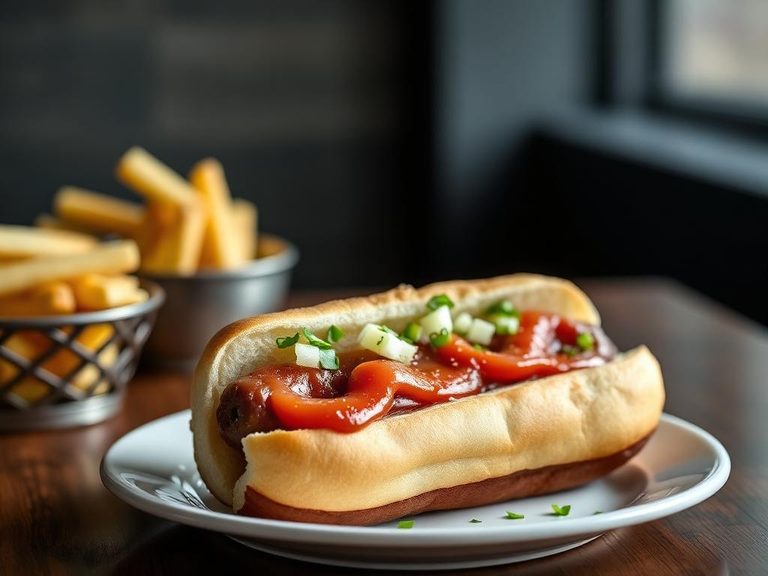
Hot dog sandwich, beef, on white bread
Common food

Photo: Wikipedia
A classic American staple, this is a savory, juicy beef sausage nestled in a soft, pillowy white bun. The experience is a satisfying contrast of textures—the snap of the casing, the tender meat, and the yielding bread—with a salty, umami-rich flavor profile. Nutritionally, it's a dense source of protein and fat, offering quick energy but minimal fiber.
Calorie split: 15% protein · 26% carbs · 60% fat
↓ Full nutrition💚 Why it's loved
People love it for its perfect balance of salty, savory, and slightly smoky flavors, and the satisfying textural contrast between the snappy sausage and soft bun. It's deeply embedded in American culture as the ultimate casual, nostalgic food for ballparks, cookouts, and quick meals.
⚠️ Watch-outs & how to enjoy it better
The high sodium and saturated fat content can be a concern for heart health and blood pressure management. The refined white bun offers little fiber, which can lead to quicker blood sugar spikes. To counteract, pair it with a fiber-rich side like a vinegar-based coleslaw or a large salad, and opt for a whole-grain bun when possible.
Key benefits
- High-quality protein source for muscle maintenance
- Provides quick energy from carbohydrates and fats
- Convenient, portable, and ready-to-eat meal
- Contains B vitamins like B12 from the beef
- A familiar comfort food for many cultures
🍽️ Popular dishes



🌍 Where it's eaten
💡 Did you know?
The term 'hot dog' is thought to have originated from a cartoonist in the early 1900s who, unsure of the sausage's true meat content (often jokingly called 'dachshund sausage'), simply labeled it a 'hot dog' in his drawing.
Full nutrition (USDA data · scales with serving)
| Water | 48.1 g |
| Energy | 295 kcal |
| Protein | 10.9 g |
| Total lipid (fat) | 19.6 g |
| Carbohydrate, by difference | 18.9 g |
| Fiber, total dietary | 0.80 g |
| Total Sugars | 2.7 g |
| Calcium, Ca | 83.0 mg |
| Iron, Fe | 1.9 mg |
| Magnesium, Mg | 17.0 mg |
| Phosphorus, P | 119 mg |
| Potassium, K | 254 mg |
| Sodium, Na | 698 mg |
| Zinc, Zn | 1.6 mg |
| Copper, Cu | 0.07 mg |
| Selenium, Se | 14.7 ug |
| Vitamin C, total ascorbic acid | 0.00 mg |
| Thiamin | 0.19 mg |
| Riboflavin | 0.18 mg |
| Niacin | 3.0 mg |
| Vitamin B-6 | 0.10 mg |
| Folate, total | 38.0 ug |
| Folic acid | 30.0 ug |
| Folate, food | 9.0 ug |
| Folate, DFE | 59.0 ug |
| Choline, total | 25.9 mg |
| Vitamin B-12 | 0.54 ug |
| Vitamin B-12, added | 0.00 ug |
| Vitamin A, RAE | 2.0 ug |
| Retinol | 2.0 ug |
| Carotene, beta | 0.00 ug |
| Carotene, alpha | 0.00 ug |
| Cryptoxanthin, beta | 0.00 ug |
| Lycopene | 0.00 ug |
| Lutein + zeaxanthin | 15.0 ug |
| Vitamin E (alpha-tocopherol) | 0.41 mg |
| Vitamin E, added | 0.00 mg |
| Vitamin D (D2 + D3) | 0.60 ug |
| Vitamin K (phylloquinone) | 1.2 ug |
| Alcohol, ethyl | 0.00 g |
| Caffeine | 0.00 mg |
| Theobromine | 0.00 mg |
Fat & fatty acid profile (per 100g)
| Fatty acids, total saturated | 7.8 g |
| SFA 4:0 | 0.00 g |
| SFA 6:0 | 0.00 g |
| SFA 8:0 | 0.01 g |
| SFA 10:0 | 0.01 g |
| SFA 12:0 | 0.02 g |
| SFA 14:0 | 0.56 g |
| SFA 16:0 | 4.3 g |
| SFA 18:0 | 2.5 g |
| Fatty acids, total monounsaturated | 8.2 g |
| MUFA 16:1 | 0.71 g |
| MUFA 18:1 | 8.0 g |
| MUFA 20:1 | 0.08 g |
| MUFA 22:1 | 0.04 g |
| Fatty acids, total polyunsaturated | 1.3 g |
| PUFA 18:2 | 1.2 g |
| PUFA 18:3 | 0.13 g |
| PUFA 18:4 | 0.00 g |
| PUFA 20:4 | 0.02 g |
| PUFA 20:5 n-3 (EPA) | 0.00 g |
| PUFA 22:5 n-3 (DPA) | 0.01 g |
| PUFA 22:6 n-3 (DHA) | 0.00 g |
| Cholesterol | 38.0 mg |
Amino acid profile (per 100g)
Estimated from Pickle relish, hot dog — USDA does not publish this profile for Hot dog sandwich.
| Tryptophan | 0.02 g |
| Threonine | 0.05 g |
| Isoleucine | 0.05 g |
| Leucine | 0.07 g |
| Lysine | 0.07 g |
| Methionine | 0.02 g |
| Cystine | 0.02 g |
| Phenylalanine | 0.05 g |
| Tyrosine | 0.03 g |
| Valine | 0.06 g |
| Arginine | 0.10 g |
| Histidine | 0.03 g |
| Alanine | 0.06 g |
| Aspartic acid | 0.09 g |
| Glutamic acid | 0.33 g |
| Glycine | 0.06 g |
| Proline | 0.07 g |
| Serine | 0.05 g |
FAQ
Is a hot dog a sandwich?
This is a famous culinary debate. The U.S. Department of Agriculture defines a sandwich as 'a meat or poultry filling between two slices of bread,' which technically makes a hot dog a sandwich. However, purists argue its unique form and cultural identity set it apart.
The 'snap' is the satisfying auditory and textural sensation when you bite through the natural casing of a high-quality sausage. It indicates the casing is fresh and has been properly cooked to create internal pressure.
Why is the bun often steamed or toasted?
Steaming makes the bun exceptionally soft and warm, helping it meld with the hot sausage. Toasting adds a slight crunch and prevents the bun from getting soggy from condiments and meat juices.
Nutrient density (calculated · NRF9.3)
Nutrient Rich Foods index: beneficial nutrients (protein, fiber, vitamins, minerals) minus saturated fat, added sugar & sodium, per 100 kcal.
NRF9.3 index — Fulgoni, Keast & Drewnowski, 2009. Computed from USDA nutrients.
Weight-loss friendliness (composite index)
Energy density 2.95 kcal/g · 15% calories from protein · 0.8 g fiber · 2.7 g sugar per 100 g.
Composite of energy density (Rolls et al., 1999), protein & fiber satiety, minus sugar. A calculated heuristic — ranks satiety-per-calorie, not a clinical measure.
Dietary load (calculated from USDA values)
Potential renal acid load. Positive = acid-forming, negative = alkaline-forming.
Sodium-to-potassium ratio: 2.75 (lower is better — aim for ≤ 1)
Sodium:potassium per WHO potassium guidance. Computed from USDA nutrients.