

Fish, tofu, and vegetables, tempura
Common food

Photo: Wikipedia
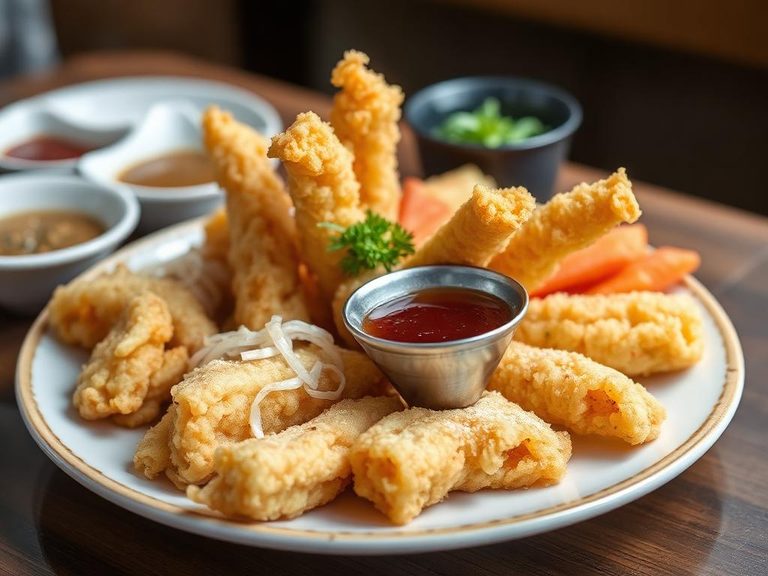
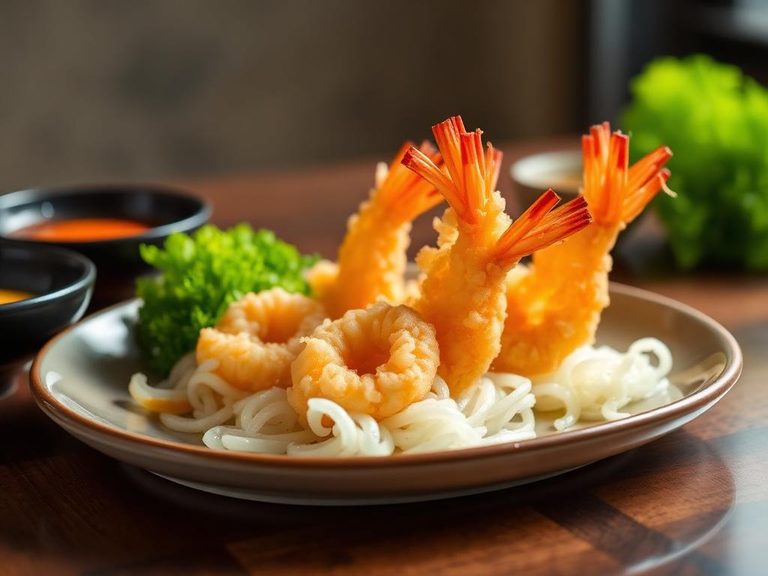
This is a light, crispy tempura batter encasing tender fish, silky tofu, and fresh vegetables, fried to a delicate golden crunch. The texture is a delightful contrast: the shatteringly crisp exterior gives way to soft, moist interiors, with the fish flaking and the tofu melting. Nutritionally, it's a high-fat dish due to the frying oil, but it also provides a good balance of protein from the fish and tofu.
Calorie split: 9% protein · 10% carbs · 81% fat
↓ Full nutrition💚 Why it's loved
People adore tempura for its masterful contrast of textures—the ethereal, lace-like crispness of the batter against the steaming, tender fillings. It's a cornerstone of Japanese cuisine, celebrated for its ability to highlight the natural, clean flavors of fresh ingredients without heavy sauces.
⚠️ Watch-outs & how to enjoy it better
The primary downside is the high fat and calorie content from deep-frying, which can make it a heavy meal. Those monitoring fat intake or with concerns about heart health should enjoy it in moderation. To counteract this, pair it with a large portion of steamed rice and a clear soup like miso to increase fiber and volume, promoting fullness with less tempura. Choosing a mix of vegetable tempura over all-fish can also reduce the overall calorie density.
Key benefits
- High-quality protein from fish and tofu
- Provides essential omega-3 fatty acids from fish
- Contains fiber and micronutrients from vegetables
- Quick-cooking and versatile for various ingredients
- A beloved textural experience in Japanese cuisine
🍽️ Popular dishes
🌍 Where it's eaten
💡 Did you know?
The word 'tempura' is believed to derive from the Latin 'tempora,' referring to the Ember Days (days of fasting) of the Catholic Church, when fried foods were permitted as an alternative to meat.
Full nutrition (USDA data · scales with serving)
| Water | 74.7 g |
| Energy | 177 kcal |
| Protein | 4.0 g |
| Total lipid (fat) | 16.0 g |
| Carbohydrate, by difference | 4.5 g |
| Fiber, total dietary | 1.1 g |
| Total Sugars | 1.6 g |
| Calcium, Ca | 35.0 mg |
| Iron, Fe | 0.47 mg |
| Magnesium, Mg | 15.0 mg |
| Phosphorus, P | 73.0 mg |
| Potassium, K | 180 mg |
| Sodium, Na | 22.0 mg |
| Zinc, Zn | 0.44 mg |
| Copper, Cu | 0.10 mg |
| Selenium, Se | 8.4 ug |
| Vitamin C, total ascorbic acid | 17.0 mg |
| Thiamin | 0.04 mg |
| Riboflavin | 0.09 mg |
| Niacin | 0.72 mg |
| Vitamin B-6 | 0.12 mg |
| Folate, total | 21.0 ug |
| Folic acid | 0.00 ug |
| Folate, food | 21.0 ug |
| Folate, DFE | 21.0 ug |
| Choline, total | 47.0 mg |
| Vitamin B-12 | 0.18 ug |
| Vitamin B-12, added | 0.00 ug |
| Vitamin A, RAE | 68.0 ug |
| Retinol | 20.0 ug |
| Carotene, beta | 566 ug |
| Carotene, alpha | 7.0 ug |
| Cryptoxanthin, beta | 2.0 ug |
| Lycopene | 0.00 ug |
| Lutein + zeaxanthin | 273 ug |
| Vitamin E (alpha-tocopherol) | 3.2 mg |
| Vitamin E, added | 0.00 mg |
| Vitamin D (D2 + D3) | 0.20 ug |
| Vitamin K (phylloquinone) | 27.1 ug |
| Alcohol, ethyl | 0.00 g |
| Caffeine | 0.00 mg |
| Theobromine | 0.00 mg |
Fat & fatty acid profile (per 100g)
| Fatty acids, total saturated | 2.4 g |
| SFA 4:0 | 0.00 g |
| SFA 6:0 | 0.00 g |
| SFA 8:0 | 0.00 g |
| SFA 10:0 | 0.00 g |
| SFA 12:0 | 0.00 g |
| SFA 14:0 | 0.01 g |
| SFA 16:0 | 1.7 g |
| SFA 18:0 | 0.53 g |
| Fatty acids, total monounsaturated | 6.6 g |
| MUFA 16:1 | 0.09 g |
| MUFA 18:1 | 6.4 g |
| MUFA 20:1 | 0.10 g |
| MUFA 22:1 | 0.00 g |
| Fatty acids, total polyunsaturated | 5.9 g |
| PUFA 18:2 | 5.2 g |
| PUFA 18:3 | 0.67 g |
| PUFA 18:4 | 0.00 g |
| PUFA 20:4 | 0.02 g |
| PUFA 20:5 n-3 (EPA) | 0.01 g |
| PUFA 22:5 n-3 (DPA) | 0.00 g |
| PUFA 22:6 n-3 (DHA) | 0.02 g |
| Cholesterol | 57.0 mg |
Amino acid profile (per 100g)
Estimated from Fish, fish sticks, frozen, prepared — USDA does not publish this profile for Fish.
| Tryptophan | 0.12 g |
| Threonine | 0.37 g |
| Isoleucine | 0.43 g |
| Leucine | 0.85 g |
| Lysine | 0.80 g |
| Methionine | 0.30 g |
| Phenylalanine | 0.47 g |
| Tyrosine | 0.29 g |
| Valine | 0.50 g |
| Arginine | 0.59 g |
| Histidine | 0.23 g |
| Alanine | 0.55 g |
| Aspartic acid | 0.82 g |
| Glutamic acid | 2.3 g |
| Glycine | 0.47 g |
| Proline | 0.78 g |
| Serine | 0.49 g |
| Hydroxyproline | 0.00 g |
FAQ
What makes tempura batter different from regular frying batter?
Tempura batter is intentionally kept cold and mixed very minimally to avoid developing gluten, which results in a lighter, crispier, and less bready texture than other fried coatings.
Is tempura healthier than other fried foods?
Compared to heavily breaded and deep-fried items like fried chicken, tempura can be lighter because its batter is thinner. However, it is still a deep-fried food with significant fat content, so it's best enjoyed as part of a balanced meal.
What is the traditional dipping sauce for tempura?
It is served with 'tentsuyu,' a warm dipping sauce made from dashi, soy sauce, and mirin, often garnished with grated daikon radish and ginger to cut through the richness.
Nutrient density (calculated · NRF9.3)
Nutrient Rich Foods index: beneficial nutrients (protein, fiber, vitamins, minerals) minus saturated fat, added sugar & sodium, per 100 kcal.
NRF9.3 index — Fulgoni, Keast & Drewnowski, 2009. Computed from USDA nutrients.
Weight-loss friendliness (composite index)
Energy density 1.77 kcal/g · 9% calories from protein · 1.1 g fiber · 1.6 g sugar per 100 g.
Composite of energy density (Rolls et al., 1999), protein & fiber satiety, minus sugar. A calculated heuristic — ranks satiety-per-calorie, not a clinical measure.
Dietary load (calculated from USDA values)
Potential renal acid load. Positive = acid-forming, negative = alkaline-forming.
Sodium-to-potassium ratio: 0.12 (lower is better — aim for ≤ 1)
Sodium:potassium per WHO potassium guidance. Computed from USDA nutrients.