

Fig, raw
Common food

Photo: Wikipedia
A raw fig is a teardrop-shaped fruit with a soft, jammy interior filled with tiny, crunchy seeds. Its flavor is a complex honey-sweetness with a subtle, berry-like tang. Nutritionally, it's a standout source of dietary fiber and natural sugars for quick energy.
Calorie split: 4% protein · 93% carbs · 3% fat
↓ Full nutrition💚 Why it's loved
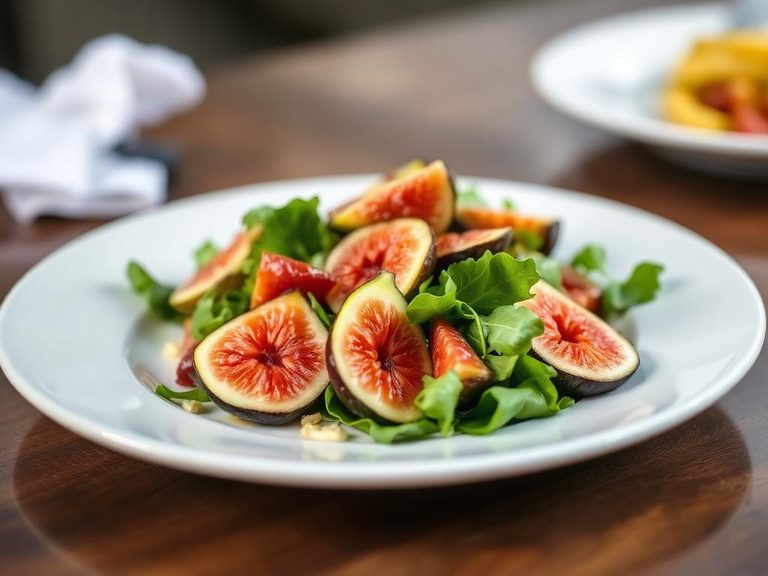
People adore figs for their uniquely luscious, honeyed flavor and the delightful textural contrast between the smooth flesh and crunchy seeds. They are cherished for their versatility, equally at home in savory salads, sweet desserts, or simply eaten fresh off the tree.
⚠️ Watch-outs & how to enjoy it better
Due to their high natural sugar content, figs can cause rapid blood-sugar spikes, so individuals monitoring their glucose levels should practice portion control. Pairing them with protein (like cheese) or healthy fats (like nuts) can help slow sugar absorption. Their high fiber content may also cause digestive discomfort if consumed in very large quantities by those not accustomed to it.
Key benefits
- Excellent source of dietary fiber for digestive health
- Provides natural sugars for a quick energy boost
- Contains essential minerals like potassium and manganese
- Rich in antioxidants that combat cellular stress
- Low in fat and a good source of prebiotics
🍽️ Popular dishes



🌍 Where it's eaten
💡 Did you know?
The tiny 'seeds' inside a fig are actually the fruit's true flowers, which bloom and are pollinated entirely inside the fig's enclosed structure.
Full nutrition (USDA data · scales with serving)
| Water | 79.1 g |
| Energy | 74.0 kcal |
| Protein | 0.75 g |
| Total lipid (fat) | 0.30 g |
| Carbohydrate, by difference | 19.2 g |
| Fiber, total dietary | 2.9 g |
| Total Sugars | 16.3 g |
| Calcium, Ca | 35.0 mg |
| Iron, Fe | 0.37 mg |
| Magnesium, Mg | 17.0 mg |
| Phosphorus, P | 14.0 mg |
| Potassium, K | 232 mg |
| Sodium, Na | 1.0 mg |
| Zinc, Zn | 0.15 mg |
| Copper, Cu | 0.07 mg |
| Selenium, Se | 0.20 ug |
| Vitamin C, total ascorbic acid | 2.0 mg |
| Thiamin | 0.06 mg |
| Riboflavin | 0.05 mg |
| Niacin | 0.40 mg |
| Vitamin B-6 | 0.11 mg |
| Folate, total | 6.0 ug |
| Folic acid | 0.00 ug |
| Folate, food | 6.0 ug |
| Folate, DFE | 6.0 ug |
| Choline, total | 4.7 mg |
| Vitamin B-12 | 0.00 ug |
| Vitamin B-12, added | 0.00 ug |
| Vitamin A, RAE | 7.0 ug |
| Retinol | 0.00 ug |
| Carotene, beta | 85.0 ug |
| Carotene, alpha | 0.00 ug |
| Cryptoxanthin, beta | 0.00 ug |
| Lycopene | 0.00 ug |
| Lutein + zeaxanthin | 9.0 ug |
| Vitamin E (alpha-tocopherol) | 0.11 mg |
| Vitamin E, added | 0.00 mg |
| Vitamin D (D2 + D3) | 0.00 ug |
| Vitamin K (phylloquinone) | 4.7 ug |
| Alcohol, ethyl | 0.00 g |
| Caffeine | 0.00 mg |
| Theobromine | 0.00 mg |
Fat & fatty acid profile (per 100g)
| Fatty acids, total saturated | 0.06 g |
| SFA 4:0 | 0.00 g |
| SFA 6:0 | 0.00 g |
| SFA 8:0 | 0.00 g |
| SFA 10:0 | 0.00 g |
| SFA 12:0 | 0.00 g |
| SFA 14:0 | 0.00 g |
| SFA 16:0 | 0.05 g |
| SFA 18:0 | 0.01 g |
| Fatty acids, total monounsaturated | 0.07 g |
| MUFA 16:1 | 0.00 g |
| MUFA 18:1 | 0.07 g |
| MUFA 20:1 | 0.00 g |
| MUFA 22:1 | 0.00 g |
| Fatty acids, total polyunsaturated | 0.14 g |
| PUFA 18:2 | 0.14 g |
| PUFA 18:3 | 0.00 g |
| PUFA 18:4 | 0.00 g |
| PUFA 20:4 | 0.00 g |
| PUFA 20:5 n-3 (EPA) | 0.00 g |
| PUFA 22:5 n-3 (DPA) | 0.00 g |
| PUFA 22:6 n-3 (DHA) | 0.00 g |
| Cholesterol | 0.00 mg |
Amino acid profile (per 100g)
Estimated from Cookies, fig bars — USDA does not publish this profile for Fig.
| Tryptophan | 0.05 g |
| Threonine | 0.11 g |
| Isoleucine | 0.13 g |
| Leucine | 0.22 g |
| Lysine | 0.14 g |
| Methionine | 0.05 g |
| Cystine | 0.07 g |
| Phenylalanine | 0.14 g |
| Tyrosine | 0.12 g |
| Valine | 0.15 g |
| Arginine | 0.12 g |
| Histidine | 0.07 g |
| Alanine | 0.15 g |
| Aspartic acid | 0.39 g |
| Glutamic acid | 0.91 g |
| Glycine | 0.12 g |
| Proline | 0.35 g |
| Serine | 0.19 g |
FAQ
What's the difference between a fresh fig and a dried fig?
Dried figs are simply fresh figs with most of the water removed, which concentrates their sugars, flavor, and calories. A 100g serving of dried figs has over 240 calories, compared to 74 kcal for fresh.
How do I know when a fig is perfectly ripe?
A ripe fig will be soft to the touch (like a ripe peach), may have a slight droop at the stem, and might have small cracks or a bit of nectar oozing from the bottom. The color deepens, but varies by variety.
Can you eat the skin of a fig?
Yes, the skin of a fresh fig is completely edible and adds fiber. It's thin and tender when the fig is ripe. Some prefer to peel very thick-skinned varieties, but it's not necessary.
Nutrient density (calculated · NRF9.3)
Nutrient Rich Foods index: beneficial nutrients (protein, fiber, vitamins, minerals) minus saturated fat, added sugar & sodium, per 100 kcal.
NRF9.3 index — Fulgoni, Keast & Drewnowski, 2009. Computed from USDA nutrients.
Weight-loss friendliness (composite index)
Energy density 0.74 kcal/g · 4% calories from protein · 2.9 g fiber · 16.3 g sugar per 100 g.
Composite of energy density (Rolls et al., 1999), protein & fiber satiety, minus sugar. A calculated heuristic — ranks satiety-per-calorie, not a clinical measure.
Dietary load (calculated from USDA values)
Potential renal acid load. Positive = acid-forming, negative = alkaline-forming.
Sodium-to-potassium ratio: 0.00 (lower is better — aim for ≤ 1)
Sodium:potassium per WHO potassium guidance. Computed from USDA nutrients.