

Egg, whole, pickled
Common food

Photo: Wikipedia
A whole egg preserved in a brine of salt, vinegar, and spices, transforming its texture into a firm, slightly bouncy delight with a complex, salty, and often tangy flavor profile. Nutritionally, it's a concentrated source of high-quality protein and healthy fats, with virtually no carbohydrates.
Calorie split: 33% protein · 3% carbs · 64% fat
↓ Full nutrition💚 Why it's loved
People love pickled eggs for their addictive salty-tangy punch and satisfying, dense texture that makes them a perfect portable snack or bar food. They are a versatile canvas, absorbing flavors from beet juice, curry spices, or hot peppers.
⚠️ Watch-outs & how to enjoy it better
The high sodium content from the brine can be a concern for those monitoring salt intake. To counteract this, enjoy them in moderation as part of a balanced meal, not as a sole snack, and pair with potassium-rich foods like bananas or leafy greens. Also, the pickling vinegar may aggravate acid reflux in some individuals.
Key benefits
- Excellent source of complete protein for muscle maintenance.
- Provides healthy fats, including omega-3s if using omega-3 enriched eggs.
- Rich in choline, important for brain health.
- Contains vitamins A, D, E, and B12.
- Long shelf life reduces food waste.
🍽️ Popular dishes
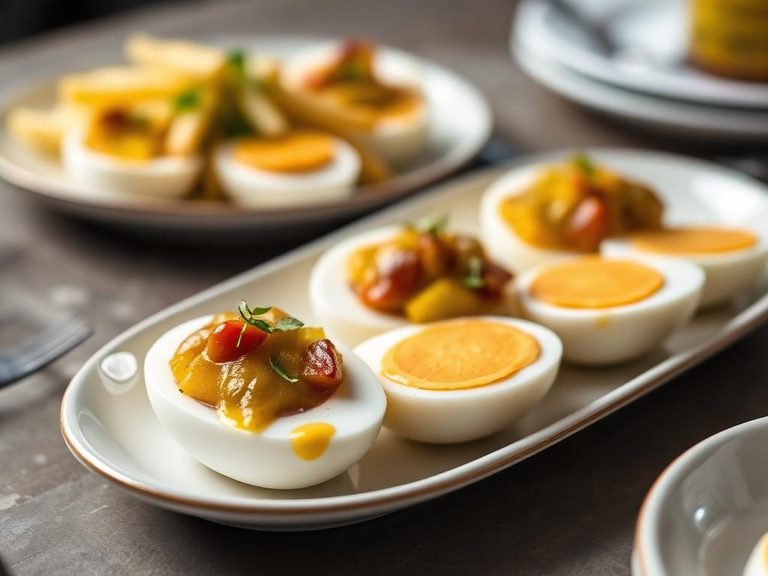
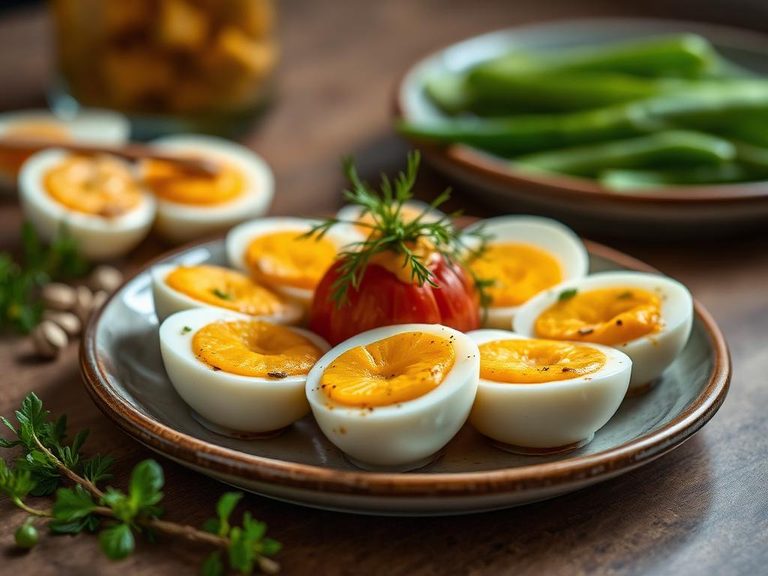

🌍 Where it's eaten
💡 Did you know?
The traditional British method for making pickled eggs often involved using the leftover vinegar from pickled beetroot, which gave the eggs a distinctive pink hue and earthy flavor.
Full nutrition (USDA data · scales with serving)
| Water | 74.1 g |
| Energy | 154 kcal |
| Protein | 12.5 g |
| Total lipid (fat) | 10.5 g |
| Carbohydrate, by difference | 1.1 g |
| Fiber, total dietary | 0.00 g |
| Total Sugars | 1.1 g |
| Calcium, Ca | 50.0 mg |
| Iron, Fe | 1.2 mg |
| Magnesium, Mg | 10.0 mg |
| Phosphorus, P | 171 mg |
| Potassium, K | 125 mg |
| Sodium, Na | 392 mg |
| Zinc, Zn | 1.0 mg |
| Copper, Cu | 0.01 mg |
| Selenium, Se | 30.6 ug |
| Vitamin C, total ascorbic acid | 0.00 mg |
| Thiamin | 0.07 mg |
| Riboflavin | 0.51 mg |
| Niacin | 0.06 mg |
| Vitamin B-6 | 0.12 mg |
| Folate, total | 44.0 ug |
| Folic acid | 0.00 ug |
| Folate, food | 44.0 ug |
| Folate, DFE | 44.0 ug |
| Choline, total | 292 mg |
| Vitamin B-12 | 1.1 ug |
| Vitamin B-12, added | 0.00 ug |
| Vitamin A, RAE | 148 ug |
| Retinol | 147 ug |
| Carotene, beta | 11.0 ug |
| Carotene, alpha | 0.00 ug |
| Cryptoxanthin, beta | 10.0 ug |
| Lycopene | 0.00 ug |
| Lutein + zeaxanthin | 351 ug |
| Vitamin E (alpha-tocopherol) | 1.0 mg |
| Vitamin E, added | 0.00 mg |
| Vitamin D (D2 + D3) | 2.2 ug |
| Vitamin K (phylloquinone) | 0.30 ug |
| Alcohol, ethyl | 0.00 g |
| Caffeine | 0.00 mg |
| Theobromine | 0.00 mg |
Fat & fatty acid profile (per 100g)
| Fatty acids, total saturated | 3.2 g |
| SFA 4:0 | 0.00 g |
| SFA 6:0 | 0.00 g |
| SFA 8:0 | 0.00 g |
| SFA 10:0 | 0.00 g |
| SFA 12:0 | 0.00 g |
| SFA 14:0 | 0.04 g |
| SFA 16:0 | 2.3 g |
| SFA 18:0 | 0.82 g |
| Fatty acids, total monounsaturated | 4.0 g |
| MUFA 16:1 | 0.31 g |
| MUFA 18:1 | 3.7 g |
| MUFA 20:1 | 0.03 g |
| MUFA 22:1 | 0.00 g |
| Fatty acids, total polyunsaturated | 1.4 g |
| PUFA 18:2 | 1.2 g |
| PUFA 18:3 | 0.04 g |
| PUFA 18:4 | 0.00 g |
| PUFA 20:4 | 0.15 g |
| PUFA 20:5 n-3 (EPA) | 0.01 g |
| PUFA 22:5 n-3 (DPA) | 0.00 g |
| PUFA 22:6 n-3 (DHA) | 0.04 g |
| Cholesterol | 370 mg |
Amino acid profile (per 100g)
Estimated from Fish, whitefish, eggs (Alaska Native) — USDA does not publish this profile for Egg.
| Tryptophan | 0.28 g |
| Threonine | 1.0 g |
| Isoleucine | 1.1 g |
| Leucine | 1.6 g |
| Lysine | 1.6 g |
| Methionine | 0.56 g |
| Cystine | 0.23 g |
| Phenylalanine | 0.90 g |
| Tyrosine | 0.76 g |
| Valine | 1.3 g |
| Arginine | 1.1 g |
| Histidine | 0.53 g |
| Alanine | 1.6 g |
| Aspartic acid | 1.6 g |
| Glutamic acid | 2.2 g |
| Glycine | 0.50 g |
| Proline | 1.1 g |
| Serine | 1.2 g |
FAQ
How long do pickled eggs last?
When fully submerged in brine and refrigerated, they can last for 3-4 months. Always use clean utensils to retrieve them.
Can I make them at home safely?
Yes. The key is to use a properly acidic brine (typically a vinegar-to-water ratio that maintains a pH below 4.6) and to refrigerate them. Always follow a tested recipe to prevent botulism risk.
Why are my pickled eggs rubbery?
This often happens if the eggs were overcooked before pickling. For a better texture, aim for a hard-boil with a slightly jammy yolk, or use a lower-temperature cooking method.
Nutrient density (calculated · NRF9.3)
Nutrient Rich Foods index: beneficial nutrients (protein, fiber, vitamins, minerals) minus saturated fat, added sugar & sodium, per 100 kcal.
NRF9.3 index — Fulgoni, Keast & Drewnowski, 2009. Computed from USDA nutrients.
Weight-loss friendliness (composite index)
Energy density 1.54 kcal/g · 32% calories from protein · 0.0 g fiber · 1.1 g sugar per 100 g.
Composite of energy density (Rolls et al., 1999), protein & fiber satiety, minus sugar. A calculated heuristic — ranks satiety-per-calorie, not a clinical measure.
Dietary load (calculated from USDA values)
Potential renal acid load. Positive = acid-forming, negative = alkaline-forming.
Sodium-to-potassium ratio: 3.14 (lower is better — aim for ≤ 1)
Sodium:potassium per WHO potassium guidance. Computed from USDA nutrients.