

Doughnut, custard-filled
Common food
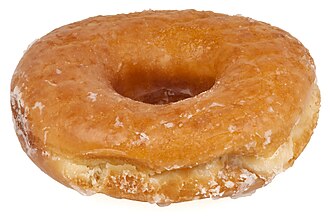
Photo: Wikipedia
A custard-filled doughnut is a golden, yeast-raised or cake-style ring, piped with a smooth, sweet vanilla custard after frying. Its exterior offers a slight crispness, giving way to a soft, airy interior and a cool, creamy center. Nutritionally, it's a high-energy treat, primarily composed of carbohydrates from flour and sugar, with a significant portion of fat from frying and the custard filling.
Calorie split: 6% protein · 47% carbs · 47% fat
↓ Full nutrition💚 Why it's loved
People adore the textural contrast between the warm, slightly crispy dough and the cool, smooth custard, creating a delightful sensory experience. It's a beloved comfort food and a staple in many bakeries, often enjoyed as a special breakfast treat or indulgent snack.
⚠️ Watch-outs & how to enjoy it better
Its high sugar and refined carbohydrate content can lead to rapid blood sugar spikes, and the frying process adds significant saturated fat. Those monitoring blood sugar, calorie intake, or with gluten allergies should be cautious. To counteract, enjoy a smaller portion alongside a source of protein (like Greek yogurt) or healthy fat (like nuts) to slow digestion, or opt for a baked version when available.
Key benefits
- Provides quick energy from simple carbohydrates.
- Contains some protein from wheat flour and egg in the custard.
- Offers a small amount of dietary fiber if made with whole-grain flour.
- Can be a source of calcium and vitamins from milk-based custard.
🍽️ Popular dishes


🌍 Where it's eaten
💡 Did you know?
The modern custard-filled doughnut is believed to have been popularized in the United States by a Polish immigrant, Joe LeBeau, who sold his recipe to a New Orleans café in the early 20th century.
Full nutrition (USDA data · scales with serving)
| Water | 31.9 g |
| Energy | 363 kcal |
| Protein | 5.2 g |
| Total lipid (fat) | 18.9 g |
| Carbohydrate, by difference | 42.9 g |
| Fiber, total dietary | 1.7 g |
| Total Sugars | 21.6 g |
| Calcium, Ca | 91.0 mg |
| Iron, Fe | 1.9 mg |
| Magnesium, Mg | 14.0 mg |
| Phosphorus, P | 102 mg |
| Potassium, K | 95.0 mg |
| Sodium, Na | 287 mg |
| Zinc, Zn | 0.52 mg |
| Copper, Cu | 0.07 mg |
| Selenium, Se | 12.6 ug |
| Vitamin C, total ascorbic acid | 1.0 mg |
| Thiamin | 0.25 mg |
| Riboflavin | 0.16 mg |
| Niacin | 2.1 mg |
| Vitamin B-6 | 0.03 mg |
| Folate, total | 87.0 ug |
| Folic acid | 54.0 ug |
| Folate, food | 32.0 ug |
| Folate, DFE | 124 ug |
| Choline, total | 24.5 mg |
| Vitamin B-12 | 0.12 ug |
| Vitamin B-12, added | 0.00 ug |
| Vitamin A, RAE | 4.0 ug |
| Retinol | 4.0 ug |
| Carotene, beta | 2.0 ug |
| Carotene, alpha | 1.0 ug |
| Cryptoxanthin, beta | 1.0 ug |
| Lycopene | 0.00 ug |
| Lutein + zeaxanthin | 29.0 ug |
| Vitamin E (alpha-tocopherol) | 1.2 mg |
| Vitamin E, added | 0.00 mg |
| Vitamin D (D2 + D3) | 0.10 ug |
| Vitamin K (phylloquinone) | 9.3 ug |
| Alcohol, ethyl | 0.00 g |
| Caffeine | 0.00 mg |
| Theobromine | 0.00 mg |
Fat & fatty acid profile (per 100g)
| Fatty acids, total saturated | 7.8 g |
| SFA 4:0 | 0.00 g |
| SFA 6:0 | 0.00 g |
| SFA 8:0 | 0.01 g |
| SFA 10:0 | 0.01 g |
| SFA 12:0 | 0.09 g |
| SFA 14:0 | 0.16 g |
| SFA 16:0 | 6.0 g |
| SFA 18:0 | 1.4 g |
| Fatty acids, total monounsaturated | 6.3 g |
| MUFA 16:1 | 0.04 g |
| MUFA 18:1 | 6.2 g |
| MUFA 20:1 | 0.04 g |
| MUFA 22:1 | 0.00 g |
| Fatty acids, total polyunsaturated | 2.9 g |
| PUFA 18:2 | 2.7 g |
| PUFA 18:3 | 0.17 g |
| PUFA 18:4 | 0.00 g |
| PUFA 20:4 | 0.00 g |
| PUFA 20:5 n-3 (EPA) | 0.00 g |
| PUFA 22:5 n-3 (DPA) | 0.00 g |
| PUFA 22:6 n-3 (DHA) | 0.01 g |
| Cholesterol | 24.0 mg |
Amino acid profile (per 100g)
Estimated from Doughnuts, yeast-leavened, with creme filling — USDA does not publish this profile for Doughnut.
| Tryptophan | 0.08 g |
| Threonine | 0.21 g |
| Isoleucine | 0.27 g |
| Leucine | 0.48 g |
| Lysine | 0.24 g |
| Methionine | 0.12 g |
| Cystine | 0.13 g |
| Phenylalanine | 0.31 g |
| Tyrosine | 0.20 g |
| Valine | 0.30 g |
| Arginine | 0.27 g |
| Histidine | 0.15 g |
| Alanine | 0.24 g |
| Aspartic acid | 0.38 g |
| Glutamic acid | 1.9 g |
| Glycine | 0.22 g |
| Proline | 0.63 g |
| Serine | 0.33 g |
FAQ
How is the custard filling made?
Traditional pastry cream (crème pâtissière) is made by cooking milk, egg yolks, sugar, and cornstarch until thick, then flavoring it with vanilla. It's cooled completely before being piped into the doughnut.
What's the difference between a Boston Cream Doughnut and a regular custard-filled one?
A Boston Cream is specifically a yeast-raised, chocolate-glazed doughnut filled with vanilla custard. A 'regular' custard-filled doughnut may be cake-style, unglazed, or have a different topping like powdered sugar.
Can you freeze custard-filled doughnuts?
It's not recommended. The custard filling will separate and become watery upon thawing, ruining the texture. They are best enjoyed fresh.
Nutrient density (calculated · NRF9.3)
Nutrient Rich Foods index: beneficial nutrients (protein, fiber, vitamins, minerals) minus saturated fat, added sugar & sodium, per 100 kcal.
NRF9.3 index — Fulgoni, Keast & Drewnowski, 2009. Computed from USDA nutrients.
Weight-loss friendliness (composite index)
Energy density 3.63 kcal/g · 6% calories from protein · 1.7 g fiber · 21.6 g sugar per 100 g.
Composite of energy density (Rolls et al., 1999), protein & fiber satiety, minus sugar. A calculated heuristic — ranks satiety-per-calorie, not a clinical measure.
Dietary load (calculated from USDA values)
Potential renal acid load. Positive = acid-forming, negative = alkaline-forming.
Sodium-to-potassium ratio: 3.02 (lower is better — aim for ≤ 1)
Sodium:potassium per WHO potassium guidance. Computed from USDA nutrients.