

Crackers, wheat
Common food

Photo: Wikipedia
A crisp, dry baked biscuit made primarily from wheat flour, offering a satisfying snap and a toasty, slightly savory flavor. Nutritionally, it's a dense source of carbohydrates, providing quick energy, but its moderate fat content and significant fiber make it more substantial than a simple starch.
Calorie split: 8% protein · 62% carbs · 30% fat
↓ Full nutrition💚 Why it's loved
People adore wheat crackers for their perfect crunch and neutral, toasty flavor that acts as a blank canvas. They are the ultimate pantry staple, beloved for their versatility in everything from a simple cheese plate to a quick snack with dip.
⚠️ Watch-outs & how to enjoy it better
As a refined carbohydrate, they can cause rapid blood sugar spikes if eaten alone, and commercial varieties are often high in sodium. Those with celiac disease or gluten sensitivity must avoid them. To counteract, pair with protein (like cheese or hummus) or healthy fat (like avocado) to slow digestion, and choose low-sodium, whole-grain versions when possible.
Key benefits
- Provides quick, accessible energy from complex carbohydrates.
- Contains dietary fiber (8.6g/100g) to support digestive health.
- Offers a moderate amount of plant-based protein (8.94g/100g).
- Shelf-stable and convenient for on-the-go snacking.
- Versatile base for both sweet and savory toppings.
🍽️ Popular dishes
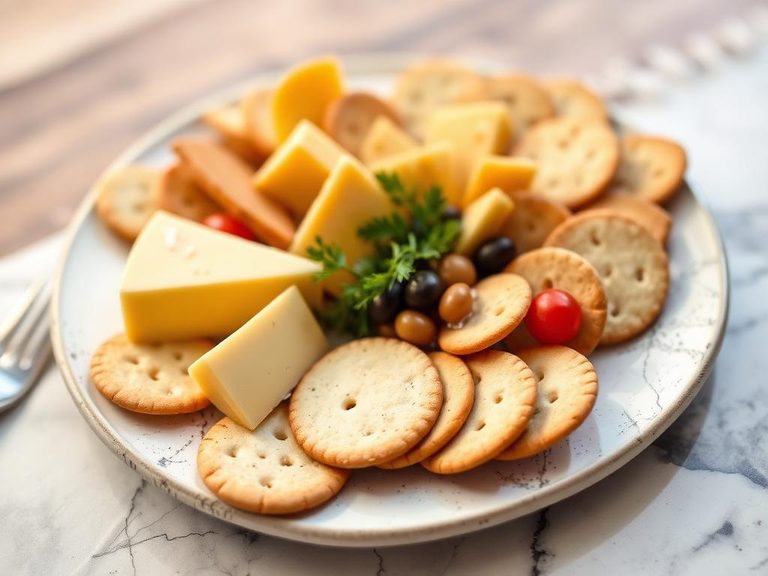
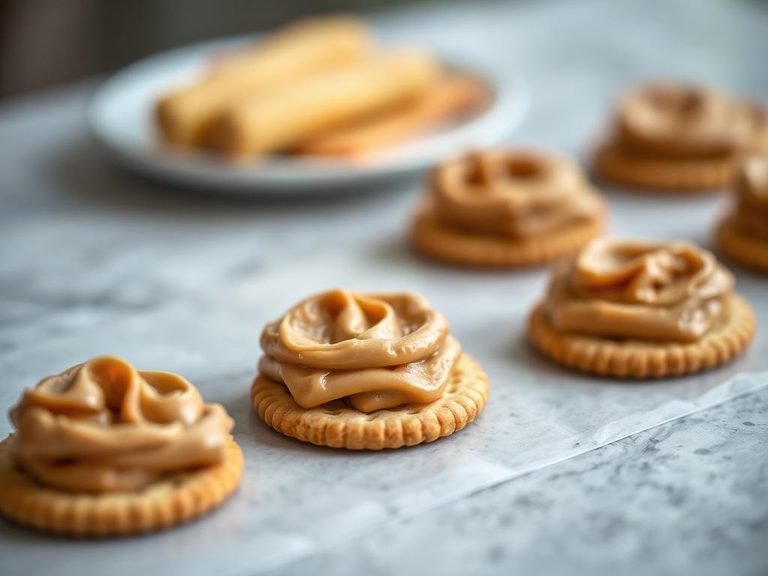
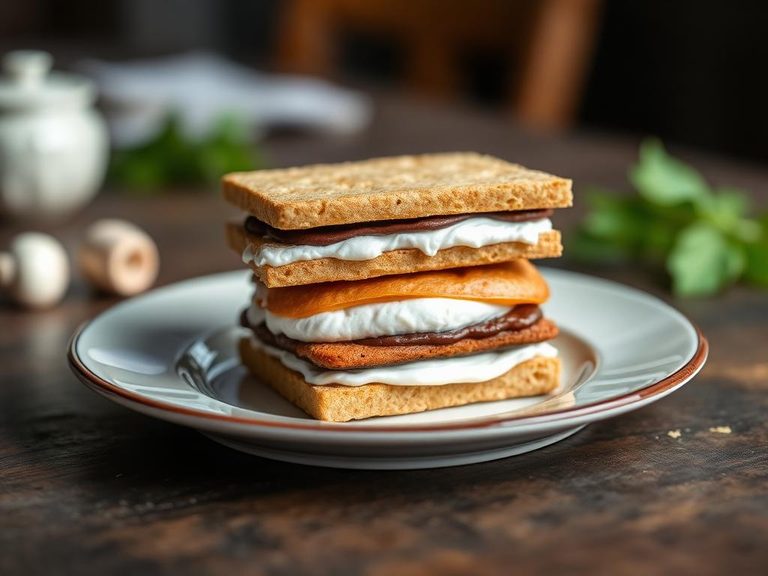
🌍 Where it's eaten
💡 Did you know?
The word 'cracker' may have originated from the sound of the dough cracking during baking or from the 'cracking' noise made when they are eaten.
Full nutrition (USDA data · scales with serving)
| Water | 2.8 g |
| Energy | 441 kcal |
| Protein | 8.9 g |
| Total lipid (fat) | 15.3 g |
| Carbohydrate, by difference | 70.1 g |
| Fiber, total dietary | 8.6 g |
| Total Sugars | 8.3 g |
| Calcium, Ca | 64.0 mg |
| Iron, Fe | 3.0 mg |
| Magnesium, Mg | 91.0 mg |
| Phosphorus, P | 316 mg |
| Potassium, K | 314 mg |
| Sodium, Na | 750 mg |
| Zinc, Zn | 2.1 mg |
| Copper, Cu | 0.35 mg |
| Selenium, Se | 10.0 ug |
| Vitamin C, total ascorbic acid | 0.00 mg |
| Thiamin | 0.23 mg |
| Riboflavin | 0.08 mg |
| Niacin | 4.3 mg |
| Vitamin B-6 | 0.21 mg |
| Folate, total | 33.0 ug |
| Folic acid | 1.0 ug |
| Folate, food | 32.0 ug |
| Folate, DFE | 34.0 ug |
| Choline, total | 27.2 mg |
| Vitamin B-12 | 0.00 ug |
| Vitamin B-12, added | 0.00 ug |
| Vitamin A, RAE | 0.00 ug |
| Retinol | 0.00 ug |
| Carotene, beta | 2.0 ug |
| Carotene, alpha | 0.00 ug |
| Cryptoxanthin, beta | 0.00 ug |
| Lycopene | 0.00 ug |
| Lutein + zeaxanthin | 180 ug |
| Vitamin E (alpha-tocopherol) | 1.5 mg |
| Vitamin E, added | 0.00 mg |
| Vitamin D (D2 + D3) | 0.00 ug |
| Vitamin K (phylloquinone) | 20.7 ug |
| Alcohol, ethyl | 0.00 g |
| Caffeine | 0.00 mg |
| Theobromine | 0.00 mg |
Fat & fatty acid profile (per 100g)
| Fatty acids, total saturated | 2.6 g |
| SFA 4:0 | 0.00 g |
| SFA 6:0 | 0.00 g |
| SFA 8:0 | 0.03 g |
| SFA 10:0 | 0.02 g |
| SFA 12:0 | 0.17 g |
| SFA 14:0 | 0.08 g |
| SFA 16:0 | 1.6 g |
| SFA 18:0 | 0.62 g |
| Fatty acids, total monounsaturated | 3.4 g |
| MUFA 16:1 | 0.01 g |
| MUFA 18:1 | 3.3 g |
| MUFA 20:1 | 0.04 g |
| MUFA 22:1 | 0.00 g |
| Fatty acids, total polyunsaturated | 7.7 g |
| PUFA 18:2 | 6.8 g |
| PUFA 18:3 | 0.92 g |
| PUFA 18:4 | 0.00 g |
| PUFA 20:4 | 0.00 g |
| PUFA 20:5 n-3 (EPA) | 0.00 g |
| PUFA 22:5 n-3 (DPA) | 0.00 g |
| PUFA 22:6 n-3 (DHA) | 0.00 g |
| Cholesterol | 0.00 mg |
Amino acid profile (per 100g)
Estimated from Crackers, cheese, sandwich-type with cheese filling — USDA does not publish this profile for Crackers.
| Tryptophan | 0.11 g |
| Threonine | 0.33 g |
| Isoleucine | 0.36 g |
| Leucine | 0.64 g |
| Lysine | 0.39 g |
| Methionine | 0.15 g |
| Cystine | 0.15 g |
| Phenylalanine | 0.35 g |
| Tyrosine | 0.25 g |
| Valine | 0.38 g |
| Arginine | 0.29 g |
| Histidine | 0.17 g |
| Alanine | 0.30 g |
| Aspartic acid | 0.52 g |
| Glutamic acid | 2.2 g |
| Glycine | 0.24 g |
| Proline | 0.77 g |
| Serine | 0.40 g |
FAQ
What's the difference between wheat crackers and soda crackers?
Soda crackers are a specific type of wheat cracker leavened with baking soda, giving them a lighter, flakier texture. Most 'wheat crackers' are denser and may be leavened with yeast or chemical leaveners.
Are wheat crackers a good source of fiber?
It depends on the brand. At 8.6g per 100g, the provided data indicates a high-fiber cracker, likely made with whole wheat flour. Many commercial varieties are made from refined flour and have much less fiber.
Can I use wheat crackers in place of breadcrumbs?
Absolutely. Crush them finely to use as a coating for baked chicken or fish, or as a topping for mac and cheese, adding a toasty flavor and extra crunch.
Nutrient density (calculated · NRF9.3)
Nutrient Rich Foods index: beneficial nutrients (protein, fiber, vitamins, minerals) minus saturated fat, added sugar & sodium, per 100 kcal.
NRF9.3 index — Fulgoni, Keast & Drewnowski, 2009. Computed from USDA nutrients.
Weight-loss friendliness (composite index)
Energy density 4.41 kcal/g · 8% calories from protein · 8.6 g fiber · 8.3 g sugar per 100 g.
Composite of energy density (Rolls et al., 1999), protein & fiber satiety, minus sugar. A calculated heuristic — ranks satiety-per-calorie, not a clinical measure.
Dietary load (calculated from USDA values)
Potential renal acid load. Positive = acid-forming, negative = alkaline-forming.
Sodium-to-potassium ratio: 2.39 (lower is better — aim for ≤ 1)
Sodium:potassium per WHO potassium guidance. Computed from USDA nutrients.