

Cornbread stuffing
Common food

Photo: Wikipedia
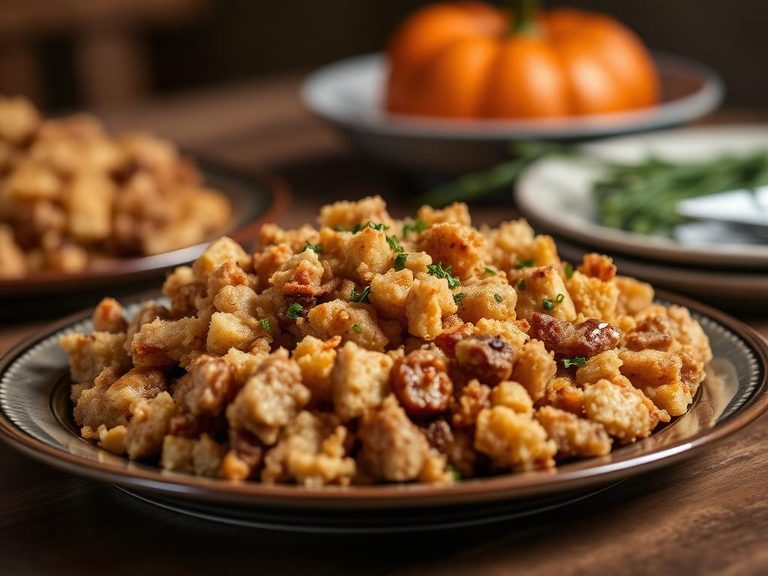
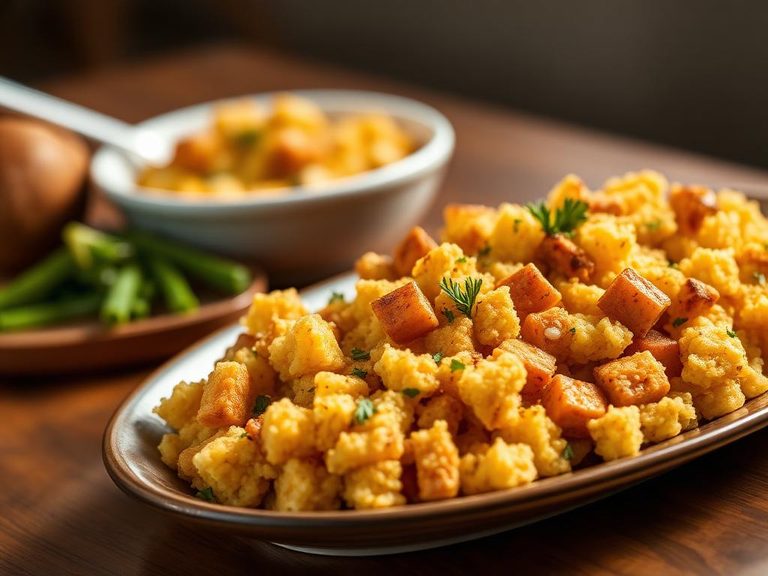
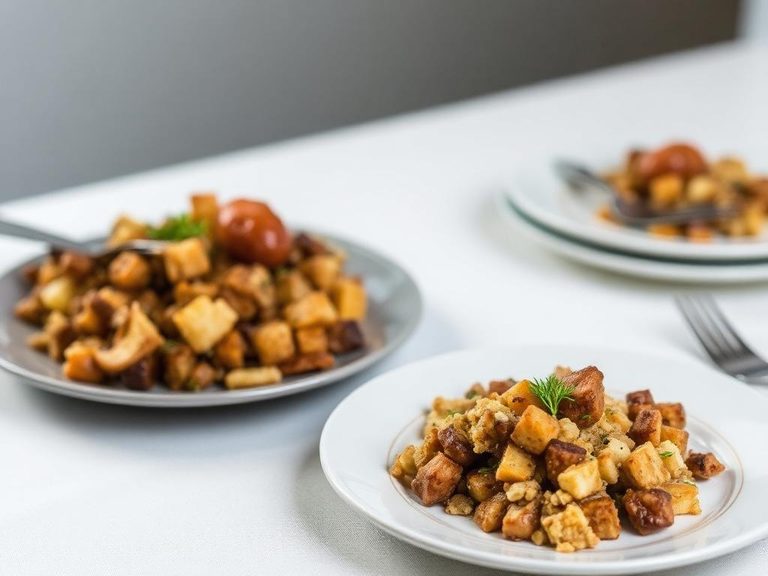
Cornbread stuffing is a savory, baked side dish made from crumbled cornbread mixed with broth, vegetables, and herbs. It has a moist, dense texture with a slightly crumbly bite and a rich, savory flavor profile. Nutritionally, it provides a moderate calorie source with a balance of carbohydrates and fats.
Calorie split: 7% protein · 49% carbs · 44% fat
↓ Full nutrition💚 Why it's loved
People love cornbread stuffing for its comforting, savory flavor and its ability to absorb delicious broths and seasonings. It's a beloved holiday staple, especially in the Southern United States, representing tradition and family gatherings.
⚠️ Watch-outs & how to enjoy it better
Its primary downsides are being relatively high in sodium and refined carbohydrates, which can affect blood sugar. To counteract this, pair it with a lean protein like turkey or chicken and a fiber-rich vegetable side, and practice portion control.
Key benefits
- Good source of dietary fiber
- Provides moderate energy from complex carbs
- Contains some plant-based protein
- Can be made with whole-grain cornmeal
- Versatile base for adding vegetables
🍽️ Popular dishes
🌍 Where it's eaten
💡 Did you know?
The debate over whether to call it 'stuffing' (cooked inside a bird) or 'dressing' (baked in a pan) is a passionate regional divide in the United States, with the term 'dressing' being more common in the South.
Full nutrition (USDA data · scales with serving)
| Water | 64.9 g |
| Energy | 179 kcal |
| Protein | 2.9 g |
| Total lipid (fat) | 8.8 g |
| Carbohydrate, by difference | 21.9 g |
| Fiber, total dietary | 2.9 g |
| Total Sugars | 0.00 g |
| Calcium, Ca | 26.0 mg |
| Iron, Fe | 0.94 mg |
| Magnesium, Mg | 13.0 mg |
| Phosphorus, P | 34.0 mg |
| Potassium, K | 62.0 mg |
| Sodium, Na | 526 mg |
| Zinc, Zn | 0.23 mg |
| Copper, Cu | 0.07 mg |
| Selenium, Se | 30.7 ug |
| Vitamin C, total ascorbic acid | 0.80 mg |
| Thiamin | 0.12 mg |
| Riboflavin | 0.09 mg |
| Niacin | 1.2 mg |
| Vitamin B-6 | 0.04 mg |
| Folate, total | 97.0 ug |
| Folic acid | 89.0 ug |
| Folate, food | 8.0 ug |
| Folate, DFE | 159 ug |
| Choline, total | 24.4 mg |
| Vitamin B-12 | 0.01 ug |
| Vitamin B-12, added | 0.00 ug |
| Vitamin A, RAE | 78.0 ug |
| Retinol | 73.0 ug |
| Carotene, beta | 58.0 ug |
| Carotene, alpha | 0.00 ug |
| Cryptoxanthin, beta | 0.00 ug |
| Lycopene | 0.00 ug |
| Lutein + zeaxanthin | 0.00 ug |
| Vitamin E (alpha-tocopherol) | 0.85 mg |
| Vitamin E, added | 0.00 mg |
| Vitamin D (D2 + D3) | 0.00 ug |
| Vitamin K (phylloquinone) | 8.8 ug |
| Alcohol, ethyl | 0.00 g |
| Caffeine | 0.00 mg |
| Theobromine | 0.00 mg |
Fat & fatty acid profile (per 100g)
| Fatty acids, total saturated | 1.8 g |
| SFA 4:0 | 0.00 g |
| SFA 6:0 | 0.00 g |
| SFA 8:0 | 0.00 g |
| SFA 10:0 | 0.00 g |
| SFA 12:0 | 0.00 g |
| SFA 14:0 | 0.02 g |
| SFA 16:0 | 1.1 g |
| SFA 18:0 | 0.64 g |
| Fatty acids, total monounsaturated | 3.9 g |
| MUFA 16:1 | 0.02 g |
| MUFA 18:1 | 3.8 g |
| MUFA 20:1 | 0.00 g |
| MUFA 22:1 | 0.00 g |
| Fatty acids, total polyunsaturated | 2.7 g |
| PUFA 18:2 | 2.6 g |
| PUFA 18:3 | 0.12 g |
| PUFA 18:4 | 0.00 g |
| PUFA 20:4 | 0.00 g |
| PUFA 20:5 n-3 (EPA) | 0.00 g |
| PUFA 22:5 n-3 (DPA) | 0.00 g |
| PUFA 22:6 n-3 (DHA) | 0.00 g |
| Cholesterol | 0.00 mg |
Amino acid profile (per 100g)
Estimated from Bread, stuffing, cornbread, dry mix — USDA does not publish this profile for Cornbread stuffing.
| Tryptophan | 0.10 g |
| Threonine | 0.32 g |
| Isoleucine | 0.36 g |
| Leucine | 0.87 g |
| Lysine | 0.28 g |
| Methionine | 0.19 g |
| Cystine | 0.20 g |
| Phenylalanine | 0.50 g |
| Tyrosine | 0.34 g |
| Valine | 0.45 g |
| Arginine | 0.44 g |
| Histidine | 0.25 g |
| Alanine | 0.48 g |
| Aspartic acid | 0.55 g |
| Glutamic acid | 2.7 g |
| Glycine | 0.38 g |
| Proline | 1.0 g |
| Serine | 0.49 g |
FAQ
Is cornbread stuffing gluten-free?
Not inherently. While cornmeal is gluten-free, traditional stuffing recipes often include wheat-based bread or flour as a binder, and may use broth containing gluten. Always check specific ingredients.
Can I make it ahead of time?
Yes, it's ideal for make-ahead. Prepare the mixture, refrigerate it unbaked for up to 24 hours, then bake before serving. This also helps the flavors meld.
How is it different from bread stuffing?
The base is crumbled cornbread instead of wheat bread, giving it a distinct, slightly sweet corn flavor and a denser, more crumbly texture compared to lighter, fluffier bread-based stuffings.
Nutrient density (calculated · NRF9.3)
Nutrient Rich Foods index: beneficial nutrients (protein, fiber, vitamins, minerals) minus saturated fat, added sugar & sodium, per 100 kcal.
NRF9.3 index — Fulgoni, Keast & Drewnowski, 2009. Computed from USDA nutrients.
Weight-loss friendliness (composite index)
Energy density 1.79 kcal/g · 6% calories from protein · 2.9 g fiber · 0.0 g sugar per 100 g.
Composite of energy density (Rolls et al., 1999), protein & fiber satiety, minus sugar. A calculated heuristic — ranks satiety-per-calorie, not a clinical measure.
Dietary load (calculated from USDA values)
Potential renal acid load. Positive = acid-forming, negative = alkaline-forming.
Sodium-to-potassium ratio: 8.48 (lower is better — aim for ≤ 1)
Sodium:potassium per WHO potassium guidance. Computed from USDA nutrients.