

Chow mein or chop suey, NS as to type of meat, with noodles
Common food
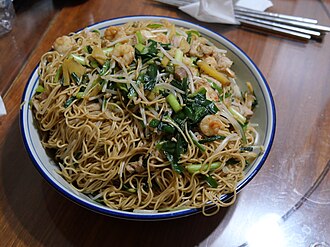
Photo: Wikipedia
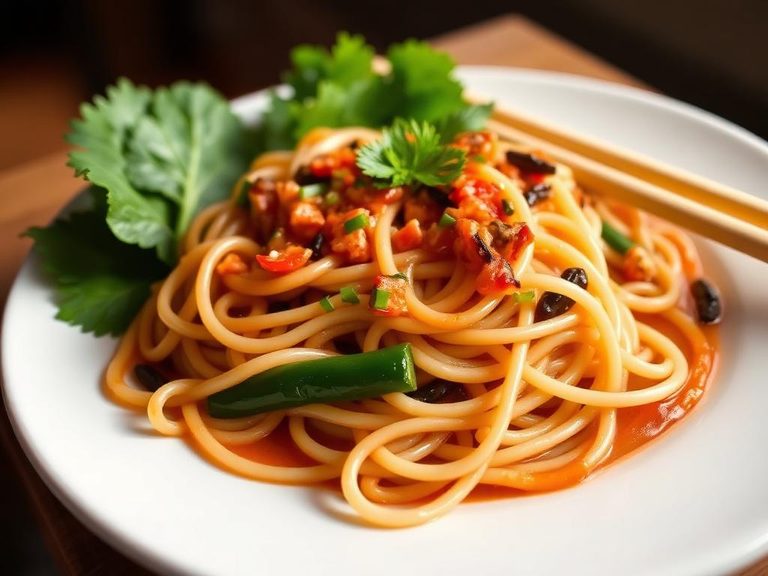
This is the classic, comforting stir-fry of noodles tossed with a savory mix of vegetables and meat, all coated in a glossy, umami-rich sauce. The texture is a delightful contrast of tender-crisp vegetables, soft noodles, and chewy protein. Despite its hearty appearance, it's surprisingly light, packing nearly 10 grams of protein per 100g for under 130 calories.
Calorie split: 30% protein · 34% carbs · 37% fat
↓ Full nutrition💚 Why it's loved
People adore it for its deeply satisfying savory flavor, the perfect blend of textures, and its role as a quick, customizable weeknight staple that feels both comforting and complete.
⚠️ Watch-outs & how to enjoy it better
The sodium content can be high from soy sauce and seasonings, and the refined noodles may cause a blood-sugar spike. To counteract, ask for sauce on the side, load up on extra steamed or fresh vegetables, and consider swapping some noodles for brown rice noodles or adding a side of steamed broccoli to increase fiber.
Key benefits
- Good source of lean protein for muscle maintenance.
- Provides quick energy from carbohydrates.
- Contains dietary fiber from vegetables and noodles.
- Relatively low in fat compared to many takeout dishes.
- Versatile base for adding extra vegetables.
🍽️ Popular dishes


🌍 Where it's eaten
💡 Did you know?
The term 'chop suey' is likely a corruption of the Cantonese 'tsap seui,' meaning 'miscellaneous leftovers,' hinting at its origins as a resourceful dish.
Full nutrition (USDA data · scales with serving)
| Water | 72.3 g |
| Energy | 131 kcal |
| Protein | 9.9 g |
| Total lipid (fat) | 5.4 g |
| Carbohydrate, by difference | 11.2 g |
| Fiber, total dietary | 1.5 g |
| Total Sugars | 1.5 g |
| Calcium, Ca | 19.0 mg |
| Iron, Fe | 1.3 mg |
| Magnesium, Mg | 14.0 mg |
| Phosphorus, P | 99.0 mg |
| Potassium, K | 174 mg |
| Sodium, Na | 408 mg |
| Zinc, Zn | 0.68 mg |
| Copper, Cu | 0.05 mg |
| Selenium, Se | 10.7 ug |
| Vitamin C, total ascorbic acid | 4.2 mg |
| Thiamin | 0.10 mg |
| Riboflavin | 0.16 mg |
| Niacin | 3.1 mg |
| Vitamin B-6 | 0.13 mg |
| Folate, total | 42.0 ug |
| Folic acid | 11.0 ug |
| Folate, food | 30.0 ug |
| Folate, DFE | 49.0 ug |
| Choline, total | 29.7 mg |
| Vitamin B-12 | 0.11 ug |
| Vitamin B-12, added | 0.00 ug |
| Vitamin A, RAE | 10.0 ug |
| Retinol | 2.0 ug |
| Carotene, beta | 87.0 ug |
| Carotene, alpha | 16.0 ug |
| Cryptoxanthin, beta | 0.00 ug |
| Lycopene | 0.00 ug |
| Lutein + zeaxanthin | 106 ug |
| Vitamin E (alpha-tocopherol) | 0.52 mg |
| Vitamin E, added | 0.00 mg |
| Vitamin D (D2 + D3) | 0.00 ug |
| Vitamin K (phylloquinone) | 11.7 ug |
| Alcohol, ethyl | 0.00 g |
| Caffeine | 0.00 mg |
| Theobromine | 0.00 mg |
Fat & fatty acid profile (per 100g)
| Fatty acids, total saturated | 1.5 g |
| SFA 4:0 | 0.00 g |
| SFA 6:0 | 0.00 g |
| SFA 8:0 | 0.00 g |
| SFA 10:0 | 0.00 g |
| SFA 12:0 | 0.47 g |
| SFA 14:0 | 0.17 g |
| SFA 16:0 | 0.57 g |
| SFA 18:0 | 0.16 g |
| Fatty acids, total monounsaturated | 2.1 g |
| MUFA 16:1 | 0.14 g |
| MUFA 18:1 | 2.0 g |
| MUFA 20:1 | 0.01 g |
| MUFA 22:1 | 0.00 g |
| Fatty acids, total polyunsaturated | 1.3 g |
| PUFA 18:2 | 1.1 g |
| PUFA 18:3 | 0.10 g |
| PUFA 18:4 | 0.00 g |
| PUFA 20:4 | 0.01 g |
| PUFA 20:5 n-3 (EPA) | 0.00 g |
| PUFA 22:5 n-3 (DPA) | 0.00 g |
| PUFA 22:6 n-3 (DHA) | 0.00 g |
| Cholesterol | 33.0 mg |
Amino acid profile (per 100g)
Estimated from Restaurant, Chinese, chicken chow mein — USDA does not publish this profile for Chow mein or chop suey.
| Tryptophan | 0.08 g |
| Threonine | 0.27 g |
| Isoleucine | 0.28 g |
| Leucine | 0.50 g |
| Lysine | 0.47 g |
| Methionine | 0.16 g |
| Cystine | 0.08 g |
| Phenylalanine | 0.25 g |
| Tyrosine | 0.22 g |
| Valine | 0.31 g |
| Arginine | 0.42 g |
| Histidine | 0.18 g |
| Alanine | 0.36 g |
| Aspartic acid | 0.60 g |
| Glutamic acid | 1.4 g |
| Glycine | 0.24 g |
| Proline | 0.35 g |
| Serine | 0.25 g |
FAQ
What's the main difference between chow mein and chop suey?
Traditionally, chow mein features crispy or soft-fried noodles as a primary component, while chop suey is a stew-like stir-fry of meat and vegetables served over rice or pre-cooked noodles.
Is this dish gluten-free?
Standard versions are not, as they contain wheat noodles and soy sauce. For a gluten-free option, use rice noodles and tamari or coconut aminos.
How can I make it healthier at home?
Use whole-wheat or brown rice noodles, double the amount of vegetables, choose lean protein like chicken breast or tofu, and use low-sodium soy sauce or broth to control salt.
Nutrient density (calculated · NRF9.3)
Nutrient Rich Foods index: beneficial nutrients (protein, fiber, vitamins, minerals) minus saturated fat, added sugar & sodium, per 100 kcal.
NRF9.3 index — Fulgoni, Keast & Drewnowski, 2009. Computed from USDA nutrients.
Weight-loss friendliness (composite index)
Energy density 1.31 kcal/g · 30% calories from protein · 1.5 g fiber · 1.5 g sugar per 100 g.
Composite of energy density (Rolls et al., 1999), protein & fiber satiety, minus sugar. A calculated heuristic — ranks satiety-per-calorie, not a clinical measure.
Dietary load (calculated from USDA values)
Potential renal acid load. Positive = acid-forming, negative = alkaline-forming.
Sodium-to-potassium ratio: 2.34 (lower is better — aim for ≤ 1)
Sodium:potassium per WHO potassium guidance. Computed from USDA nutrients.