

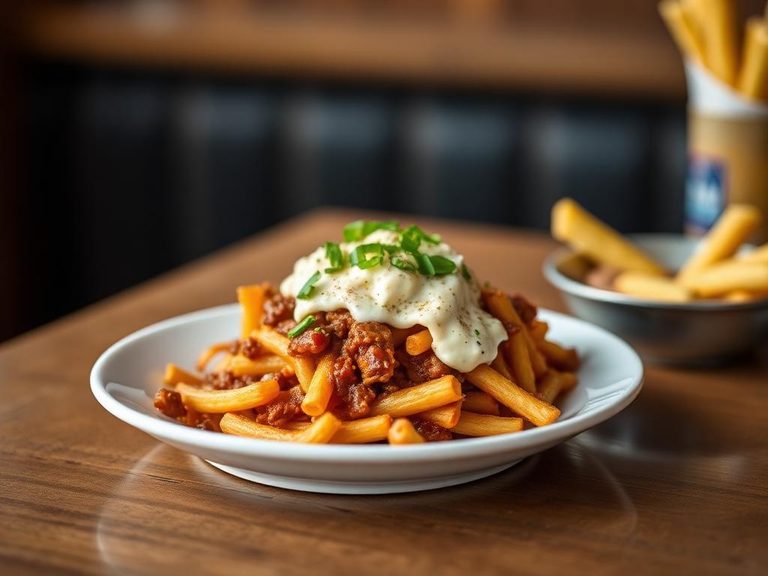
Chili with meat, from restaurant
Common food

Photo: Wikipedia
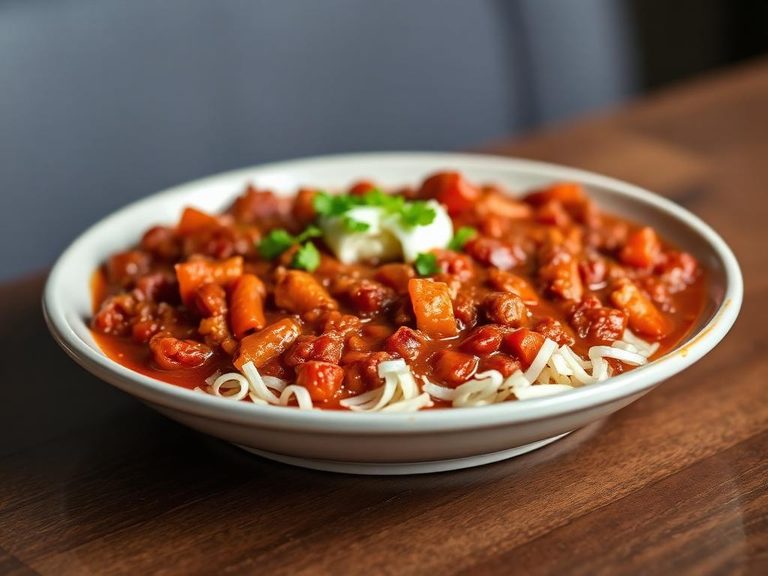
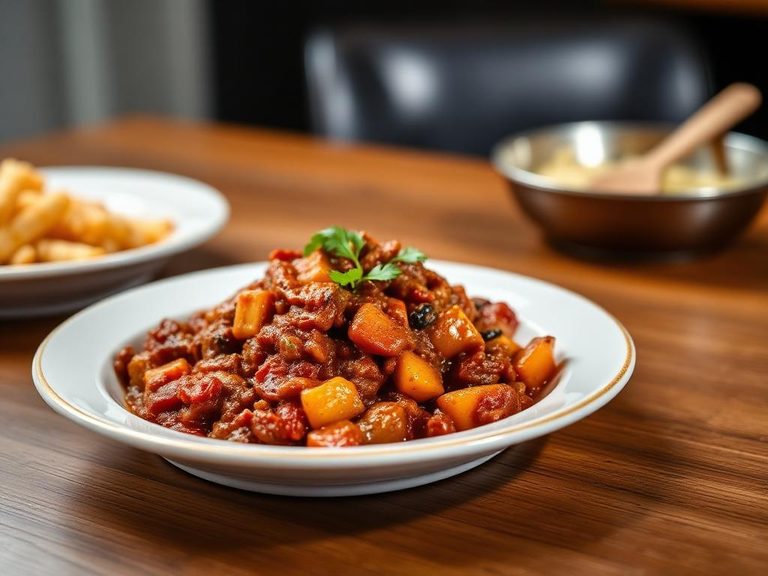
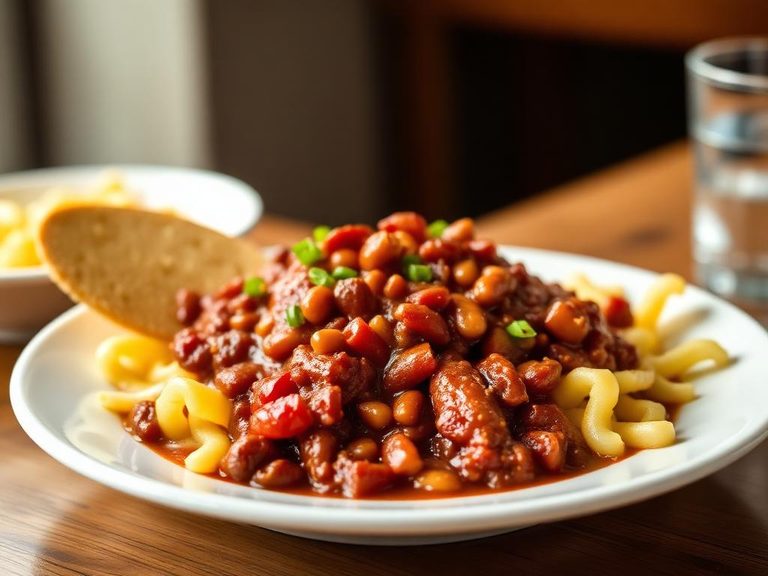
Restaurant chili with meat is a hearty, savory stew where tender ground meat and beans simmer in a rich, spicy tomato-based sauce. It offers a satisfying balance of protein and healthy fats, making it a filling meal with a robust, complex flavor profile.
Calorie split: 30% protein · 17% carbs · 53% fat
↓ Full nutrition💚 Why it's loved
People love it for its deep, comforting warmth and the way the spices meld into a complex, satisfying flavor. It's a versatile crowd-pleaser, perfect for casual gatherings, game days, or a cozy night in.
⚠️ Watch-outs & how to enjoy it better
Restaurant versions can be high in sodium, which may affect blood pressure. The spice level can be intense for some, and common ingredients like beans are legumes, a potential allergen. To mitigate, ask for a smaller portion, request less salt, and pair it with a side of plain rice or a simple salad to balance the flavors and sodium.
Key benefits
- Excellent source of high-quality protein for muscle maintenance.
- Provides healthy fats for sustained energy.
- Contains fiber from beans and tomatoes for digestive health.
- Rich in iron and B vitamins from the meat.
- Capsaicin from chili peppers may support metabolism.
🍽️ Popular dishes

🌍 Where it's eaten
💡 Did you know?
The International Chili Cook-Off, held annually since 1969, has strict rules: no beans or pasta are allowed in the 'Chili' category, defining it purely as a meat-and-spice stew.
Full nutrition (USDA data · scales with serving)
| Water | 70.3 g |
| Energy | 160 kcal |
| Protein | 12.0 g |
| Total lipid (fat) | 9.3 g |
| Carbohydrate, by difference | 6.7 g |
| Fiber, total dietary | 1.9 g |
| Total Sugars | 1.4 g |
| Calcium, Ca | 19.0 mg |
| Iron, Fe | 1.8 mg |
| Magnesium, Mg | 20.0 mg |
| Phosphorus, P | 113 mg |
| Potassium, K | 263 mg |
| Sodium, Na | 413 mg |
| Zinc, Zn | 2.7 mg |
| Copper, Cu | 0.12 mg |
| Selenium, Se | 9.7 ug |
| Vitamin C, total ascorbic acid | 5.9 mg |
| Thiamin | 0.06 mg |
| Riboflavin | 0.10 mg |
| Niacin | 2.4 mg |
| Vitamin B-6 | 0.22 mg |
| Folate, total | 31.0 ug |
| Folic acid | 0.00 ug |
| Folate, food | 31.0 ug |
| Folate, DFE | 31.0 ug |
| Choline, total | 41.2 mg |
| Vitamin B-12 | 0.98 ug |
| Vitamin B-12, added | 0.00 ug |
| Vitamin A, RAE | 12.0 ug |
| Retinol | 1.0 ug |
| Carotene, beta | 111 ug |
| Carotene, alpha | 11.0 ug |
| Cryptoxanthin, beta | 17.0 ug |
| Lycopene | 2072 ug |
| Lutein + zeaxanthin | 18.0 ug |
| Vitamin E (alpha-tocopherol) | 1.0 mg |
| Vitamin E, added | 0.00 mg |
| Vitamin D (D2 + D3) | 0.00 ug |
| Vitamin K (phylloquinone) | 6.3 ug |
| Alcohol, ethyl | 0.00 g |
| Caffeine | 0.00 mg |
| Theobromine | 0.00 mg |
Fat & fatty acid profile (per 100g)
| Fatty acids, total saturated | 2.9 g |
| SFA 4:0 | 0.00 g |
| SFA 6:0 | 0.00 g |
| SFA 8:0 | 0.00 g |
| SFA 10:0 | 0.00 g |
| SFA 12:0 | 0.01 g |
| SFA 14:0 | 0.18 g |
| SFA 16:0 | 1.7 g |
| SFA 18:0 | 0.85 g |
| Fatty acids, total monounsaturated | 4.0 g |
| MUFA 16:1 | 0.24 g |
| MUFA 18:1 | 3.7 g |
| MUFA 20:1 | 0.04 g |
| MUFA 22:1 | 0.00 g |
| Fatty acids, total polyunsaturated | 1.4 g |
| PUFA 18:2 | 1.2 g |
| PUFA 18:3 | 0.19 g |
| PUFA 18:4 | 0.00 g |
| PUFA 20:4 | 0.02 g |
| PUFA 20:5 n-3 (EPA) | 0.00 g |
| PUFA 22:5 n-3 (DPA) | 0.00 g |
| PUFA 22:6 n-3 (DHA) | 0.00 g |
| Cholesterol | 34.0 mg |
Amino acid profile (per 100g)
Estimated from Restaurant, family style, chili with meat and beans — USDA does not publish this profile for Chili with meat.
| Tryptophan | 0.14 g |
| Threonine | 0.40 g |
| Isoleucine | 0.56 g |
| Leucine | 0.93 g |
| Lysine | 0.84 g |
| Methionine | 0.28 g |
| Cystine | 0.12 g |
| Phenylalanine | 0.47 g |
| Tyrosine | 0.34 g |
| Valine | 0.64 g |
| Arginine | 0.77 g |
| Histidine | 0.37 g |
| Alanine | 0.79 g |
| Aspartic acid | 1.2 g |
| Glutamic acid | 2.1 g |
| Glycine | 0.83 g |
| Proline | 0.85 g |
| Serine | 0.37 g |
| Hydroxyproline | 0.24 g |
FAQ
Is restaurant chili with meat a good source of protein?
Yes, it is. With about 12 grams of protein per 100g, a standard 300g serving provides roughly 36 grams, which is a significant portion of the daily recommended intake.
How can I make a restaurant-style chili healthier at home?
Use lean ground meat (like turkey or 90% lean beef), increase the ratio of beans and vegetables, and control the salt by using low-sodium broth and tomato products. You can also add extra fiber with lentils or more beans.
Why is my homemade chili not as flavorful as restaurant chili?
Restaurants often use a longer, slower cooking process to develop deep flavors and may use a wider variety of dried chilies and spices. Toasting your spices in oil before adding liquids and allowing the chili to simmer for hours can significantly boost the flavor.
Nutrient density (calculated · NRF9.3)
Nutrient Rich Foods index: beneficial nutrients (protein, fiber, vitamins, minerals) minus saturated fat, added sugar & sodium, per 100 kcal.
NRF9.3 index — Fulgoni, Keast & Drewnowski, 2009. Computed from USDA nutrients.
Weight-loss friendliness (composite index)
Energy density 1.60 kcal/g · 30% calories from protein · 1.9 g fiber · 1.4 g sugar per 100 g.
Composite of energy density (Rolls et al., 1999), protein & fiber satiety, minus sugar. A calculated heuristic — ranks satiety-per-calorie, not a clinical measure.
Dietary load (calculated from USDA values)
Potential renal acid load. Positive = acid-forming, negative = alkaline-forming.
Sodium-to-potassium ratio: 1.57 (lower is better — aim for ≤ 1)
Sodium:potassium per WHO potassium guidance. Computed from USDA nutrients.