

Cereal, other, honey
Common food

Photo: Wikipedia
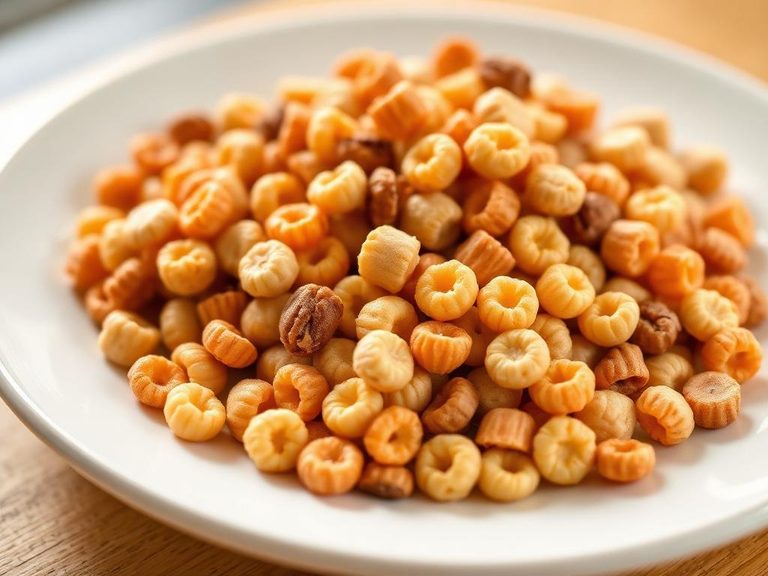
Honey cereal is a lightly sweetened, crunchy breakfast staple where golden honey is often baked into or drizzled over oat or wheat-based flakes and clusters. It offers a satisfying, toasty crunch with a mild, floral sweetness that isn't overpowering. Nutritionally, it's a high-carb energy source with a moderate amount of sugar per serving.
Calorie split: 8% protein · 78% carbs · 13% fat
↓ Full nutrition💚 Why it's loved
People love it for the comforting, nostalgic combination of crispy cereal and the gentle, familiar sweetness of honey. It's incredibly versatile, pairing well with cold milk, yogurt, or even as a crunchy topping for smoothie bowls.
⚠️ Watch-outs & how to enjoy it better
The high carbohydrate and sugar content can lead to a rapid blood-sugar spike and subsequent crash, making it a poor choice for sustained energy. To counteract this, pair it with a source of protein and fat like Greek yogurt or a handful of nuts, and practice portion control by measuring out a single serving.
Key benefits
- Provides quick energy from carbohydrates
- Often fortified with essential vitamins and minerals
- Contains some dietary fiber for digestive health
- Offers a convenient, no-cook breakfast option
- The honey flavor can be a more natural-tasting sweetener
🍽️ Popular dishes

🌍 Where it's eaten
💡 Did you know?
The specific process of 'honey-coating' cereal often involves spraying the flakes with a honey solution and then toasting them again, which helps the sweetness adhere and intensifies the toasty flavor.
Full nutrition (USDA data · scales with serving)
| Water | 7.7 g |
| Energy | 388 kcal |
| Protein | 8.0 g |
| Total lipid (fat) | 5.7 g |
| Carbohydrate, by difference | 76.1 g |
| Fiber, total dietary | 6.1 g |
| Total Sugars | 26.5 g |
| Calcium, Ca | 184 mg |
| Iron, Fe | 20.0 mg |
| Magnesium, Mg | 66.0 mg |
| Phosphorus, P | 199 mg |
| Potassium, K | 190 mg |
| Sodium, Na | 504 mg |
| Zinc, Zn | 1.7 mg |
| Copper, Cu | 0.20 mg |
| Selenium, Se | 16.1 ug |
| Vitamin C, total ascorbic acid | 11.4 mg |
| Thiamin | 0.92 mg |
| Riboflavin | 0.80 mg |
| Niacin | 9.8 mg |
| Vitamin B-6 | 1.0 mg |
| Folate, total | 374 ug |
| Folic acid | 353 ug |
| Folate, food | 21.0 ug |
| Folate, DFE | 622 ug |
| Choline, total | 19.1 mg |
| Vitamin B-12 | 1.3 ug |
| Vitamin B-12, added | 1.3 ug |
| Vitamin A, RAE | 2.0 ug |
| Retinol | 0.00 ug |
| Carotene, beta | 17.0 ug |
| Carotene, alpha | 11.0 ug |
| Cryptoxanthin, beta | 0.00 ug |
| Lycopene | 0.00 ug |
| Lutein + zeaxanthin | 359 ug |
| Vitamin E (alpha-tocopherol) | 0.63 mg |
| Vitamin E, added | 0.00 mg |
| Vitamin D (D2 + D3) | 5.0 ug |
| Vitamin K (phylloquinone) | 2.6 ug |
| Alcohol, ethyl | 0.00 g |
| Caffeine | 0.00 mg |
| Theobromine | 0.00 mg |
Fat & fatty acid profile (per 100g)
| Fatty acids, total saturated | 0.67 g |
| SFA 4:0 | 0.00 g |
| SFA 6:0 | 0.00 g |
| SFA 8:0 | 0.00 g |
| SFA 10:0 | 0.00 g |
| SFA 12:0 | 0.01 g |
| SFA 14:0 | 0.01 g |
| SFA 16:0 | 0.52 g |
| SFA 18:0 | 0.07 g |
| Fatty acids, total monounsaturated | 2.4 g |
| MUFA 16:1 | 0.01 g |
| MUFA 18:1 | 2.4 g |
| MUFA 20:1 | 0.05 g |
| MUFA 22:1 | 0.00 g |
| Fatty acids, total polyunsaturated | 1.8 g |
| PUFA 18:2 | 1.5 g |
| PUFA 18:3 | 0.23 g |
| PUFA 18:4 | 0.00 g |
| PUFA 20:4 | 0.00 g |
| PUFA 20:5 n-3 (EPA) | 0.00 g |
| PUFA 22:5 n-3 (DPA) | 0.00 g |
| PUFA 22:6 n-3 (DHA) | 0.00 g |
| Cholesterol | 0.00 mg |
Amino acid profile (per 100g)
Estimated from Cereals ready-to-eat, POST, HONEY BUNCHES OF OATS, honey roasted — USDA does not publish this profile for Cereal.
| Tryptophan | 0.09 g |
| Threonine | 0.24 g |
| Isoleucine | 0.26 g |
| Leucine | 0.80 g |
| Lysine | 0.12 g |
| Methionine | 0.10 g |
| Cystine | 0.11 g |
| Phenylalanine | 0.39 g |
| Tyrosine | 0.21 g |
| Valine | 0.34 g |
| Arginine | 0.24 g |
| Histidine | 0.18 g |
| Alanine | 0.46 g |
| Aspartic acid | 0.48 g |
| Glutamic acid | 1.9 g |
| Glycine | 0.27 g |
| Proline | 0.49 g |
| Serine | 0.38 g |
FAQ
Is honey cereal healthier than sugary kids' cereals?
Often, but not always. While honey can be a more 'natural' sweetener, many honey cereals have a similar total sugar content to other sweetened varieties. Always check the nutrition label for sugar grams per serving.
Can I eat this on a low-carb diet?
Generally, no. With over 76g of carbohydrates per 100g, it is a high-carb food and would not fit into a standard low-carb or ketogenic diet.
What's the best way to make it less sugary?
Mix it with a plain, unsweetened cereal like bran flakes or shredded wheat to dilute the sweetness. You can also top it with fresh fruit for natural sweetness and added nutrients.
Nutrient density (calculated · NRF9.3)
Nutrient Rich Foods index: beneficial nutrients (protein, fiber, vitamins, minerals) minus saturated fat, added sugar & sodium, per 100 kcal.
NRF9.3 index — Fulgoni, Keast & Drewnowski, 2009. Computed from USDA nutrients.
Weight-loss friendliness (composite index)
Energy density 3.88 kcal/g · 8% calories from protein · 6.1 g fiber · 26.5 g sugar per 100 g.
Composite of energy density (Rolls et al., 1999), protein & fiber satiety, minus sugar. A calculated heuristic — ranks satiety-per-calorie, not a clinical measure.
Dietary load (calculated from USDA values)
Potential renal acid load. Positive = acid-forming, negative = alkaline-forming.
Sodium-to-potassium ratio: 2.65 (lower is better — aim for ≤ 1)
Sodium:potassium per WHO potassium guidance. Computed from USDA nutrients.