

Candy, fruit flavored pieces
Common food
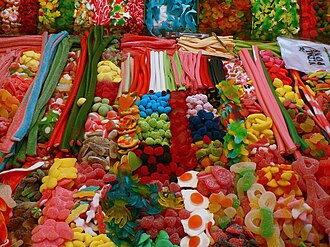
Photo: Wikipedia
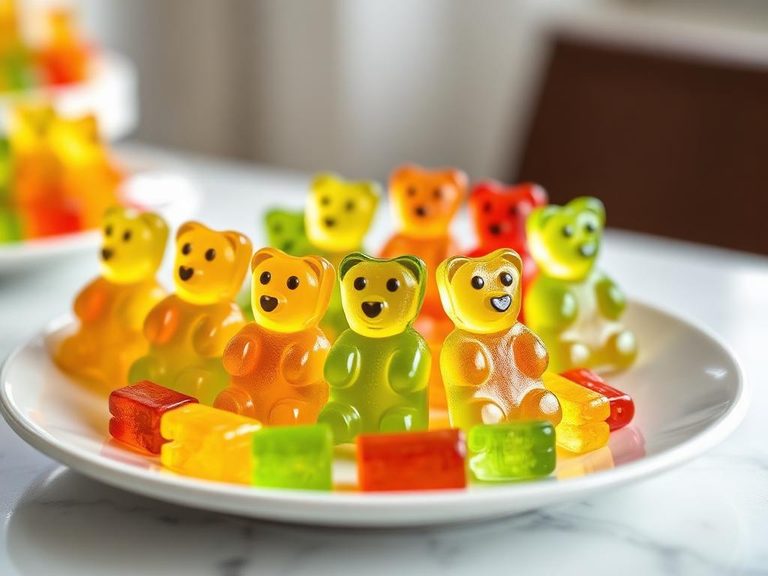
These are small, chewy, fruit-flavored confections, often shaped like little bears, worms, or other playful forms, with a vibrant, sweet taste and a satisfyingly dense, gummy texture. Nutritionally, they are a near-pure source of quick energy from carbohydrates, specifically sugar, with virtually no protein, fat, or fiber.
Calorie split: 0% protein · 95% carbs · 5% fat
↓ Full nutrition💚 Why it's loved
People love them for their playful, intense fruit flavors and satisfyingly chewy texture, which makes them a nostalgic and fun treat. Their versatility is key—they're enjoyed straight from the bag, used to decorate cakes, or even as a colorful topping for yogurt and ice cream.
⚠️ Watch-outs & how to enjoy it better
Due to their very high sugar content and lack of fiber, they can cause rapid blood-sugar spikes and provide little satiety, making them a poor choice for those managing diabetes or seeking sustained energy. To enjoy them more responsibly, pair a small portion with a source of protein or healthy fat (like nuts or cheese) to slow sugar absorption, and practice strict portion control by taking a few pieces rather than eating from the bag.
Key benefits
- Provides a rapid source of energy
- Offers a consistent and intense sweet flavor
- Shelf-stable and convenient for on-the-go snacking
- Often used as a fun, colorful baking or decoration ingredient
🍽️ Popular dishes
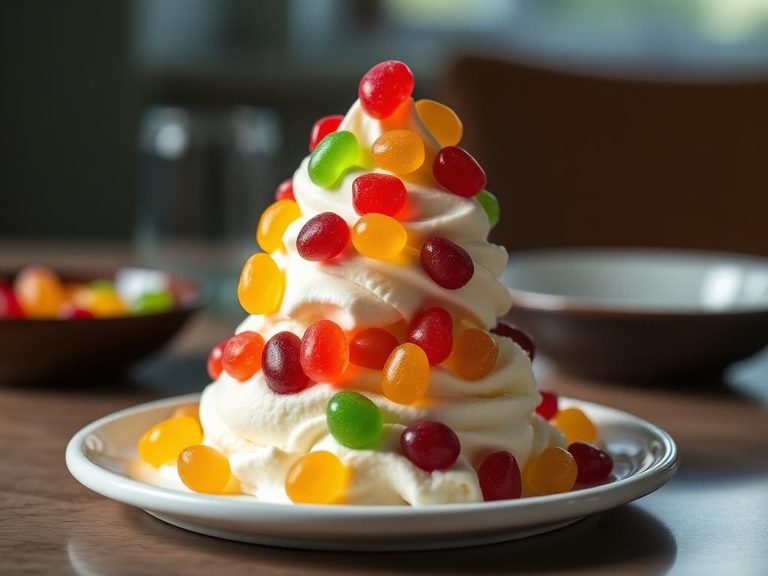
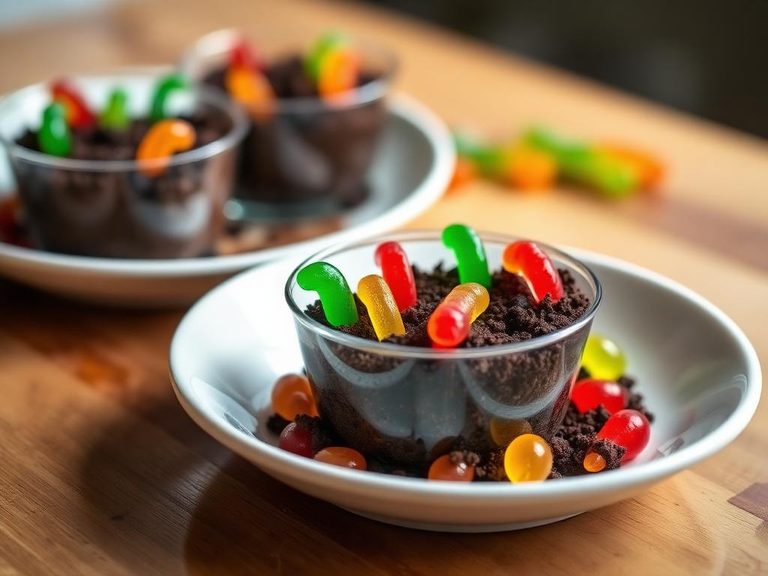
🌍 Where it's eaten
💡 Did you know?
The original gummy bear was created in Germany in the 1920s by Hans Riegel, who named his company 'Haribo' from an abbreviation of his name and his home city, Bonn.
Full nutrition (USDA data · scales with serving)
| Water | 2.6 g |
| Energy | 400 kcal |
| Protein | 0.10 g |
| Total lipid (fat) | 2.3 g |
| Carbohydrate, by difference | 94.4 g |
| Fiber, total dietary | 0.00 g |
| Total Sugars | 69.4 g |
| Calcium, Ca | 2.0 mg |
| Iron, Fe | 0.15 mg |
| Magnesium, Mg | 2.0 mg |
| Phosphorus, P | 2.0 mg |
| Potassium, K | 8.0 mg |
| Sodium, Na | 26.0 mg |
| Zinc, Zn | 0.02 mg |
| Copper, Cu | 0.03 mg |
| Selenium, Se | 0.80 ug |
| Vitamin C, total ascorbic acid | 0.00 mg |
| Thiamin | 0.00 mg |
| Riboflavin | 0.01 mg |
| Niacin | 0.01 mg |
| Vitamin B-6 | 0.00 mg |
| Folate, total | 0.00 ug |
| Folic acid | 0.00 ug |
| Folate, food | 0.00 ug |
| Folate, DFE | 0.00 ug |
| Choline, total | 0.00 mg |
| Vitamin B-12 | 0.00 ug |
| Vitamin B-12, added | 0.00 ug |
| Vitamin A, RAE | 0.00 ug |
| Retinol | 0.00 ug |
| Carotene, beta | 0.00 ug |
| Carotene, alpha | 0.00 ug |
| Cryptoxanthin, beta | 0.00 ug |
| Lycopene | 0.00 ug |
| Lutein + zeaxanthin | 0.00 ug |
| Vitamin E (alpha-tocopherol) | 0.08 mg |
| Vitamin E, added | 0.00 mg |
| Vitamin D (D2 + D3) | 0.00 ug |
| Vitamin K (phylloquinone) | 0.60 ug |
| Alcohol, ethyl | 0.00 g |
| Caffeine | 0.00 mg |
| Theobromine | 0.00 mg |
Fat & fatty acid profile (per 100g)
| Fatty acids, total saturated | 2.1 g |
| SFA 4:0 | 0.00 g |
| SFA 6:0 | 0.01 g |
| SFA 8:0 | 0.07 g |
| SFA 10:0 | 0.07 g |
| SFA 12:0 | 1.1 g |
| SFA 14:0 | 0.36 g |
| SFA 16:0 | 0.17 g |
| SFA 18:0 | 0.30 g |
| Fatty acids, total monounsaturated | 0.00 g |
| MUFA 16:1 | 0.00 g |
| MUFA 18:1 | 0.00 g |
| MUFA 20:1 | 0.00 g |
| MUFA 22:1 | 0.00 g |
| Fatty acids, total polyunsaturated | 0.00 g |
| PUFA 18:2 | 0.00 g |
| PUFA 18:3 | 0.00 g |
| PUFA 18:4 | 0.00 g |
| PUFA 20:4 | 0.00 g |
| PUFA 20:5 n-3 (EPA) | 0.00 g |
| PUFA 22:5 n-3 (DPA) | 0.00 g |
| PUFA 22:6 n-3 (DHA) | 0.00 g |
| Cholesterol | 0.00 mg |
Amino acid profile (per 100g)
Estimated from Oil, industrial, coconut, principal uses candy coatings, oil sprays, roasting nuts — USDA does not publish this profile for Candy.
| Tryptophan | 0.00 g |
| Threonine | 0.00 g |
| Isoleucine | 0.00 g |
| Leucine | 0.00 g |
| Lysine | 0.00 g |
| Methionine | 0.00 g |
| Cystine | 0.00 g |
| Phenylalanine | 0.00 g |
| Tyrosine | 0.00 g |
| Valine | 0.00 g |
| Arginine | 0.00 g |
| Histidine | 0.00 g |
| Alanine | 0.00 g |
| Aspartic acid | 0.00 g |
| Glutamic acid | 0.00 g |
| Glycine | 0.00 g |
| Proline | 0.00 g |
| Serine | 0.00 g |
FAQ
Are fruit-flavored gummy candies made with real fruit juice?
Typically, no. Most commercial varieties use fruit flavorings and colorings, with little to no actual fruit juice. The primary ingredients are usually corn syrup, sugar, gelatin, and citric acid.
Why are some gummy candies sour?
The sour coating is often a mixture of sugar and food-grade acids, like citric acid, malic acid, or tartaric acid, which create that tangy, puckering sensation.
Are there vegan versions of gummy bears?
Yes, traditional gummy candies use gelatin (an animal product), but many brands now offer vegan alternatives using plant-based gelling agents like pectin, agar, or carrageenan.
Nutrient density (calculated · NRF9.3)
Nutrient Rich Foods index: beneficial nutrients (protein, fiber, vitamins, minerals) minus saturated fat, added sugar & sodium, per 100 kcal.
NRF9.3 index — Fulgoni, Keast & Drewnowski, 2009. Computed from USDA nutrients.
Weight-loss friendliness (composite index)
Energy density 4.00 kcal/g · 0% calories from protein · 0.0 g fiber · 69.4 g sugar per 100 g.
Composite of energy density (Rolls et al., 1999), protein & fiber satiety, minus sugar. A calculated heuristic — ranks satiety-per-calorie, not a clinical measure.
Dietary load (calculated from USDA values)
Potential renal acid load. Positive = acid-forming, negative = alkaline-forming.
Sodium-to-potassium ratio: 3.25 (lower is better — aim for ≤ 1)
Sodium:potassium per WHO potassium guidance. Computed from USDA nutrients.