

Snacks, fruit leather, pieces, with vitamin C
Whole food · Snacks

Photo: Wikipedia
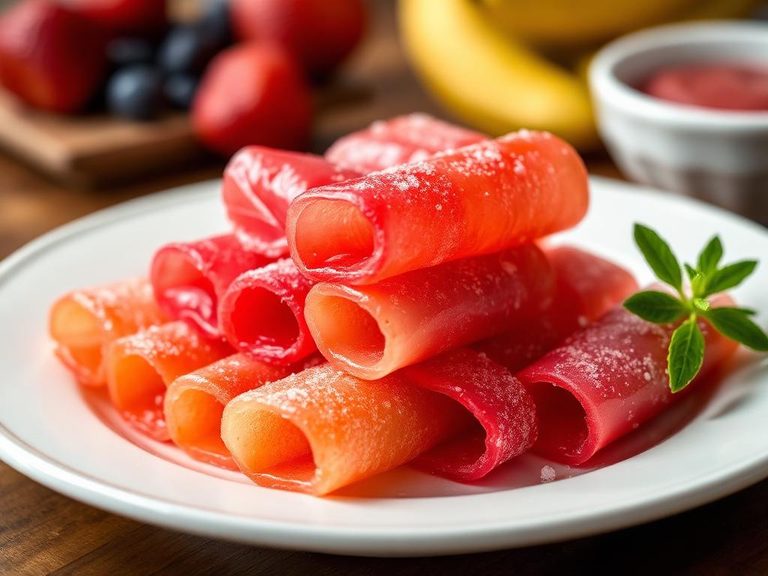
Fruit leather pieces are a chewy, concentrated snack made from pureed and dried fruit, offering a sweet-tart burst of flavor in a portable, shelf-stable form. With a smooth yet pliable texture, they deliver a satisfying chew without the stickiness of a full roll. Notably, this version is fortified with Vitamin C, adding a nutritional boost to its naturally high carbohydrate energy.
Calorie split: 0% protein · 91% carbs · 8% fat
↓ Full nutrition💚 Why it's loved
People love fruit leather for its intensely concentrated fruit flavor and satisfying, taffy-like chew that feels like a treat. Its versatility shines as a lunchbox staple, hiking fuel, or a quick natural sweet fix that connects to a long tradition of preserving fruit.
⚠️ Watch-outs & how to enjoy it better
Despite no added sugar, its high carbohydrate density (85g per 100g) can lead to rapid blood-sugar spikes if eaten in large amounts alone. To counteract this, pair a portion with a source of protein or fat (like nuts or yogurt) to slow absorption, and practice mindful portion control.
Key benefits
- Provides a quick, energy-dense source of carbohydrates.
- Fortified with Vitamin C to support immune function.
- Offers dietary fiber for digestive health.
- Shelf-stable and portable for on-the-go snacking.
- Typically made with no added sugar, relying on fruit's natural sweetness.
🍽️ Popular dishes
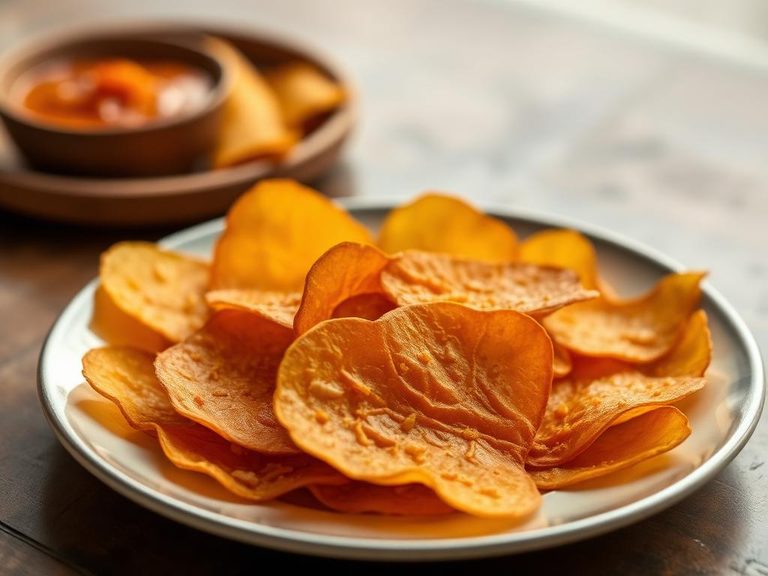
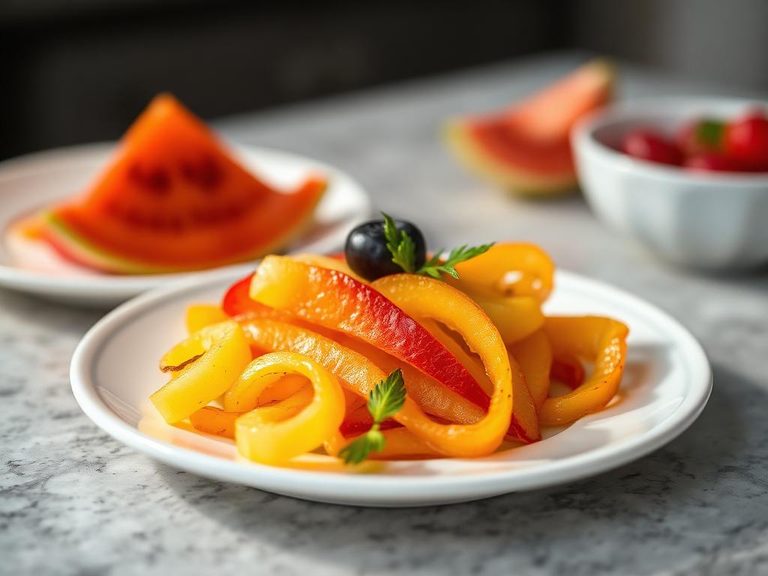
🌍 Where it's eaten
💡 Did you know?
The process of making fruit leather is essentially a form of dehydration that concentrates the fruit's natural sugars and flavors, a preservation technique with roots in ancient times, long before commercial snack brands existed.
Full nutrition (USDA data · scales with serving)
| Water | 10.2 g |
| Energy | 373 kcal |
| Energy | 1561 kj |
| Protein | 0.10 g |
| Total lipid (fat) | 3.5 g |
| Ash | 1.0 g |
| Carbohydrate, by difference | 85.2 g |
| Fiber, total dietary | 3.5 g |
| Calcium, Ca | 18.0 mg |
| Iron, Fe | 0.75 mg |
| Magnesium, Mg | 14.0 mg |
| Phosphorus, P | 24.0 mg |
| Potassium, K | 164 mg |
| Sodium, Na | 317 mg |
| Zinc, Zn | 0.19 mg |
| Copper, Cu | 0.17 mg |
| Selenium, Se | 3.2 ug |
| Vitamin C, total ascorbic acid | 120 mg |
| Thiamin | 0.04 mg |
| Riboflavin | 0.10 mg |
| Niacin | 0.10 mg |
| Vitamin B-6 | 0.30 mg |
| Folate, total | 14.0 ug |
| Folate, food | 14.0 ug |
| Vitamin B-12 | 0.00 ug |
| Vitamin A, IU | 116 iu |
| Alcohol, ethyl | 0.00 g |
Fat & fatty acid profile (per 100g)
| Fatty acids, total saturated | 0.99 g |
| SFA 4:0 | 0.00 g |
| SFA 6:0 | 0.00 g |
| SFA 8:0 | 0.00 g |
| SFA 10:0 | 0.00 g |
| SFA 12:0 | 0.01 g |
| SFA 14:0 | 0.02 g |
| SFA 16:0 | 0.61 g |
| SFA 18:0 | 0.33 g |
| Fatty acids, total monounsaturated | 1.7 g |
| MUFA 16:1 | 0.01 g |
| MUFA 18:1 | 1.7 g |
| MUFA 20:1 | 0.01 g |
| MUFA 22:1 | 0.00 g |
| Fatty acids, total polyunsaturated | 0.09 g |
| PUFA 18:2 | 0.08 g |
| PUFA 18:3 | 0.01 g |
| PUFA 18:4 | 0.00 g |
| PUFA 20:4 | 0.00 g |
| PUFA 20:5 n-3 (EPA) | 0.00 g |
| PUFA 22:5 n-3 (DPA) | 0.00 g |
| PUFA 22:6 n-3 (DHA) | 0.00 g |
| Cholesterol | 0.00 mg |
Amino acid profile (per 100g)
Estimated from Snacks, corn-based, extruded, chips, plain — USDA does not publish this profile for Snacks.
| Tryptophan | 0.05 g |
| Threonine | 0.25 g |
| Isoleucine | 0.23 g |
| Leucine | 0.80 g |
| Lysine | 0.18 g |
| Methionine | 0.14 g |
| Cystine | 0.12 g |
| Phenylalanine | 0.32 g |
| Tyrosine | 0.27 g |
| Valine | 0.33 g |
| Arginine | 0.33 g |
| Histidine | 0.20 g |
| Alanine | 0.49 g |
| Aspartic acid | 0.46 g |
| Glutamic acid | 1.2 g |
| Glycine | 0.27 g |
| Proline | 0.57 g |
| Serine | 0.31 g |
FAQ
Is fruit leather the same as dried fruit?
Not exactly. Fruit leather starts as a cooked fruit puree that is spread thin and dried, resulting in a smooth, chewy texture. Dried fruit (like raisins or apple chips) is typically dehydrated whole or in slices, retaining more of the original fruit's structure.
Why is there 0g of sugar listed if it's made from fruit?
This likely refers to 'added sugars.' The carbohydrates come from the fruit's natural sugars (fructose), which are not classified as 'added sugars' on nutrition labels in many regions. The total carbohydrate count includes these natural sugars.
Can I make this at home?
Yes! Blend fresh or frozen fruit into a smooth puree, optionally add a splash of lemon juice, spread thinly on a parchment-lined baking sheet, and bake at a very low temperature (around 170°F/75°C) for several hours until it's no longer sticky to the touch.
Nutrient density (calculated · NRF9.3)
Nutrient Rich Foods index: beneficial nutrients (protein, fiber, vitamins, minerals) minus saturated fat, added sugar & sodium, per 100 kcal.
NRF9.3 index — Fulgoni, Keast & Drewnowski, 2009. Computed from USDA nutrients.
Weight-loss friendliness (composite index)
Energy density 3.73 kcal/g · 0% calories from protein · 3.5 g fiber · 0.0 g sugar per 100 g.
Composite of energy density (Rolls et al., 1999), protein & fiber satiety, minus sugar. A calculated heuristic — ranks satiety-per-calorie, not a clinical measure.
Dietary load (calculated from USDA values)
Potential renal acid load. Positive = acid-forming, negative = alkaline-forming.
Sodium-to-potassium ratio: 1.93 (lower is better — aim for ≤ 1)
Sodium:potassium per WHO potassium guidance. Computed from USDA nutrients.