

Cake, pineapple, upside down
Common food

Photo: Wikipedia
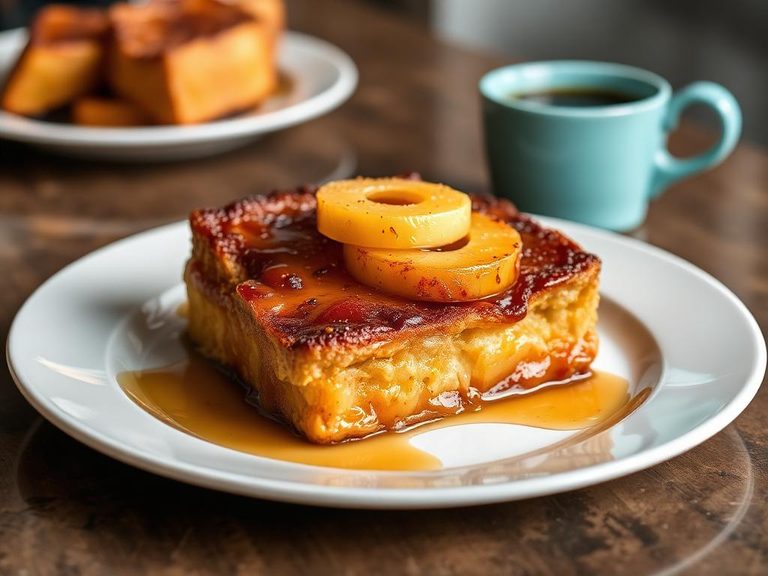
Pineapple upside-down cake is a classic American dessert featuring a caramelized pineapple and cherry topping baked into a moist, buttery yellow cake. The texture is a delightful contrast between the sticky, sweet fruit layer and the tender, spongy cake beneath. Nutritionally, it is a high-energy treat, providing quick carbohydrates from sugar and fat, with minimal protein or fiber.
Calorie split: 3% protein · 57% carbs · 40% fat
↓ Full nutrition💚 Why it's loved
People love it for its signature sweet-tart pineapple flavor, the satisfyingly gooey caramelized topping, and its deep roots in mid-20th century American home baking, evoking a sense of comfort and nostalgia.
⚠️ Watch-outs & how to enjoy it better
It is high in added sugars and refined carbs, which can cause blood-sugar spikes, and the butter and oil contribute significant saturated fat. To mitigate this, practice strict portion control, pair a small slice with a protein source like Greek yogurt, and consider using whole-grain flour to slightly increase fiber content.
Key benefits
- Provides quick energy from carbohydrates
- Contains small amounts of manganese and vitamin C from pineapple
- Offers a comforting, nostalgic flavor experience
- Simple to prepare with common pantry ingredients
🍽️ Popular dishes
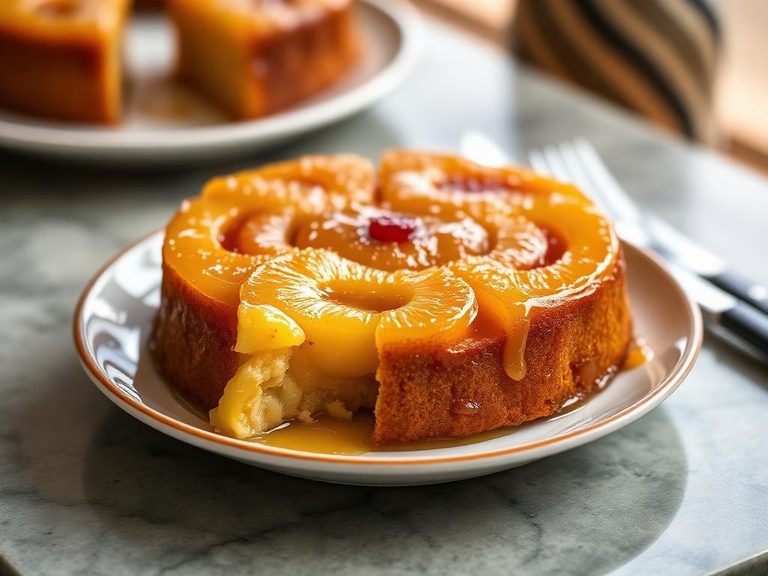
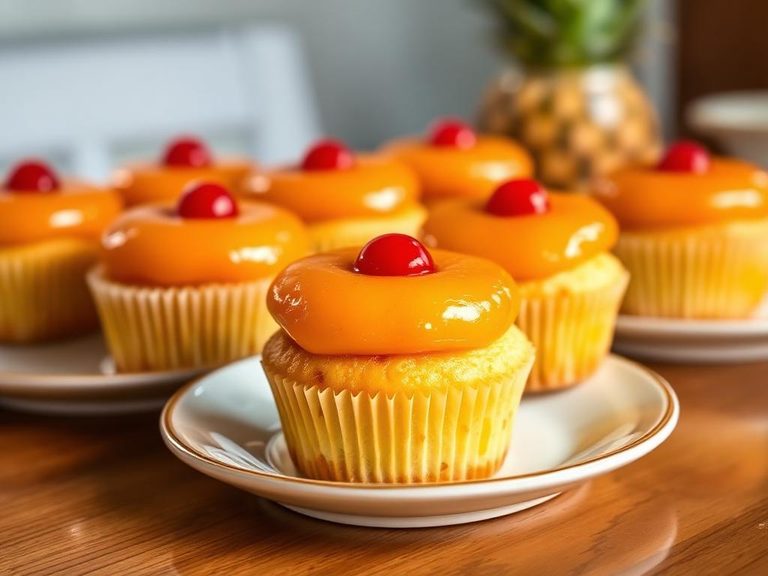
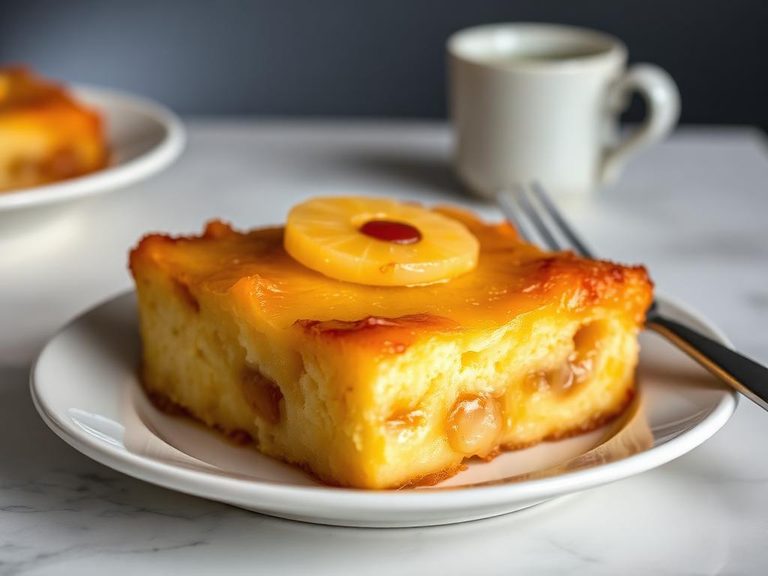
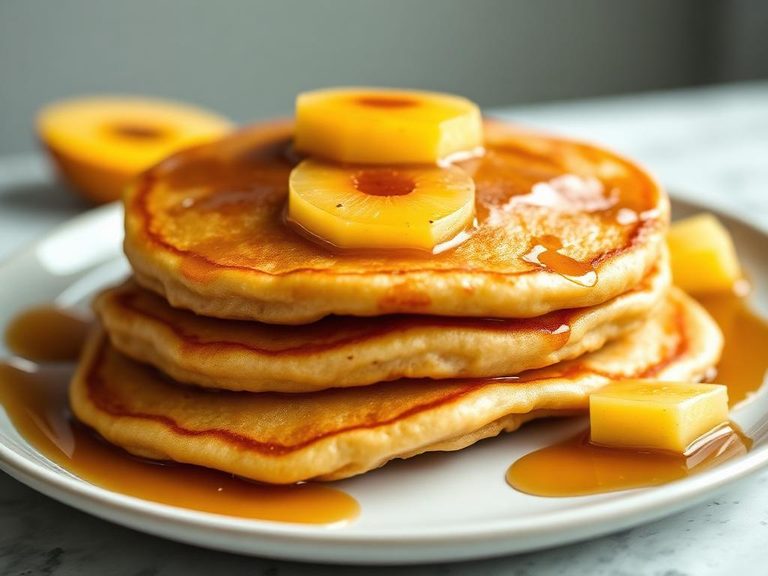
🌍 Where it's eaten
💡 Did you know?
The cake's iconic 'upside-down' method was popularized in the 1920s with the invention of the cast-iron skillet, which allowed the fruit to caramelize perfectly before the batter was added and the whole thing flipped.
Full nutrition (USDA data · scales with serving)
| Water | 45.0 g |
| Energy | 273 kcal |
| Protein | 2.4 g |
| Total lipid (fat) | 12.2 g |
| Carbohydrate, by difference | 39.1 g |
| Fiber, total dietary | 0.70 g |
| Total Sugars | 28.2 g |
| Calcium, Ca | 80.0 mg |
| Iron, Fe | 0.94 mg |
| Magnesium, Mg | 10.0 mg |
| Phosphorus, P | 104 mg |
| Potassium, K | 74.0 mg |
| Sodium, Na | 214 mg |
| Zinc, Zn | 0.24 mg |
| Copper, Cu | 0.06 mg |
| Selenium, Se | 4.0 ug |
| Vitamin C, total ascorbic acid | 1.5 mg |
| Thiamin | 0.07 mg |
| Riboflavin | 0.10 mg |
| Niacin | 0.64 mg |
| Vitamin B-6 | 0.05 mg |
| Folate, total | 19.0 ug |
| Folic acid | 11.0 ug |
| Folate, food | 8.0 ug |
| Folate, DFE | 27.0 ug |
| Choline, total | 29.6 mg |
| Vitamin B-12 | 0.10 ug |
| Vitamin B-12, added | 0.00 ug |
| Vitamin A, RAE | 71.0 ug |
| Retinol | 69.0 ug |
| Carotene, beta | 18.0 ug |
| Carotene, alpha | 0.00 ug |
| Cryptoxanthin, beta | 2.0 ug |
| Lycopene | 0.00 ug |
| Lutein + zeaxanthin | 51.0 ug |
| Vitamin E (alpha-tocopherol) | 1.2 mg |
| Vitamin E, added | 0.00 mg |
| Vitamin D (D2 + D3) | 0.30 ug |
| Vitamin K (phylloquinone) | 6.0 ug |
| Alcohol, ethyl | 0.00 g |
| Caffeine | 0.00 mg |
| Theobromine | 0.00 mg |
Fat & fatty acid profile (per 100g)
| Fatty acids, total saturated | 4.5 g |
| SFA 4:0 | 0.14 g |
| SFA 6:0 | 0.10 g |
| SFA 8:0 | 0.06 g |
| SFA 10:0 | 0.13 g |
| SFA 12:0 | 0.15 g |
| SFA 14:0 | 0.51 g |
| SFA 16:0 | 2.5 g |
| SFA 18:0 | 0.81 g |
| Fatty acids, total monounsaturated | 3.6 g |
| MUFA 16:1 | 0.11 g |
| MUFA 18:1 | 3.4 g |
| MUFA 20:1 | 0.04 g |
| MUFA 22:1 | 0.00 g |
| Fatty acids, total polyunsaturated | 2.1 g |
| PUFA 18:2 | 1.9 g |
| PUFA 18:3 | 0.23 g |
| PUFA 18:4 | 0.00 g |
| PUFA 20:4 | 0.01 g |
| PUFA 20:5 n-3 (EPA) | 0.00 g |
| PUFA 22:5 n-3 (DPA) | 0.00 g |
| PUFA 22:6 n-3 (DHA) | 0.00 g |
| Cholesterol | 56.0 mg |
Amino acid profile (per 100g)
Estimated from Bread, pound cake type, pan de torta salvadoran — USDA does not publish this profile for Cake.
| Tryptophan | 0.09 g |
| Threonine | 0.16 g |
| Isoleucine | 0.24 g |
| Leucine | 0.54 g |
| Lysine | 0.15 g |
| Methionine | 0.18 g |
| Cystine | 0.06 g |
| Phenylalanine | 0.35 g |
| Tyrosine | 0.17 g |
| Valine | 0.33 g |
| Arginine | 0.18 g |
| Histidine | 0.10 g |
| Alanine | 0.29 g |
| Aspartic acid | 0.39 g |
| Glutamic acid | 2.2 g |
| Glycine | 0.23 g |
| Proline | 1.1 g |
| Serine | 0.38 g |
| Hydroxyproline | 0.00 g |
FAQ
Why is it called upside-down cake?
It's baked with the fruit and sugar topping at the bottom of the pan, then inverted onto a plate after baking so the caramelized fruit is on top.
Can I use canned pineapple instead of fresh?
Yes, canned pineapple rings or chunks are traditional and convenient, but be sure to drain them well to prevent excess moisture in the cake.
How do I prevent the cake from sticking to the pan?
Ensure the butter and sugar topping is fully melted and bubbling before adding the batter, and let the cake cool in the pan for only 5-10 minutes before inverting it onto a serving plate.
Nutrient density (calculated · NRF9.3)
Nutrient Rich Foods index: beneficial nutrients (protein, fiber, vitamins, minerals) minus saturated fat, added sugar & sodium, per 100 kcal.
NRF9.3 index — Fulgoni, Keast & Drewnowski, 2009. Computed from USDA nutrients.
Weight-loss friendliness (composite index)
Energy density 2.73 kcal/g · 3% calories from protein · 0.7 g fiber · 28.2 g sugar per 100 g.
Composite of energy density (Rolls et al., 1999), protein & fiber satiety, minus sugar. A calculated heuristic — ranks satiety-per-calorie, not a clinical measure.
Dietary load (calculated from USDA values)
Potential renal acid load. Positive = acid-forming, negative = alkaline-forming.
Sodium-to-potassium ratio: 2.89 (lower is better — aim for ≤ 1)
Sodium:potassium per WHO potassium guidance. Computed from USDA nutrients.