

Bread, oatmeal, toasted
Common food
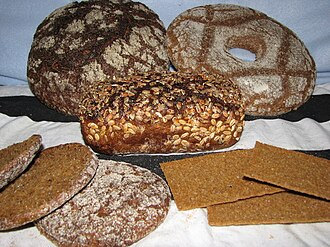
Photo: Wikipedia
Toasted oatmeal bread is a hearty, whole-grain loaf where rolled oats are baked directly into the dough, creating a pleasantly chewy texture with a nutty, slightly sweet flavor. The toasting process deepens its malty notes and adds a satisfying crispness to the crust. Nutritionally, it's a solid source of complex carbohydrates and dietary fiber, offering more sustained energy than many refined white breads.
Calorie split: 13% protein · 73% carbs · 15% fat
↓ Full nutrition💚 Why it's loved
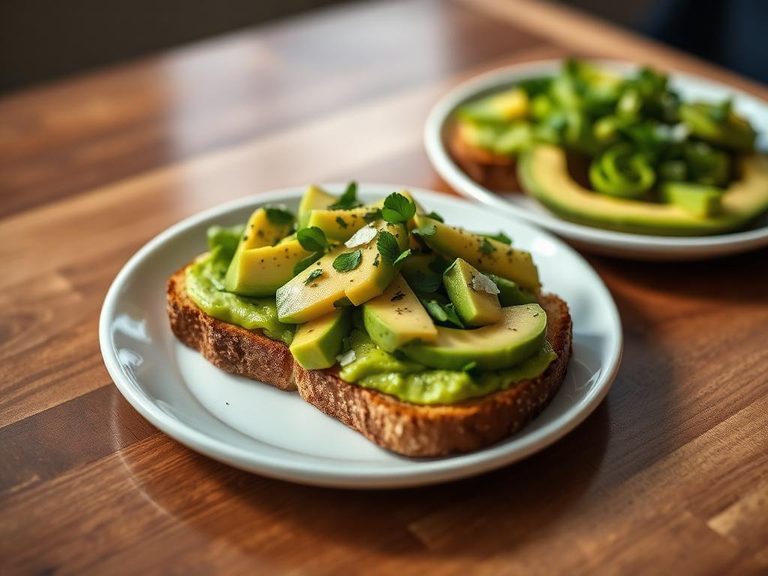
People love it for its robust, wholesome flavor that pairs beautifully with both sweet and savory toppings. Its sturdy texture holds up well to toasting and doesn't get soggy, making it a reliable base for everything from avocado to jam.
⚠️ Watch-outs & how to enjoy it better
As a carbohydrate-dense food, it can cause blood-sugar spikes if eaten alone, especially by those with insulin sensitivity. It also contains gluten (from wheat flour) and is a common allergen. To counteract this, always pair a slice with a protein (like eggs or nut butter) or healthy fat (like avocado or cheese) to slow digestion and stabilize blood sugar.
Key benefits
- Good source of dietary fiber for digestive health.
- Provides complex carbohydrates for steady energy.
- Contains plant-based protein from oats.
- Offers more micronutrients than refined white bread.
- The beta-glucan fiber in oats may support heart health.
🍽️ Popular dishes


🌍 Where it's eaten
💡 Did you know?
The beta-glucan soluble fiber in oats, which is preserved in this bread, forms a viscous gel in the digestive tract that can bind to cholesterol-rich bile acids, helping to remove them from the body.
Full nutrition (USDA data · scales with serving)
| Water | 30.4 g |
| Energy | 296 kcal |
| Protein | 9.2 g |
| Total lipid (fat) | 4.8 g |
| Carbohydrate, by difference | 53.3 g |
| Fiber, total dietary | 4.4 g |
| Total Sugars | 8.9 g |
| Calcium, Ca | 73.0 mg |
| Iron, Fe | 3.0 mg |
| Magnesium, Mg | 41.0 mg |
| Phosphorus, P | 138 mg |
| Potassium, K | 156 mg |
| Sodium, Na | 491 mg |
| Zinc, Zn | 1.1 mg |
| Copper, Cu | 0.23 mg |
| Selenium, Se | 27.0 ug |
| Vitamin C, total ascorbic acid | 0.00 mg |
| Thiamin | 0.35 mg |
| Riboflavin | 0.26 mg |
| Niacin | 3.4 mg |
| Vitamin B-6 | 0.07 mg |
| Folate, total | 58.0 ug |
| Folic acid | 33.0 ug |
| Folate, food | 25.0 ug |
| Folate, DFE | 81.0 ug |
| Choline, total | 20.5 mg |
| Vitamin B-12 | 0.03 ug |
| Vitamin B-12, added | 0.00 ug |
| Vitamin A, RAE | 5.0 ug |
| Retinol | 5.0 ug |
| Carotene, beta | 0.00 ug |
| Carotene, alpha | 0.00 ug |
| Cryptoxanthin, beta | 0.00 ug |
| Lycopene | 0.00 ug |
| Lutein + zeaxanthin | 75.0 ug |
| Vitamin E (alpha-tocopherol) | 0.53 mg |
| Vitamin E, added | 0.00 mg |
| Vitamin D (D2 + D3) | 0.00 ug |
| Vitamin K (phylloquinone) | 1.6 ug |
| Alcohol, ethyl | 0.00 g |
| Caffeine | 0.00 mg |
| Theobromine | 0.00 mg |
Fat & fatty acid profile (per 100g)
| Fatty acids, total saturated | 0.77 g |
| SFA 4:0 | 0.00 g |
| SFA 6:0 | 0.00 g |
| SFA 8:0 | 0.00 g |
| SFA 10:0 | 0.00 g |
| SFA 12:0 | 0.01 g |
| SFA 14:0 | 0.01 g |
| SFA 16:0 | 0.58 g |
| SFA 18:0 | 0.16 g |
| Fatty acids, total monounsaturated | 1.7 g |
| MUFA 16:1 | 0.03 g |
| MUFA 18:1 | 1.7 g |
| MUFA 20:1 | 0.00 g |
| MUFA 22:1 | 0.00 g |
| Fatty acids, total polyunsaturated | 1.9 g |
| PUFA 18:2 | 1.8 g |
| PUFA 18:3 | 0.11 g |
| PUFA 18:4 | 0.00 g |
| PUFA 20:4 | 0.00 g |
| PUFA 20:5 n-3 (EPA) | 0.00 g |
| PUFA 22:5 n-3 (DPA) | 0.00 g |
| PUFA 22:6 n-3 (DHA) | 0.00 g |
| Cholesterol | 0.00 mg |
Amino acid profile (per 100g)
Estimated from Bread, salvadoran sweet cheese (quesadilla salvadorena) — USDA does not publish this profile for Bread.
| Tryptophan | 0.07 g |
| Threonine | 0.21 g |
| Isoleucine | 0.30 g |
| Leucine | 0.65 g |
| Lysine | 0.50 g |
| Methionine | 0.28 g |
| Cystine | 0.06 g |
| Phenylalanine | 0.37 g |
| Tyrosine | 0.23 g |
| Valine | 0.43 g |
| Arginine | 0.25 g |
| Histidine | 0.15 g |
| Alanine | 0.36 g |
| Aspartic acid | 0.59 g |
| Glutamic acid | 1.3 g |
| Glycine | 0.20 g |
| Proline | 0.83 g |
| Serine | 0.45 g |
| Hydroxyproline | 0.00 g |
FAQ
Is toasted oatmeal bread healthier than regular white bread?
Generally, yes. It typically has more fiber, protein, and nutrients like iron and B vitamins because it uses whole oats and often whole wheat flour, whereas white bread is made from refined flour with the bran and germ removed.
Does toasting the bread change its nutrition?
Toasting primarily affects texture and flavor, creating a Maillard reaction that adds browning and complexity. It doesn't significantly alter the core macronutrient profile, though it may slightly reduce moisture content.
Can I use this bread for sandwiches?
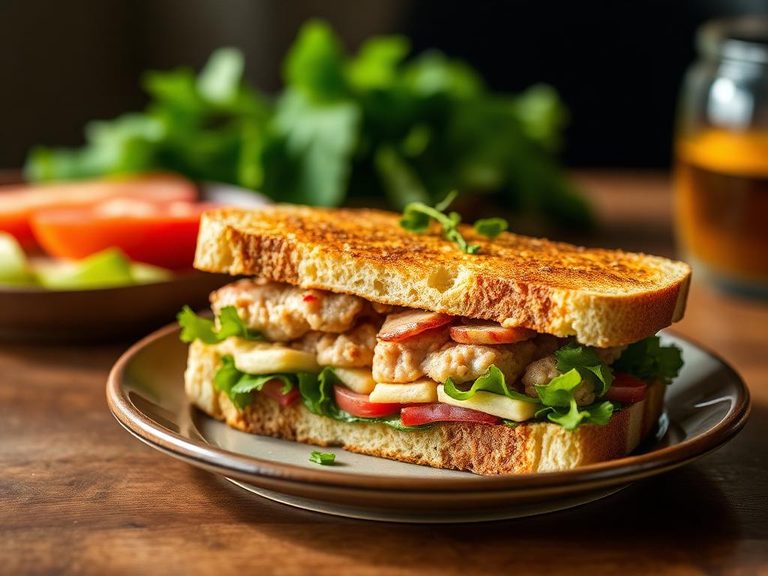
Absolutely. Its sturdy, chewy texture makes it excellent for sandwiches, especially those with moist fillings like tuna salad or sliced tomatoes, as it resists sogginess better than softer breads.
Nutrient density (calculated · NRF9.3)
Nutrient Rich Foods index: beneficial nutrients (protein, fiber, vitamins, minerals) minus saturated fat, added sugar & sodium, per 100 kcal.
NRF9.3 index — Fulgoni, Keast & Drewnowski, 2009. Computed from USDA nutrients.
Weight-loss friendliness (composite index)
Energy density 2.96 kcal/g · 12% calories from protein · 4.4 g fiber · 8.9 g sugar per 100 g.
Composite of energy density (Rolls et al., 1999), protein & fiber satiety, minus sugar. A calculated heuristic — ranks satiety-per-calorie, not a clinical measure.
Dietary load (calculated from USDA values)
Potential renal acid load. Positive = acid-forming, negative = alkaline-forming.
Sodium-to-potassium ratio: 3.15 (lower is better — aim for ≤ 1)
Sodium:potassium per WHO potassium guidance. Computed from USDA nutrients.