

Bagel, wheat, with raisins
Common food

Photo: Wikipedia
A hearty, chewy whole-wheat bagel studded with sweet, plump raisins. Its dense, satisfying texture pairs perfectly with the bursts of fruity sweetness from the raisins. It offers a notable protein boost and substantial fiber compared to plain white bagels.
Calorie split: 15% protein · 80% carbs · 5% fat
↓ Full nutrition💚 Why it's loved
People love it for the comforting, nostalgic flavor combination of warm, malty wheat and sweet raisins. It's a versatile breakfast or snack base, perfect toasted with cream cheese or butter.
⚠️ Watch-outs & how to enjoy it better
The high carbohydrate content (51.93g per 100g) and added sugar (12.03g) can cause blood-sugar spikes if eaten alone. To counteract this, pair it with a protein or fat source like cream cheese, nut butter, or eggs to slow digestion. Those watching sodium should check labels, as bagels can be surprisingly high in salt.
Key benefits
- Good source of plant-based protein (9.51g per 100g).
- High in dietary fiber (4.1g per 100g) for digestive health.
- Provides complex carbohydrates for sustained energy.
- Whole wheat content offers more micronutrients than refined flour.
- Raisins add natural sweetness and iron.
🍽️ Popular dishes

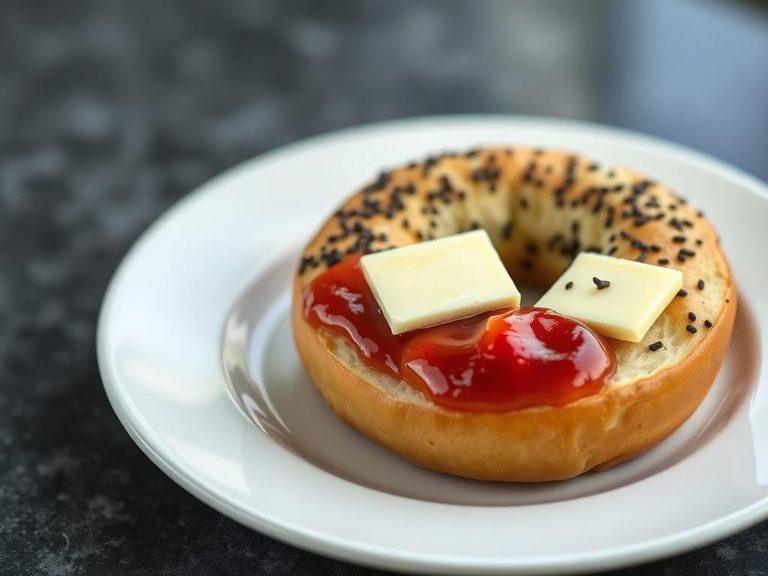

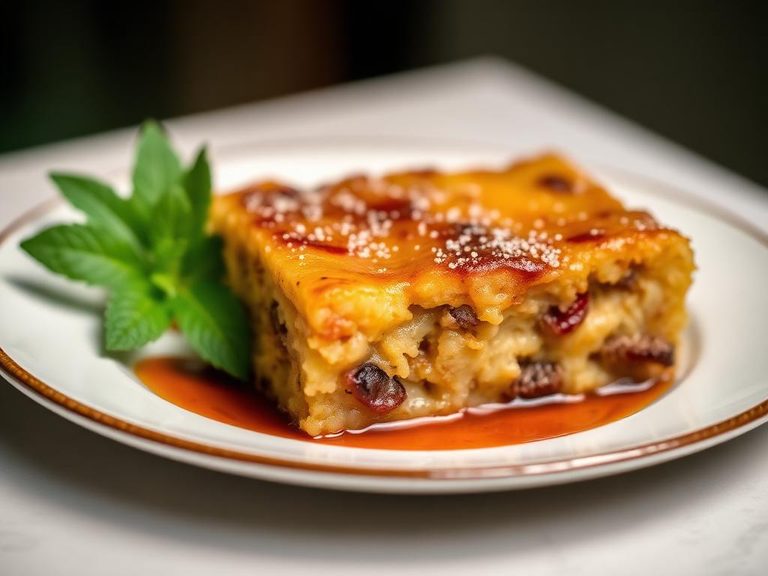

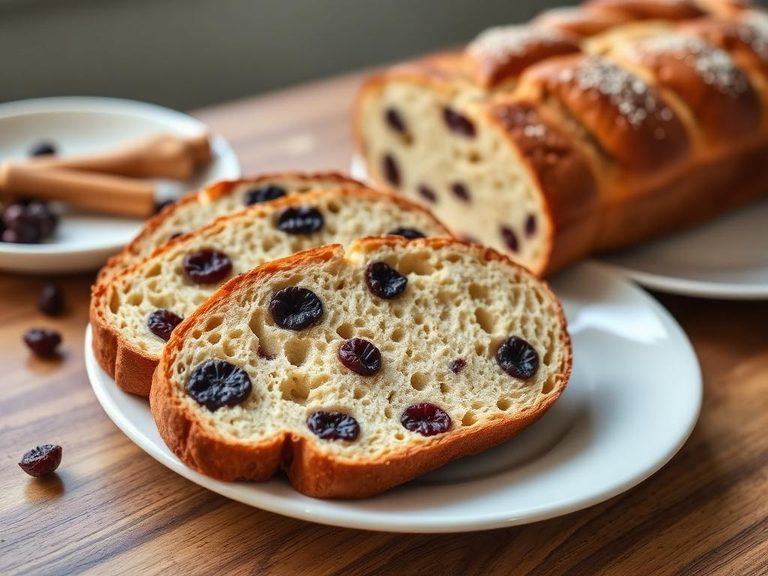
🌍 Where it's eaten
💡 Did you know?
The holes in bagels are thought to help them cook more evenly and quickly by increasing the surface area exposed to boiling water before baking.
Full nutrition (USDA data · scales with serving)
| Water | 35.3 g |
| Energy | 255 kcal |
| Protein | 9.5 g |
| Total lipid (fat) | 1.4 g |
| Carbohydrate, by difference | 51.9 g |
| Fiber, total dietary | 4.1 g |
| Total Sugars | 12.0 g |
| Calcium, Ca | 100 mg |
| Iron, Fe | 2.7 mg |
| Magnesium, Mg | 50.0 mg |
| Phosphorus, P | 138 mg |
| Potassium, K | 215 mg |
| Sodium, Na | 398 mg |
| Zinc, Zn | 1.0 mg |
| Copper, Cu | 0.18 mg |
| Selenium, Se | 25.9 ug |
| Vitamin C, total ascorbic acid | 0.20 mg |
| Thiamin | 0.37 mg |
| Riboflavin | 0.20 mg |
| Niacin | 3.1 mg |
| Vitamin B-6 | 0.15 mg |
| Folate, total | 69.0 ug |
| Folic acid | 41.0 ug |
| Folate, food | 28.0 ug |
| Folate, DFE | 98.0 ug |
| Choline, total | 9.9 mg |
| Vitamin B-12 | 0.00 ug |
| Vitamin B-12, added | 0.00 ug |
| Vitamin A, RAE | 0.00 ug |
| Retinol | 0.00 ug |
| Carotene, beta | 2.0 ug |
| Carotene, alpha | 0.00 ug |
| Cryptoxanthin, beta | 0.00 ug |
| Lycopene | 0.00 ug |
| Lutein + zeaxanthin | 79.0 ug |
| Vitamin E (alpha-tocopherol) | 0.30 mg |
| Vitamin E, added | 0.00 mg |
| Vitamin D (D2 + D3) | 0.00 ug |
| Vitamin K (phylloquinone) | 1.7 ug |
| Alcohol, ethyl | 0.00 g |
| Caffeine | 0.00 mg |
| Theobromine | 0.00 mg |
Fat & fatty acid profile (per 100g)
| Fatty acids, total saturated | 0.01 g |
| SFA 4:0 | 0.00 g |
| SFA 6:0 | 0.00 g |
| SFA 8:0 | 0.00 g |
| SFA 10:0 | 0.00 g |
| SFA 12:0 | 0.00 g |
| SFA 14:0 | 0.00 g |
| SFA 16:0 | 0.01 g |
| SFA 18:0 | 0.00 g |
| Fatty acids, total monounsaturated | 0.26 g |
| MUFA 16:1 | 0.01 g |
| MUFA 18:1 | 0.25 g |
| MUFA 20:1 | 0.00 g |
| MUFA 22:1 | 0.00 g |
| Fatty acids, total polyunsaturated | 0.85 g |
| PUFA 18:2 | 0.78 g |
| PUFA 18:3 | 0.07 g |
| PUFA 18:4 | 0.00 g |
| PUFA 20:4 | 0.00 g |
| PUFA 20:5 n-3 (EPA) | 0.00 g |
| PUFA 22:5 n-3 (DPA) | 0.00 g |
| PUFA 22:6 n-3 (DHA) | 0.00 g |
| Cholesterol | 0.00 mg |
Amino acid profile (per 100g)
Estimated from Bagels, plain, unenriched, without calcium propionate(includes onion, poppy, sesame) — USDA does not publish this profile for Bagel.
| Tryptophan | 0.12 g |
| Threonine | 0.30 g |
| Isoleucine | 0.40 g |
| Leucine | 0.73 g |
| Lysine | 0.25 g |
| Methionine | 0.19 g |
| Cystine | 0.23 g |
| Phenylalanine | 0.52 g |
| Tyrosine | 0.30 g |
| Valine | 0.46 g |
| Arginine | 0.38 g |
| Histidine | 0.23 g |
| Alanine | 0.35 g |
| Aspartic acid | 0.48 g |
| Glutamic acid | 3.5 g |
| Glycine | 0.37 g |
| Proline | 1.2 g |
| Serine | 0.51 g |
FAQ
Is a raisin bagel healthier than a plain bagel?
It can be, as it typically contains more fiber and some micronutrients from the whole wheat and raisins. However, it also has more sugar. The healthiest choice depends on your overall dietary goals.
How should I store raisin bagels to keep them fresh?
For short-term use (a few days), store in a paper bag at room temperature. For longer storage, slice and freeze in an airtight bag; toast directly from frozen.
Are raisin bagels a good pre-workout food?
They can be a good source of quick energy due to their carbohydrate content. Eating one 1-2 hours before exercise, perhaps with a little nut butter, can provide fuel without being too heavy.
Nutrient density (calculated · NRF9.3)
Nutrient Rich Foods index: beneficial nutrients (protein, fiber, vitamins, minerals) minus saturated fat, added sugar & sodium, per 100 kcal.
NRF9.3 index — Fulgoni, Keast & Drewnowski, 2009. Computed from USDA nutrients.
Weight-loss friendliness (composite index)
Energy density 2.55 kcal/g · 15% calories from protein · 4.1 g fiber · 12.0 g sugar per 100 g.
Composite of energy density (Rolls et al., 1999), protein & fiber satiety, minus sugar. A calculated heuristic — ranks satiety-per-calorie, not a clinical measure.
Dietary load (calculated from USDA values)
Potential renal acid load. Positive = acid-forming, negative = alkaline-forming.
Sodium-to-potassium ratio: 1.85 (lower is better — aim for ≤ 1)
Sodium:potassium per WHO potassium guidance. Computed from USDA nutrients.