

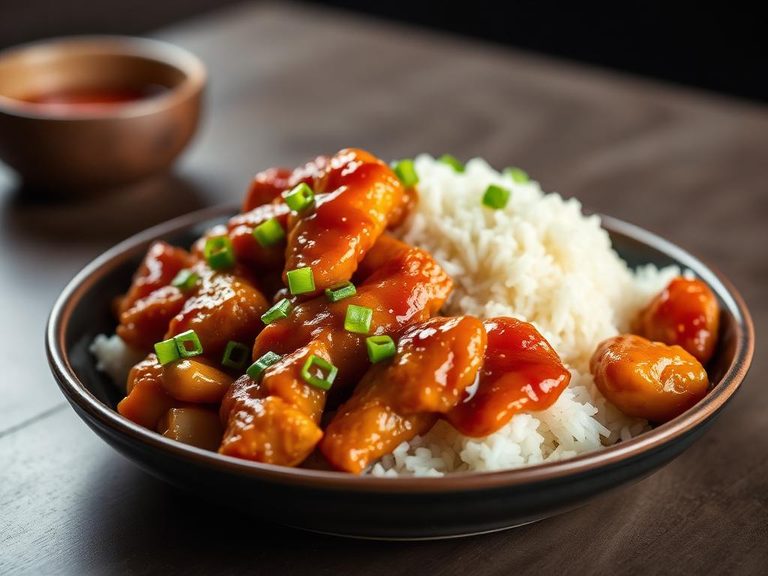
Teriyaki chicken with rice and vegetable, diet frozen meal
Common food

Photo: Wikipedia
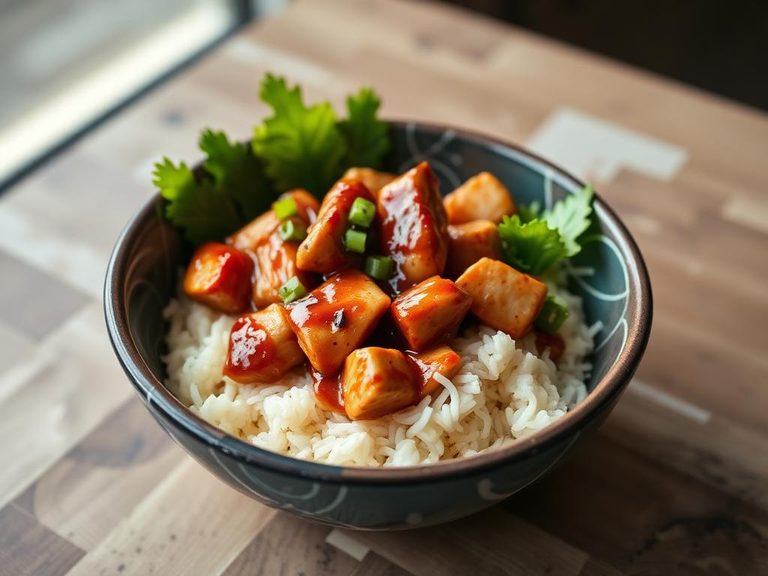
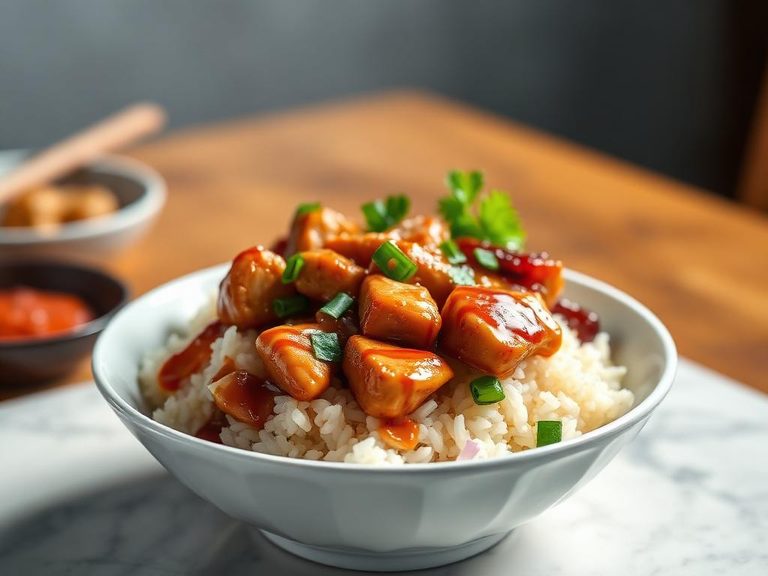
A convenient, portion-controlled frozen meal featuring tender chicken pieces glazed in a sweet-savory teriyaki sauce, served alongside fluffy white rice and a mix of crisp-tender vegetables like broccoli and carrots. The flavor profile is a classic balance of umami from the soy-based sauce with a hint of sweetness, while the texture offers a satisfying contrast between the soft rice, tender protein, and slight crunch from the vegetables. At just 126 kcal per 100g, it's an exceptionally light option, with the majority of its energy coming from carbohydrates.
Calorie split: 18% protein · 71% carbs · 11% fat
↓ Full nutrition💚 Why it's loved
People love it for delivering the iconic, crave-worthy sweet-salty flavor of teriyaki in a quick, no-prep format that feels like a real meal. It's a reliable go-to for a satisfying yet light dinner that doesn't require culinary skill or cleanup.
⚠️ Watch-outs & how to enjoy it better
The main downside is the high carbohydrate-to-protein ratio (nearly 4:1), which can lead to a quicker return of hunger and potential blood-sugar spikes, especially for those monitoring glucose. The sodium content in the teriyaki sauce is also typically high. To counteract this, consider adding a side of plain Greek yogurt or a handful of edamame to boost protein and fat, which slows digestion and improves satiety.
Key benefits
- Extremely low-calorie for a complete meal
- Provides a balanced mix of protein, carbs, and vegetables
- Convenient portion control for weight management
- Quick to prepare, ideal for busy schedules
- Offers a familiar, comforting flavor profile
🍽️ Popular dishes
🌍 Where it's eaten
💡 Did you know?
The word 'teriyaki' comes from the Japanese words 'teri' (meaning luster or shine, from the glaze) and 'yaki' (meaning grilled or broiled), describing the cooking method, not just the sauce.
Full nutrition (USDA data · scales with serving)
| Water | 69.1 g |
| Energy | 126 kcal |
| Protein | 5.7 g |
| Total lipid (fat) | 1.6 g |
| Carbohydrate, by difference | 22.5 g |
| Fiber, total dietary | 0.70 g |
| Total Sugars | 4.1 g |
| Calcium, Ca | 13.0 mg |
| Iron, Fe | 0.35 mg |
| Magnesium, Mg | 14.0 mg |
| Phosphorus, P | 94.0 mg |
| Potassium, K | 123 mg |
| Sodium, Na | 333 mg |
| Zinc, Zn | 0.38 mg |
| Copper, Cu | 0.03 mg |
| Selenium, Se | 7.1 ug |
| Vitamin C, total ascorbic acid | 3.0 mg |
| Thiamin | 0.07 mg |
| Riboflavin | 0.06 mg |
| Niacin | 2.3 mg |
| Vitamin B-6 | 0.16 mg |
| Folate, total | 18.0 ug |
| Folic acid | 5.0 ug |
| Folate, food | 13.0 ug |
| Folate, DFE | 22.0 ug |
| Choline, total | 13.4 mg |
| Vitamin B-12 | 0.32 ug |
| Vitamin B-12, added | 0.32 ug |
| Vitamin A, RAE | 32.0 ug |
| Retinol | 2.0 ug |
| Carotene, beta | 287 ug |
| Carotene, alpha | 107 ug |
| Cryptoxanthin, beta | 43.0 ug |
| Lycopene | 53.0 ug |
| Lutein + zeaxanthin | 97.0 ug |
| Vitamin E (alpha-tocopherol) | 0.23 mg |
| Vitamin E, added | 0.00 mg |
| Vitamin D (D2 + D3) | 0.00 ug |
| Vitamin K (phylloquinone) | 3.8 ug |
| Alcohol, ethyl | 0.00 g |
| Caffeine | 0.00 mg |
| Theobromine | 0.00 mg |
Fat & fatty acid profile (per 100g)
| Fatty acids, total saturated | 0.33 g |
| SFA 4:0 | 0.00 g |
| SFA 6:0 | 0.00 g |
| SFA 8:0 | 0.00 g |
| SFA 10:0 | 0.00 g |
| SFA 12:0 | 0.00 g |
| SFA 14:0 | 0.01 g |
| SFA 16:0 | 0.24 g |
| SFA 18:0 | 0.07 g |
| Fatty acids, total monounsaturated | 0.50 g |
| MUFA 16:1 | 0.04 g |
| MUFA 18:1 | 0.47 g |
| MUFA 20:1 | 0.00 g |
| MUFA 22:1 | 0.00 g |
| Fatty acids, total polyunsaturated | 0.41 g |
| PUFA 18:2 | 0.38 g |
| PUFA 18:3 | 0.02 g |
| PUFA 18:4 | 0.00 g |
| PUFA 20:4 | 0.01 g |
| PUFA 20:5 n-3 (EPA) | 0.00 g |
| PUFA 22:5 n-3 (DPA) | 0.00 g |
| PUFA 22:6 n-3 (DHA) | 0.00 g |
| Cholesterol | 16.0 mg |
Amino acid profile (per 100g)
Estimated from Rice bowl with chicken, frozen entree, prepared (includes fried, teriyaki, and sweet and sour varieties) — USDA does not publish this profile for Teriyaki chicken with rice and vegetable.
| Tryptophan | 0.07 g |
| Threonine | 0.25 g |
| Isoleucine | 0.27 g |
| Leucine | 0.46 g |
| Lysine | 0.42 g |
| Methionine | 0.13 g |
| Cystine | 0.08 g |
| Phenylalanine | 0.26 g |
| Tyrosine | 0.16 g |
| Valine | 0.31 g |
| Arginine | 0.39 g |
| Histidine | 0.19 g |
| Alanine | 0.34 g |
| Aspartic acid | 0.57 g |
| Glutamic acid | 0.93 g |
| Glycine | 0.26 g |
| Proline | 0.24 g |
| Serine | 0.24 g |
FAQ
Is this a good meal for building muscle?
It's not ideal as a primary muscle-building meal due to its relatively low protein content (5.65g per 100g) and high carbohydrate ratio. For muscle synthesis, you'd want a meal with a much higher protein density, such as 20-30g per serving.
Why is the calorie count so low?
The low calorie count is achieved through a high water content in the vegetables and rice, and a very lean portion of chicken. The sauce is likely applied sparingly. It's designed as a light, diet-conscious option rather than a hearty, calorie-dense meal.
Can I improve the nutrition of this meal?
Absolutely. You can significantly boost its nutritional value by stirring in a handful of spinach or edamame while heating, which adds fiber and micronutrients. Serving it with a side of cottage cheese or a hard-boiled egg also adds substantial protein to balance the macros.
Nutrient density (calculated · NRF9.3)
Nutrient Rich Foods index: beneficial nutrients (protein, fiber, vitamins, minerals) minus saturated fat, added sugar & sodium, per 100 kcal.
NRF9.3 index — Fulgoni, Keast & Drewnowski, 2009. Computed from USDA nutrients.
Weight-loss friendliness (composite index)
Energy density 1.26 kcal/g · 18% calories from protein · 0.7 g fiber · 4.1 g sugar per 100 g.
Composite of energy density (Rolls et al., 1999), protein & fiber satiety, minus sugar. A calculated heuristic — ranks satiety-per-calorie, not a clinical measure.
Dietary load (calculated from USDA values)
Potential renal acid load. Positive = acid-forming, negative = alkaline-forming.
Sodium-to-potassium ratio: 2.71 (lower is better — aim for ≤ 1)
Sodium:potassium per WHO potassium guidance. Computed from USDA nutrients.