

Strudel, berry
Common food

Photo: Wikipedia
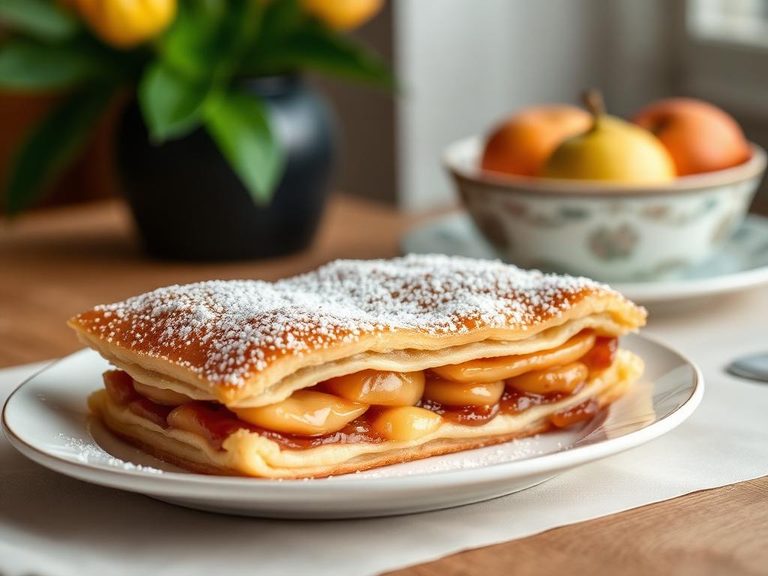
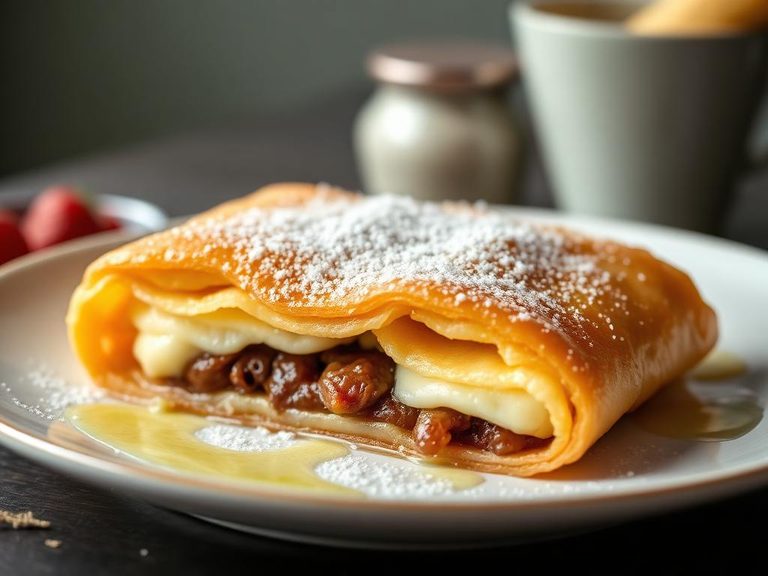
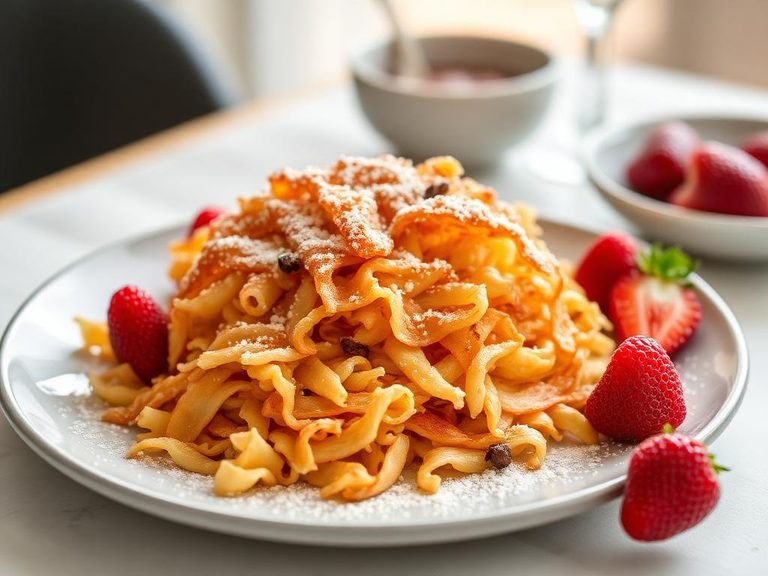
A berry strudel is a delicate, flaky pastry filled with a sweet-tart mixture of berries, often encased in layers of paper-thin, buttery dough. The filling bursts with jammy fruit flavor, contrasting with the crisp, shattering texture of the baked crust. Nutritionally, it's a carbohydrate-rich treat, with the sugar and fat content contributing to its indulgent profile.
Calorie split: 3% protein · 53% carbs · 43% fat
↓ Full nutrition💚 Why it's loved
People love it for the perfect marriage of warm, juicy berries and the buttery, flaky pastry, creating a comforting and indulgent treat. It's a beloved centerpiece for breakfasts, coffee breaks, and dessert tables across Central Europe.
⚠️ Watch-outs & how to enjoy it better
The high sugar and refined carbohydrate content can lead to blood sugar spikes, making it less ideal for those monitoring glucose levels. To mitigate this, enjoy a smaller portion alongside a source of protein or fat (like Greek yogurt or nuts) to slow digestion. Those with gluten or dairy allergies should also exercise caution.
Key benefits
- Quick source of energy from carbohydrates
- Provides some dietary fiber from the berry filling
- Contains antioxidants from the berries
- Offers a satisfying blend of textures and flavors
🍽️ Popular dishes
🌍 Where it's eaten
💡 Did you know?
The dough for traditional strudel is stretched so thin you can reportedly read a newspaper through it before baking.
Full nutrition (USDA data · scales with serving)
| Water | 43.2 g |
| Energy | 291 kcal |
| Protein | 2.4 g |
| Total lipid (fat) | 14.2 g |
| Carbohydrate, by difference | 39.2 g |
| Fiber, total dietary | 2.7 g |
| Total Sugars | 21.7 g |
| Calcium, Ca | 21.0 mg |
| Iron, Fe | 0.56 mg |
| Magnesium, Mg | 15.0 mg |
| Phosphorus, P | 38.0 mg |
| Potassium, K | 98.0 mg |
| Sodium, Na | 131 mg |
| Zinc, Zn | 0.28 mg |
| Copper, Cu | 0.09 mg |
| Selenium, Se | 1.3 ug |
| Vitamin C, total ascorbic acid | 1.4 mg |
| Thiamin | 0.04 mg |
| Riboflavin | 0.03 mg |
| Niacin | 0.74 mg |
| Vitamin B-6 | 0.04 mg |
| Folate, total | 43.0 ug |
| Folic acid | 19.0 ug |
| Folate, food | 23.0 ug |
| Folate, DFE | 56.0 ug |
| Choline, total | 9.0 mg |
| Vitamin B-12 | 0.00 ug |
| Vitamin B-12, added | 0.00 ug |
| Vitamin A, RAE | 129 ug |
| Retinol | 124 ug |
| Carotene, beta | 60.0 ug |
| Carotene, alpha | 0.00 ug |
| Cryptoxanthin, beta | 1.0 ug |
| Lycopene | 0.00 ug |
| Lutein + zeaxanthin | 55.0 ug |
| Vitamin E (alpha-tocopherol) | 0.55 mg |
| Vitamin E, added | 0.00 mg |
| Vitamin D (D2 + D3) | 0.10 ug |
| Vitamin K (phylloquinone) | 10.4 ug |
| Alcohol, ethyl | 0.00 g |
| Caffeine | 0.00 mg |
| Theobromine | 0.00 mg |
Fat & fatty acid profile (per 100g)
| Fatty acids, total saturated | 7.6 g |
| SFA 4:0 | 0.34 g |
| SFA 6:0 | 0.24 g |
| SFA 8:0 | 0.14 g |
| SFA 10:0 | 0.32 g |
| SFA 12:0 | 0.36 g |
| SFA 14:0 | 1.2 g |
| SFA 16:0 | 3.5 g |
| SFA 18:0 | 1.2 g |
| Fatty acids, total monounsaturated | 2.8 g |
| MUFA 16:1 | 0.17 g |
| MUFA 18:1 | 2.5 g |
| MUFA 20:1 | 0.02 g |
| MUFA 22:1 | 0.00 g |
| Fatty acids, total polyunsaturated | 0.61 g |
| PUFA 18:2 | 0.52 g |
| PUFA 18:3 | 0.10 g |
| PUFA 18:4 | 0.00 g |
| PUFA 20:4 | 0.02 g |
| PUFA 20:5 n-3 (EPA) | 0.00 g |
| PUFA 22:5 n-3 (DPA) | 0.01 g |
| PUFA 22:6 n-3 (DHA) | 0.00 g |
| Cholesterol | 39.0 mg |
Amino acid profile (per 100g)
Estimated from Strudel, apple — USDA does not publish this profile for Strudel.
| Tryptophan | 0.04 g |
| Threonine | 0.12 g |
| Isoleucine | 0.15 g |
| Leucine | 0.26 g |
| Lysine | 0.15 g |
| Methionine | 0.07 g |
| Cystine | 0.06 g |
| Phenylalanine | 0.15 g |
| Tyrosine | 0.12 g |
| Valine | 0.16 g |
| Arginine | 0.14 g |
| Histidine | 0.08 g |
| Alanine | 0.12 g |
| Aspartic acid | 0.21 g |
| Glutamic acid | 0.85 g |
| Glycine | 0.10 g |
| Proline | 0.30 g |
| Serine | 0.18 g |
FAQ
Is berry strudel a breakfast or dessert food?
It's versatile! In its regions of origin, it's commonly enjoyed as a mid-morning or afternoon coffee treat (Kaffee und Kuchen), but it also serves as a popular dessert or even a sweet breakfast item.
What's the difference between strudel and pie?
Strudel uses a very thin, elastic, layered dough that is stretched and rolled, resulting in a flaky, delicate crust. Pie typically uses a thicker, crumblier pastry dough that is rolled out and placed in a dish.
Can I make it with frozen berries?
Yes, frozen berries are a common and convenient substitute. Thaw and drain them well first to prevent the filling from becoming too watery and making the pastry soggy.
Nutrient density (calculated · NRF9.3)
Nutrient Rich Foods index: beneficial nutrients (protein, fiber, vitamins, minerals) minus saturated fat, added sugar & sodium, per 100 kcal.
NRF9.3 index — Fulgoni, Keast & Drewnowski, 2009. Computed from USDA nutrients.
Weight-loss friendliness (composite index)
Energy density 2.91 kcal/g · 3% calories from protein · 2.7 g fiber · 21.7 g sugar per 100 g.
Composite of energy density (Rolls et al., 1999), protein & fiber satiety, minus sugar. A calculated heuristic — ranks satiety-per-calorie, not a clinical measure.
Dietary load (calculated from USDA values)
Potential renal acid load. Positive = acid-forming, negative = alkaline-forming.
Sodium-to-potassium ratio: 1.34 (lower is better — aim for ≤ 1)
Sodium:potassium per WHO potassium guidance. Computed from USDA nutrients.