

Roll, wheat or cracked wheat, hot dog bun
Common food

Photo: Wikipedia
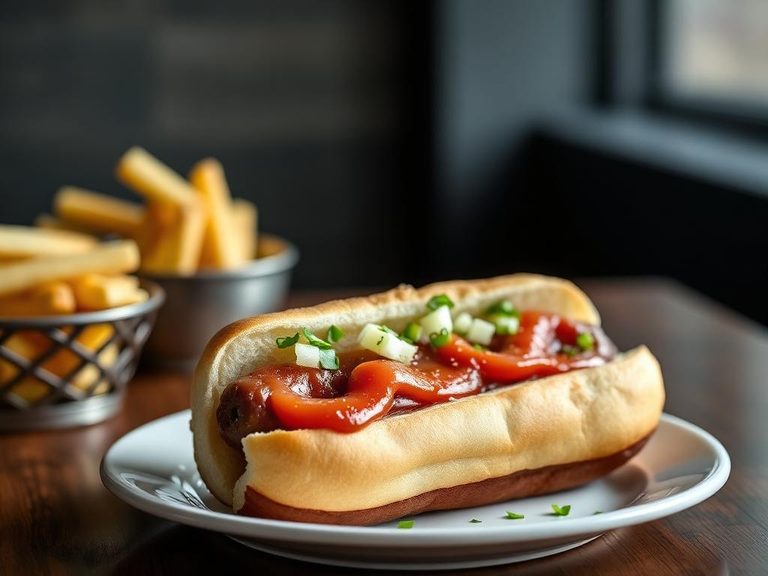
This is a soft, pillowy wheat bun specifically engineered to cradle a hot dog, with a lightly toasted, slightly sweet crust and a tender, airy crumb. Its nutrition is surprisingly balanced for a white bread product, offering a decent 11.7g of protein per 100g and a moderate 4.2g of fiber, especially if made with cracked wheat. It's a classic vessel that transforms a simple sausage into a complete, handheld meal.
Calorie split: 17% protein · 70% carbs · 12% fat
↓ Full nutrition💚 Why it's loved
People love it for its perfect synergy of texture and function—it's soft enough to bite through cleanly but sturdy enough to hold juicy fillings without disintegrating. Its mild, slightly sweet flavor is the ideal backdrop that lets the hot dog, mustard, and relish shine, embodying a sense of nostalgic, casual American cookout culture.
⚠️ Watch-outs & how to enjoy it better
As a refined white flour product, it can cause rapid blood-sugar spikes and offers less sustained energy than whole-grain alternatives. It is also a common carrier for high-sodium processed meats and sugary condiments. To counteract this, opt for a whole wheat or cracked wheat bun, load it with fiber-rich toppings like sauerkraut or grilled onions, and choose lower-sodium, nitrate-free hot dogs.
Key benefits
- Good source of plant-based protein for a bread product
- Provides quick energy from its carbohydrate content
- Contains dietary fiber, especially in whole wheat or cracked wheat versions
- Lightweight and portable for on-the-go meals
- Acts as a functional and flavorful carrier for proteins and vegetables
🍽️ Popular dishes



🌍 Where it's eaten
💡 Did you know?
The standard hot dog bun is said to have been popularized by a German immigrant in St. Louis around the 1904 World's Fair, who supposedly ran out of gloves and began serving sausages in sliced bread rolls instead.
Full nutrition (USDA data · scales with serving)
| Water | 35.2 g |
| Energy | 269 kcal |
| Protein | 11.7 g |
| Total lipid (fat) | 3.6 g |
| Carbohydrate, by difference | 47.3 g |
| Fiber, total dietary | 4.2 g |
| Total Sugars | 6.9 g |
| Calcium, Ca | 196 mg |
| Iron, Fe | 2.9 mg |
| Magnesium, Mg | 47.0 mg |
| Phosphorus, P | 154 mg |
| Potassium, K | 181 mg |
| Sodium, Na | 463 mg |
| Zinc, Zn | 1.2 mg |
| Copper, Cu | 0.17 mg |
| Selenium, Se | 26.7 ug |
| Vitamin C, total ascorbic acid | 1.3 mg |
| Thiamin | 0.53 mg |
| Riboflavin | 0.29 mg |
| Niacin | 4.8 mg |
| Vitamin B-6 | 0.13 mg |
| Folate, total | 84.0 ug |
| Folic acid | 53.0 ug |
| Folate, food | 31.0 ug |
| Folate, DFE | 121 ug |
| Choline, total | 14.5 mg |
| Vitamin B-12 | 0.19 ug |
| Vitamin B-12, added | 0.00 ug |
| Vitamin A, RAE | 27.0 ug |
| Retinol | 27.0 ug |
| Carotene, beta | 6.0 ug |
| Carotene, alpha | 0.00 ug |
| Cryptoxanthin, beta | 0.00 ug |
| Lycopene | 0.00 ug |
| Lutein + zeaxanthin | 6.0 ug |
| Vitamin E (alpha-tocopherol) | 0.40 mg |
| Vitamin E, added | 0.00 mg |
| Vitamin D (D2 + D3) | 0.00 ug |
| Vitamin K (phylloquinone) | 6.8 ug |
| Alcohol, ethyl | 0.00 g |
| Caffeine | 0.00 mg |
| Theobromine | 0.00 mg |
Fat & fatty acid profile (per 100g)
| Fatty acids, total saturated | 0.75 g |
| SFA 4:0 | 0.00 g |
| SFA 6:0 | 0.00 g |
| SFA 8:0 | 0.00 g |
| SFA 10:0 | 0.00 g |
| SFA 12:0 | 0.00 g |
| SFA 14:0 | 0.01 g |
| SFA 16:0 | 0.49 g |
| SFA 18:0 | 0.21 g |
| Fatty acids, total monounsaturated | 0.71 g |
| MUFA 16:1 | 0.02 g |
| MUFA 18:1 | 0.68 g |
| MUFA 20:1 | 0.01 g |
| MUFA 22:1 | 0.00 g |
| Fatty acids, total polyunsaturated | 1.8 g |
| PUFA 18:2 | 1.6 g |
| PUFA 18:3 | 0.18 g |
| PUFA 18:4 | 0.00 g |
| PUFA 20:4 | 0.00 g |
| PUFA 20:5 n-3 (EPA) | 0.00 g |
| PUFA 22:5 n-3 (DPA) | 0.00 g |
| PUFA 22:6 n-3 (DHA) | 0.00 g |
| Cholesterol | 0.00 mg |
Amino acid profile (per 100g)
Estimated from Candies, TOOTSIE ROLL, chocolate-flavor roll — USDA does not publish this profile for Roll.
| Tryptophan | 0.19 g |
| Threonine | 0.04 g |
| Isoleucine | 0.06 g |
| Leucine | 0.11 g |
| Lysine | 0.09 g |
| Methionine | 0.01 g |
| Cystine | 0.00 g |
| Phenylalanine | 0.05 g |
| Tyrosine | 0.02 g |
| Valine | 0.08 g |
| Arginine | 0.06 g |
| Histidine | 0.03 g |
| Alanine | 0.06 g |
| Aspartic acid | 0.20 g |
| Glutamic acid | 0.28 g |
| Glycine | 0.05 g |
| Proline | 0.03 g |
| Serine | 0.08 g |
| Hydroxyproline | 0.00 g |
FAQ
Why are hot dog buns often split on the side instead of the top?
The side-split design, known as a 'New England style' or 'top-loading' bun, is practical for grilling or toasting the inside surfaces and helps contain toppings better than a top-split bun, preventing them from falling out.
Can I use a hot dog bun for other recipes?
Absolutely! They are excellent for making garlic bread sticks, mini French toast, bread pudding, or as a base for quick, open-faced sandwiches or tuna melts.
How can I keep hot dog buns from getting soggy?
To prevent sogginess, lightly toast the inside surfaces before adding fillings. You can also create a moisture barrier by placing a leaf of lettuce or a slice of cheese against the bun before adding wet condiments or juicy meats.
Nutrient density (calculated · NRF9.3)
Nutrient Rich Foods index: beneficial nutrients (protein, fiber, vitamins, minerals) minus saturated fat, added sugar & sodium, per 100 kcal.
NRF9.3 index — Fulgoni, Keast & Drewnowski, 2009. Computed from USDA nutrients.
Weight-loss friendliness (composite index)
Energy density 2.69 kcal/g · 17% calories from protein · 4.2 g fiber · 6.9 g sugar per 100 g.
Composite of energy density (Rolls et al., 1999), protein & fiber satiety, minus sugar. A calculated heuristic — ranks satiety-per-calorie, not a clinical measure.
Dietary load (calculated from USDA values)
Potential renal acid load. Positive = acid-forming, negative = alkaline-forming.
Sodium-to-potassium ratio: 2.56 (lower is better — aim for ≤ 1)
Sodium:potassium per WHO potassium guidance. Computed from USDA nutrients.