

Rice, white, with vegetables and gravy, fat added
Common food

Photo: Wikipedia
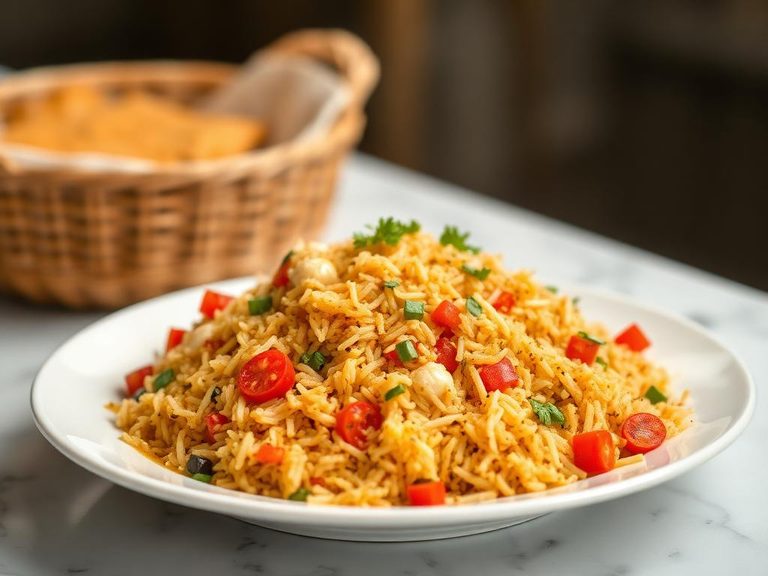
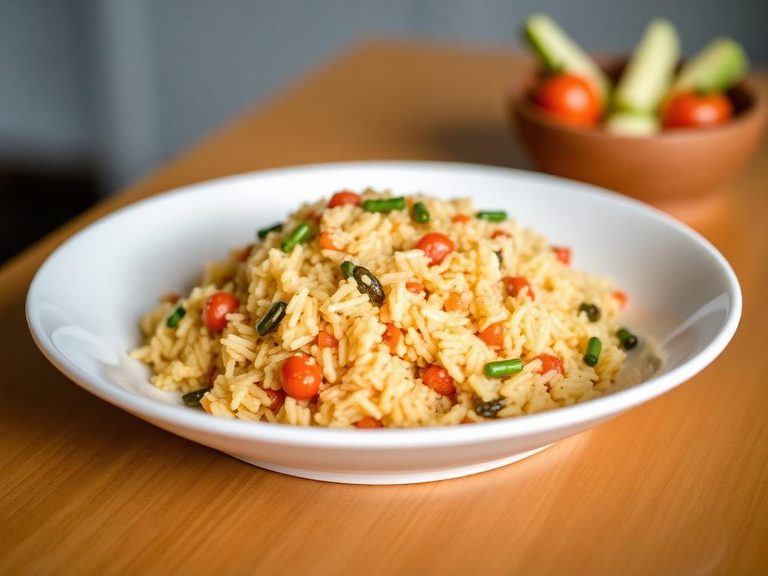
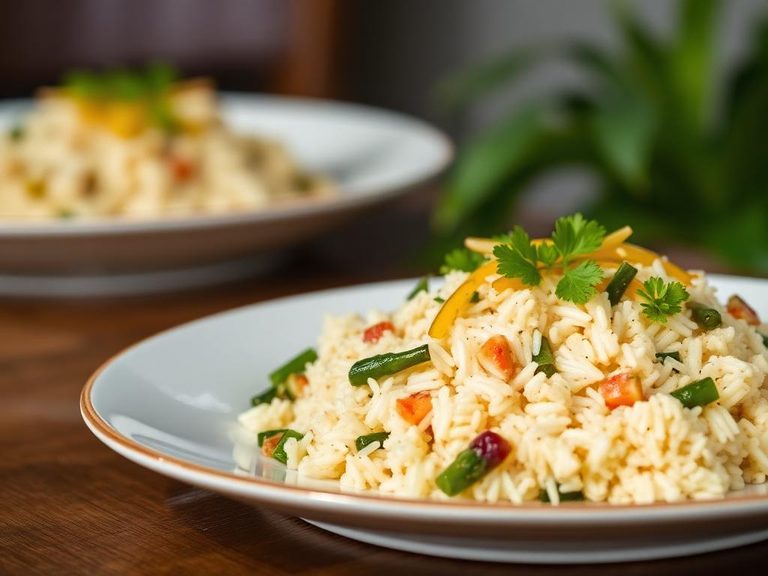
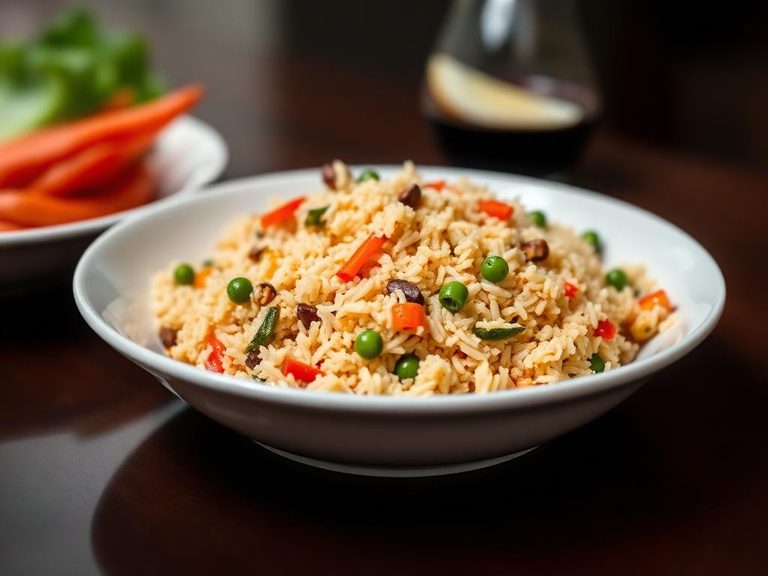
This is a comforting, savory dish of fluffy white rice tossed with tender, diced vegetables and enveloped in a savory gravy. The texture is soft and cohesive, with the gravy adding a rich, umami depth that coats each grain. Nutritionally, it's a low-calorie, plant-based meal that provides a modest amount of fiber and protein from its vegetable components.
Calorie split: 8% protein · 71% carbs · 21% fat
↓ Full nutrition💚 Why it's loved
People love it as a hearty, one-pot comfort food that's both satisfying and simple. Its savory gravy and soft texture make it a versatile base that can be customized with countless vegetable and spice combinations.
⚠️ Watch-outs & how to enjoy it better
The primary downside is its high glycemic load from refined white rice, which can cause rapid blood-sugar spikes, making it less ideal for individuals managing diabetes or insulin resistance. To counteract this, pair it with a significant source of protein (like beans, tofu, or chicken) and healthy fat (like avocado or nuts) to slow digestion, or consider mixing in some brown rice or quinoa for added fiber.
Key benefits
- Low in calories at 107 kcal per 100g
- Provides dietary fiber from mixed vegetables
- Good source of complex carbohydrates for energy
- Contains plant-based protein
- Low in fat, especially saturated fat
🍽️ Popular dishes
🌍 Where it's eaten
💡 Did you know?
The 'gravy' in many such dishes isn't just a sauce; it's often a flavor foundation built by sautéing a 'sofrito' or 'mirepoix'—a mix of aromatic vegetables like onions, carrots, and celery—which caramelizes to create deep, complex flavors before any liquid is added.
Full nutrition (USDA data · scales with serving)
| Water | 75.9 g |
| Energy | 107 kcal |
| Protein | 2.1 g |
| Total lipid (fat) | 2.4 g |
| Carbohydrate, by difference | 18.6 g |
| Fiber, total dietary | 1.1 g |
| Total Sugars | 0.73 g |
| Calcium, Ca | 13.0 mg |
| Iron, Fe | 0.81 mg |
| Magnesium, Mg | 11.0 mg |
| Phosphorus, P | 38.0 mg |
| Potassium, K | 63.0 mg |
| Sodium, Na | 237 mg |
| Zinc, Zn | 0.37 mg |
| Copper, Cu | 0.06 mg |
| Selenium, Se | 4.1 ug |
| Vitamin C, total ascorbic acid | 0.60 mg |
| Thiamin | 0.10 mg |
| Riboflavin | 0.04 mg |
| Niacin | 1.0 mg |
| Vitamin B-6 | 0.07 mg |
| Folate, total | 34.0 ug |
| Folic acid | 29.0 ug |
| Folate, food | 6.0 ug |
| Folate, DFE | 55.0 ug |
| Choline, total | 6.9 mg |
| Vitamin B-12 | 0.00 ug |
| Vitamin B-12, added | 0.00 ug |
| Vitamin A, RAE | 43.0 ug |
| Retinol | 0.00 ug |
| Carotene, beta | 415 ug |
| Carotene, alpha | 193 ug |
| Cryptoxanthin, beta | 0.00 ug |
| Lycopene | 0.00 ug |
| Lutein + zeaxanthin | 127 ug |
| Vitamin E (alpha-tocopherol) | 0.41 mg |
| Vitamin E, added | 0.00 mg |
| Vitamin D (D2 + D3) | 0.00 ug |
| Vitamin K (phylloquinone) | 6.4 ug |
| Alcohol, ethyl | 0.00 g |
| Caffeine | 0.00 mg |
| Theobromine | 0.00 mg |
Fat & fatty acid profile (per 100g)
| Fatty acids, total saturated | 0.42 g |
| SFA 4:0 | 0.00 g |
| SFA 6:0 | 0.00 g |
| SFA 8:0 | 0.00 g |
| SFA 10:0 | 0.00 g |
| SFA 12:0 | 0.00 g |
| SFA 14:0 | 0.01 g |
| SFA 16:0 | 0.32 g |
| SFA 18:0 | 0.08 g |
| Fatty acids, total monounsaturated | 0.97 g |
| MUFA 16:1 | 0.04 g |
| MUFA 18:1 | 0.92 g |
| MUFA 20:1 | 0.01 g |
| MUFA 22:1 | 0.00 g |
| Fatty acids, total polyunsaturated | 0.75 g |
| PUFA 18:2 | 0.66 g |
| PUFA 18:3 | 0.08 g |
| PUFA 18:4 | 0.00 g |
| PUFA 20:4 | 0.00 g |
| PUFA 20:5 n-3 (EPA) | 0.00 g |
| PUFA 22:5 n-3 (DPA) | 0.00 g |
| PUFA 22:6 n-3 (DHA) | 0.00 g |
| Cholesterol | 1.0 mg |
Amino acid profile (per 100g)
Estimated from Snacks, rice cakes, brown rice, sesame seed — USDA does not publish this profile for Rice.
| Tryptophan | 0.10 g |
| Threonine | 0.28 g |
| Isoleucine | 0.32 g |
| Leucine | 0.63 g |
| Lysine | 0.29 g |
| Methionine | 0.17 g |
| Cystine | 0.09 g |
| Phenylalanine | 0.39 g |
| Tyrosine | 0.29 g |
| Valine | 0.44 g |
| Arginine | 0.59 g |
| Histidine | 0.19 g |
| Alanine | 0.44 g |
| Aspartic acid | 0.71 g |
| Glutamic acid | 1.6 g |
| Glycine | 0.38 g |
| Proline | 0.35 g |
| Serine | 0.39 g |
FAQ
Is this dish considered healthy?
It can be a healthy part of a balanced diet. It's low in calories and fat, and the vegetables add vitamins and fiber. Its healthiness depends heavily on the specific vegetables used, the amount of sodium in the gravy, and what you pair it with.
How can I make it higher in protein?
You can easily boost the protein by adding legumes like chickpeas, lentils, or black beans. Incorporating diced tofu, tempeh, or lean meat like chicken or shrimp during cooking are also excellent options.
Why is it so filling despite being low in calories?
The combination of high-volume, water-rich vegetables and the fiber from those vegetables, along with the starchy rice, creates a meal that is physically filling and provides sustained energy, helping with satiety.
Nutrient density (calculated · NRF9.3)
Nutrient Rich Foods index: beneficial nutrients (protein, fiber, vitamins, minerals) minus saturated fat, added sugar & sodium, per 100 kcal.
NRF9.3 index — Fulgoni, Keast & Drewnowski, 2009. Computed from USDA nutrients.
Weight-loss friendliness (composite index)
Energy density 1.07 kcal/g · 8% calories from protein · 1.1 g fiber · 0.7 g sugar per 100 g.
Composite of energy density (Rolls et al., 1999), protein & fiber satiety, minus sugar. A calculated heuristic — ranks satiety-per-calorie, not a clinical measure.
Dietary load (calculated from USDA values)
Potential renal acid load. Positive = acid-forming, negative = alkaline-forming.
Sodium-to-potassium ratio: 3.76 (lower is better — aim for ≤ 1)
Sodium:potassium per WHO potassium guidance. Computed from USDA nutrients.