

Rice, white, with lentils, NS as to fat
Common food

Photo: Wikipedia
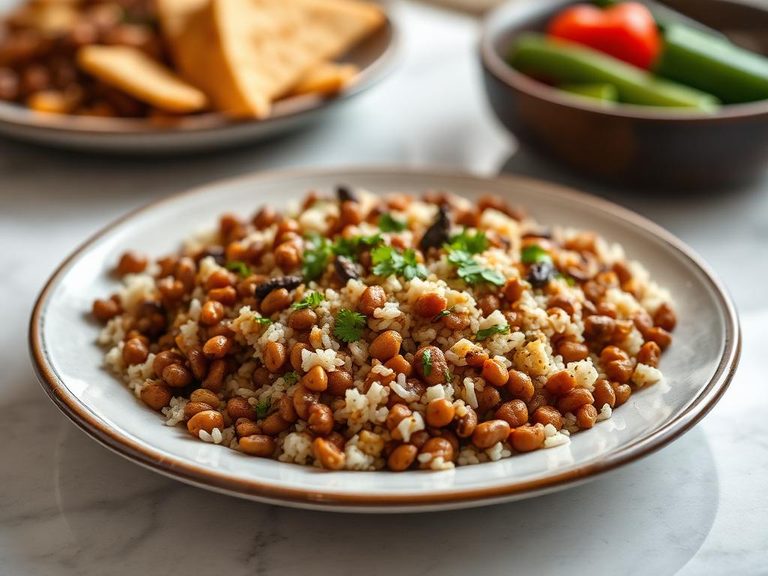
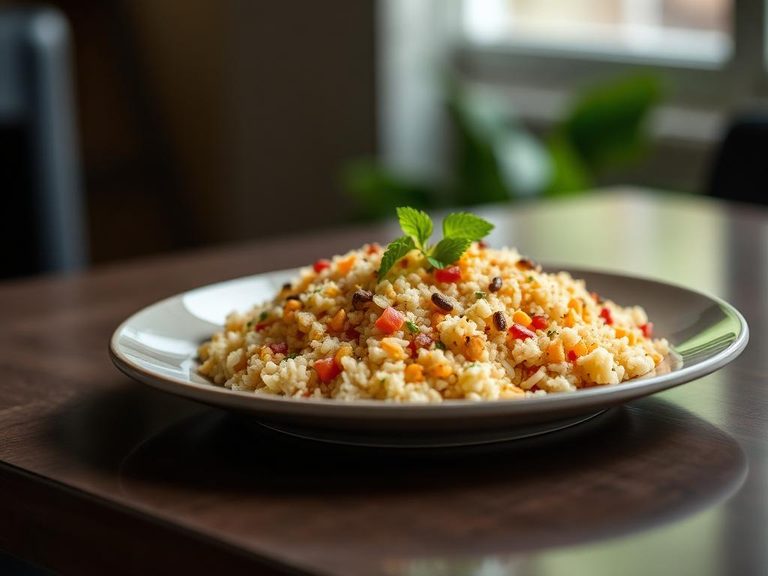
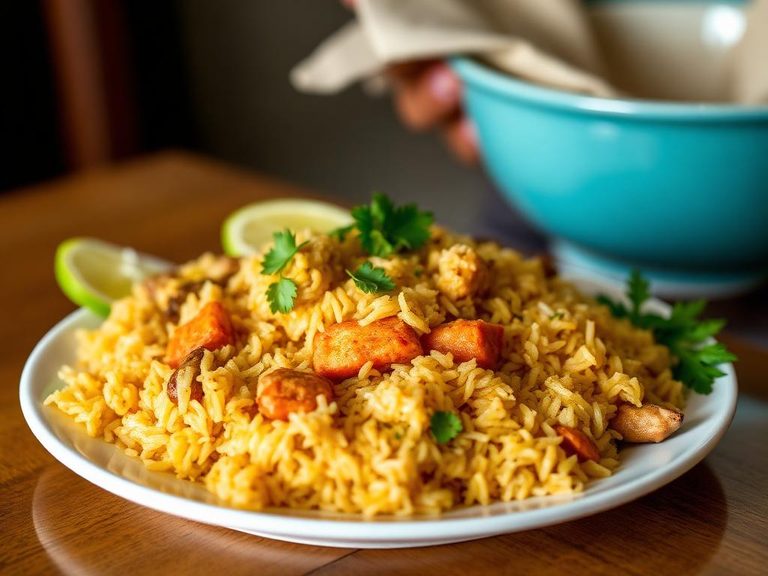
A comforting, fluffy blend of tender white rice and earthy lentils, creating a satisfying, slightly nutty and savory base. This simple staple offers a solid plant-based protein boost alongside its carbohydrate energy, making it a wholesome and filling choice.
Calorie split: 15% protein · 57% carbs · 29% fat
↓ Full nutrition💚 Why it's loved
People love this dish for its humble, comforting simplicity and its ability to absorb the flavors of any accompanying sauce or spice. It's a beloved, versatile canvas in many cuisines, often served as a hearty, affordable, and nutritious everyday meal.
⚠️ Watch-outs & how to enjoy it better
As a high-carbohydrate dish, it can cause rapid blood-sugar spikes, especially for those with insulin sensitivity. To counteract this, pair it with a source of fat (like a drizzle of olive oil) or additional protein (such as yogurt or a side of meat) to slow digestion. Portion control is also key for managing carbohydrate intake.
Key benefits
- Good source of plant-based protein for muscle maintenance
- Provides sustained energy from complex carbohydrates
- Contains dietary fiber for digestive health
- Low in sugar, supporting stable energy levels
- Naturally cholesterol-free and low in saturated fat
🍽️ Popular dishes
🌍 Where it's eaten
💡 Did you know?
The combination of rice and lentils is one of the oldest known complete protein pairings in human history, documented in ancient texts from the Indus Valley and Mesopotamia.
Full nutrition (USDA data · scales with serving)
| Water | 67.2 g |
| Energy | 150 kcal |
| Protein | 5.5 g |
| Total lipid (fat) | 4.8 g |
| Carbohydrate, by difference | 21.4 g |
| Fiber, total dietary | 4.1 g |
| Total Sugars | 1.3 g |
| Calcium, Ca | 17.0 mg |
| Iron, Fe | 2.2 mg |
| Magnesium, Mg | 23.0 mg |
| Phosphorus, P | 106 mg |
| Potassium, K | 207 mg |
| Sodium, Na | 189 mg |
| Zinc, Zn | 0.82 mg |
| Copper, Cu | 0.15 mg |
| Selenium, Se | 4.3 ug |
| Vitamin C, total ascorbic acid | 1.3 mg |
| Thiamin | 0.15 mg |
| Riboflavin | 0.04 mg |
| Niacin | 1.1 mg |
| Vitamin B-6 | 0.14 mg |
| Folate, total | 110 ug |
| Folic acid | 21.0 ug |
| Folate, food | 89.0 ug |
| Folate, DFE | 125 ug |
| Choline, total | 17.2 mg |
| Vitamin B-12 | 0.00 ug |
| Vitamin B-12, added | 0.00 ug |
| Vitamin A, RAE | 1.0 ug |
| Retinol | 0.00 ug |
| Carotene, beta | 12.0 ug |
| Carotene, alpha | 0.00 ug |
| Cryptoxanthin, beta | 2.0 ug |
| Lycopene | 0.00 ug |
| Lutein + zeaxanthin | 6.0 ug |
| Vitamin E (alpha-tocopherol) | 0.94 mg |
| Vitamin E, added | 0.00 mg |
| Vitamin D (D2 + D3) | 0.00 ug |
| Vitamin K (phylloquinone) | 6.7 ug |
| Alcohol, ethyl | 0.00 g |
| Caffeine | 0.00 mg |
| Theobromine | 0.00 mg |
Fat & fatty acid profile (per 100g)
| Fatty acids, total saturated | 0.66 g |
| SFA 4:0 | 0.00 g |
| SFA 6:0 | 0.00 g |
| SFA 8:0 | 0.00 g |
| SFA 10:0 | 0.00 g |
| SFA 12:0 | 0.00 g |
| SFA 14:0 | 0.00 g |
| SFA 16:0 | 0.48 g |
| SFA 18:0 | 0.14 g |
| Fatty acids, total monounsaturated | 2.0 g |
| MUFA 16:1 | 0.02 g |
| MUFA 18:1 | 1.9 g |
| MUFA 20:1 | 0.03 g |
| MUFA 22:1 | 0.00 g |
| Fatty acids, total polyunsaturated | 1.9 g |
| PUFA 18:2 | 1.6 g |
| PUFA 18:3 | 0.22 g |
| PUFA 18:4 | 0.00 g |
| PUFA 20:4 | 0.00 g |
| PUFA 20:5 n-3 (EPA) | 0.00 g |
| PUFA 22:5 n-3 (DPA) | 0.00 g |
| PUFA 22:6 n-3 (DHA) | 0.00 g |
| Cholesterol | 0.00 mg |
Amino acid profile (per 100g)
Estimated from Snacks, rice cakes, brown rice, sesame seed — USDA does not publish this profile for Rice.
| Tryptophan | 0.10 g |
| Threonine | 0.28 g |
| Isoleucine | 0.32 g |
| Leucine | 0.63 g |
| Lysine | 0.29 g |
| Methionine | 0.17 g |
| Cystine | 0.09 g |
| Phenylalanine | 0.39 g |
| Tyrosine | 0.29 g |
| Valine | 0.44 g |
| Arginine | 0.59 g |
| Histidine | 0.19 g |
| Alanine | 0.44 g |
| Aspartic acid | 0.71 g |
| Glutamic acid | 1.6 g |
| Glycine | 0.38 g |
| Proline | 0.35 g |
| Serine | 0.39 g |
FAQ
Is rice with lentils a complete protein?
Yes, when eaten together, rice and lentils form a complete protein, meaning they provide all nine essential amino acids your body needs.
How can I make it less mushy?
Rinse both grains thoroughly before cooking. Use a ratio of about 1.5 cups of water to 1 cup of the rice-lentil mix, and simmer covered until just tender. Let it rest off the heat for 5 minutes before fluffing with a fork.
Can I use brown rice?
Absolutely. Brown rice will increase the fiber content and give a chewier texture, but you'll need to extend the cooking time and slightly increase the water.
Nutrient density (calculated · NRF9.3)
Nutrient Rich Foods index: beneficial nutrients (protein, fiber, vitamins, minerals) minus saturated fat, added sugar & sodium, per 100 kcal.
NRF9.3 index — Fulgoni, Keast & Drewnowski, 2009. Computed from USDA nutrients.
Weight-loss friendliness (composite index)
Energy density 1.50 kcal/g · 15% calories from protein · 4.1 g fiber · 1.3 g sugar per 100 g.
Composite of energy density (Rolls et al., 1999), protein & fiber satiety, minus sugar. A calculated heuristic — ranks satiety-per-calorie, not a clinical measure.
Dietary load (calculated from USDA values)
Potential renal acid load. Positive = acid-forming, negative = alkaline-forming.
Sodium-to-potassium ratio: 0.91 (lower is better — aim for ≤ 1)
Sodium:potassium per WHO potassium guidance. Computed from USDA nutrients.