

Pretzels, soft, ready-to-eat, topped with cheese
Common food

Photo: Wikipedia
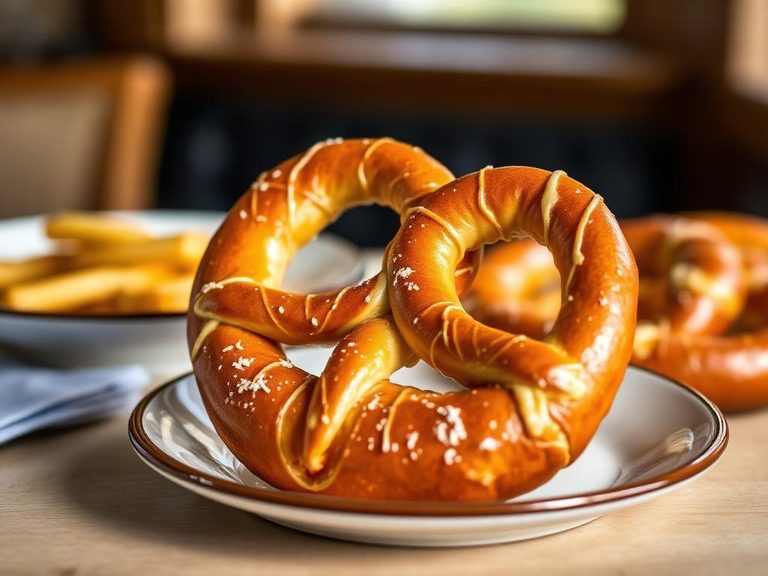
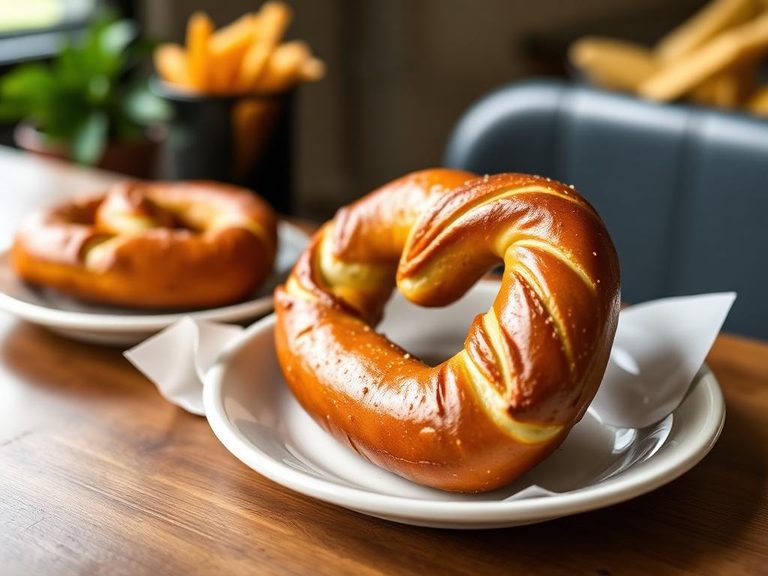
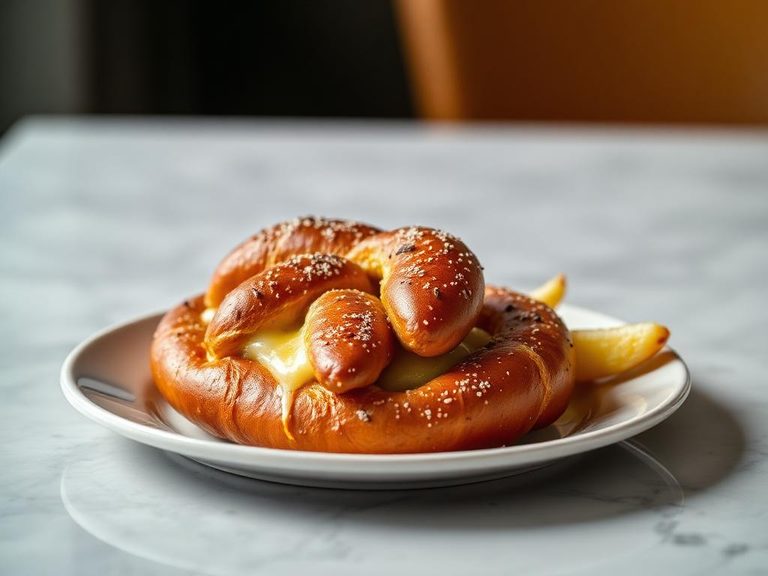
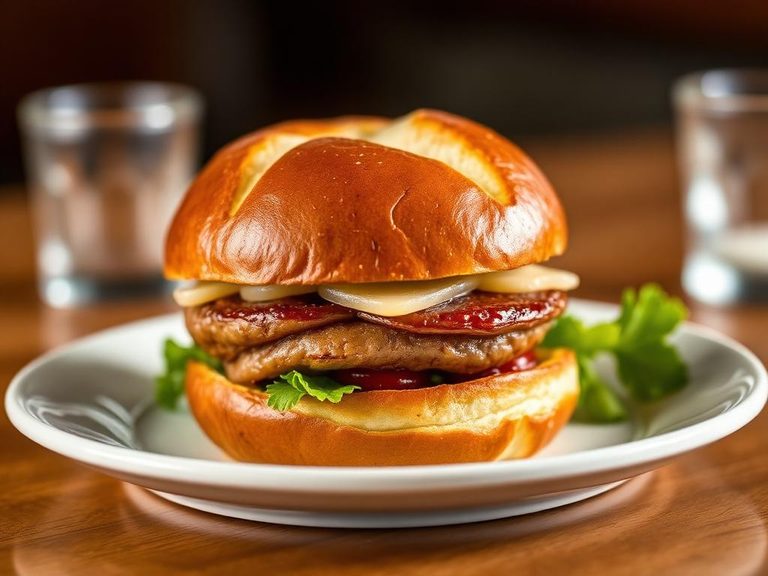
A golden, pillowy soft pretzel, its surface generously blanketed in a savory, melted cheese topping that delivers a satisfyingly chewy bite and a rich, salty-savory flavor. It's a substantial snack that combines the comforting, bready core of a classic pretzel with the indulgent, umami depth of cheese.
Calorie split: 12% protein · 74% carbs · 14% fat
↓ Full nutrition💚 Why it's loved
People adore the perfect marriage of the warm, chewy, slightly sweet dough with the salty, sharp, and often gooey cheese topping. It's a beloved comfort food that bridges the gap between a snack and a light meal, perfect for game days, street fairs, or a quick, satisfying bite.
⚠️ Watch-outs & how to enjoy it better
The high carbohydrate content can lead to rapid blood sugar spikes, especially when eaten alone. Those watching sodium intake should be mindful, as both the pretzel dough and cheese topping are typically salty. To counteract this, pair it with a source of protein or healthy fat (like a side of Greek yogurt or a handful of nuts) to slow digestion, and practice portion control by sharing or saving half for later.
Key benefits
- Good source of plant-based protein from wheat flour
- Provides quick energy from carbohydrates
- Low in fat compared to many baked snacks
- Contains dietary fiber for digestive health
- Offers a satisfying mix of textures and flavors
🍽️ Popular dishes
🌍 Where it's eaten
💡 Did you know?
The distinctive 'X' or split on the bottom of a traditional soft pretzel is said to represent the arms of monks, who originally created the dough in the shape of crossed arms in prayer.
Full nutrition (USDA data · scales with serving)
| Water | 19.3 g |
| Energy | 339 kcal |
| Protein | 10.2 g |
| Total lipid (fat) | 5.4 g |
| Carbohydrate, by difference | 62.4 g |
| Fiber, total dietary | 1.5 g |
| Total Sugars | 0.45 g |
| Calcium, Ca | 110 mg |
| Iron, Fe | 3.4 mg |
| Magnesium, Mg | 22.0 mg |
| Phosphorus, P | 138 mg |
| Potassium, K | 92.0 mg |
| Sodium, Na | 310 mg |
| Zinc, Zn | 1.3 mg |
| Copper, Cu | 0.11 mg |
| Selenium, Se | 18.4 ug |
| Vitamin C, total ascorbic acid | 0.00 mg |
| Thiamin | 0.36 mg |
| Riboflavin | 0.30 mg |
| Niacin | 3.7 mg |
| Vitamin B-6 | 0.03 mg |
| Folate, total | 24.0 ug |
| Folic acid | 0.00 ug |
| Folate, food | 24.0 ug |
| Folate, DFE | 24.0 ug |
| Choline, total | 17.1 mg |
| Vitamin B-12 | 0.20 ug |
| Vitamin B-12, added | 0.00 ug |
| Vitamin A, RAE | 26.0 ug |
| Retinol | 26.0 ug |
| Carotene, beta | 0.00 ug |
| Carotene, alpha | 0.00 ug |
| Cryptoxanthin, beta | 0.00 ug |
| Lycopene | 0.00 ug |
| Lutein + zeaxanthin | 15.0 ug |
| Vitamin E (alpha-tocopherol) | 0.54 mg |
| Vitamin E, added | 0.00 mg |
| Vitamin D (D2 + D3) | 0.10 ug |
| Vitamin K (phylloquinone) | 2.5 ug |
| Alcohol, ethyl | 0.00 g |
| Caffeine | 0.00 mg |
| Theobromine | 0.00 mg |
Fat & fatty acid profile (per 100g)
| Fatty acids, total saturated | 2.1 g |
| SFA 4:0 | 0.05 g |
| SFA 6:0 | 0.04 g |
| SFA 8:0 | 0.03 g |
| SFA 10:0 | 0.07 g |
| SFA 12:0 | 0.08 g |
| SFA 14:0 | 0.25 g |
| SFA 16:0 | 1.1 g |
| SFA 18:0 | 0.47 g |
| Fatty acids, total monounsaturated | 1.5 g |
| MUFA 16:1 | 0.04 g |
| MUFA 18:1 | 1.5 g |
| MUFA 20:1 | 0.01 g |
| MUFA 22:1 | 0.00 g |
| Fatty acids, total polyunsaturated | 0.92 g |
| PUFA 18:2 | 0.87 g |
| PUFA 18:3 | 0.06 g |
| PUFA 18:4 | 0.00 g |
| PUFA 20:4 | 0.00 g |
| PUFA 20:5 n-3 (EPA) | 0.00 g |
| PUFA 22:5 n-3 (DPA) | 0.00 g |
| PUFA 22:6 n-3 (DHA) | 0.00 g |
| Cholesterol | 8.0 mg |
Amino acid profile (per 100g)
Estimated from Snacks, pretzels, hard, confectioner's coating, chocolate-flavor — USDA does not publish this profile for Pretzels.
| Tryptophan | 0.10 g |
| Threonine | 0.25 g |
| Isoleucine | 0.29 g |
| Leucine | 0.53 g |
| Lysine | 0.25 g |
| Methionine | 0.13 g |
| Cystine | 0.15 g |
| Phenylalanine | 0.36 g |
| Tyrosine | 0.23 g |
| Valine | 0.33 g |
| Arginine | 0.31 g |
| Histidine | 0.16 g |
| Alanine | 0.27 g |
| Aspartic acid | 0.42 g |
| Glutamic acid | 2.2 g |
| Glycine | 0.27 g |
| Proline | 0.74 g |
| Serine | 0.36 g |
FAQ
What makes a soft pretzel different from a hard pretzel?
A soft pretzel is made from a yeast-leavened dough, boiled briefly in an alkaline water bath (often with baking soda or lye) before baking, which gives it its characteristic chewy interior and shiny, dark crust. A hard pretzel is typically made from a stiffer, unleavened dough that is baked until completely dry and crunchy.
Is the cheese topping on a pretzel typically real cheese?
It varies. Authentic or gourmet versions may use real melted cheese like cheddar, Swiss, or a cheese sauce. Many commercial or stadium-style pretzels use a processed cheese product or sauce designed for smooth melting and a consistent, salty flavor.
Why is the pretzel dough boiled before baking?
The brief boil in an alkaline solution (like baking soda water) gelatinizes the starches on the dough's surface. This process is what creates the pretzel's signature glossy, brown, and slightly chewy crust during baking.
Nutrient density (calculated · NRF9.3)
Nutrient Rich Foods index: beneficial nutrients (protein, fiber, vitamins, minerals) minus saturated fat, added sugar & sodium, per 100 kcal.
NRF9.3 index — Fulgoni, Keast & Drewnowski, 2009. Computed from USDA nutrients.
Weight-loss friendliness (composite index)
Energy density 3.39 kcal/g · 12% calories from protein · 1.5 g fiber · 0.5 g sugar per 100 g.
Composite of energy density (Rolls et al., 1999), protein & fiber satiety, minus sugar. A calculated heuristic — ranks satiety-per-calorie, not a clinical measure.
Dietary load (calculated from USDA values)
Potential renal acid load. Positive = acid-forming, negative = alkaline-forming.
Sodium-to-potassium ratio: 3.37 (lower is better — aim for ≤ 1)
Sodium:potassium per WHO potassium guidance. Computed from USDA nutrients.