

Potato, home fries, ready-to-heat
Common food

Photo: Wikipedia
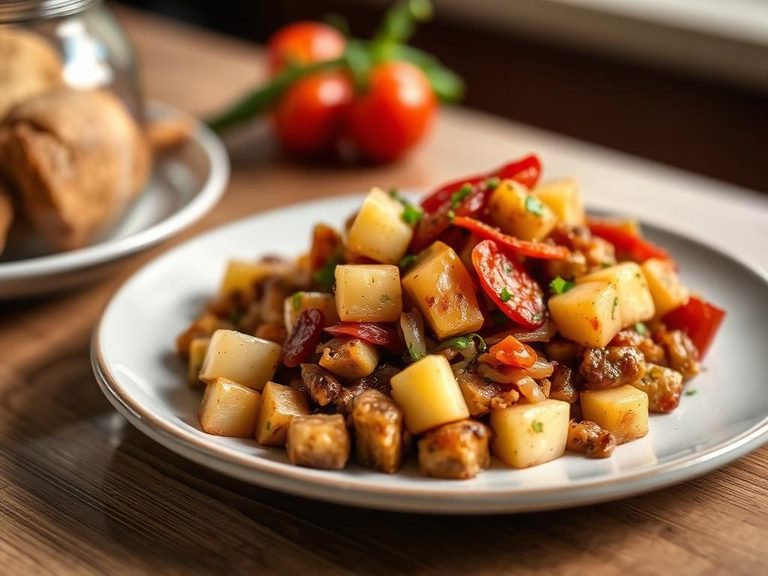
These are pre-cut, par-cooked potato chunks, typically pan-fried or roasted with oil and seasonings until golden-brown and slightly crispy on the outside while fluffy inside. They offer a comforting, savory flavor with a satisfying texture, and their primary nutritional highlight is providing a quick source of energy from carbohydrates and fats. Ready-to-heat versions are a convenient staple for breakfasts and sides, delivering a rich, buttery taste with minimal preparation.
Calorie split: 4% protein · 37% carbs · 59% fat
↓ Full nutrition💚 Why it's loved
People love home fries for their comforting, savory taste and satisfying crispy-soft texture, which makes them a beloved breakfast staple or side dish. Their versatility allows them to be paired with eggs, meats, or sauces, fitting seamlessly into various cuisines and meals.
⚠️ Watch-outs & how to enjoy it better
Home fries can be high in fat and calories, potentially contributing to blood sugar spikes due to their carbohydrate content, and some pre-packaged versions may contain added sodium. To counteract this, pair them with protein or healthy fats like eggs or avocado, practice portion control, and choose versions with minimal added salt or cook them at home with less oil.
Key benefits
- Provides quick energy from carbohydrates
- Convenient time-saver for meal preparation
- Good source of potassium and vitamin C
- Versatile base for many dishes
- Satisfying texture and savory flavor
🍽️ Popular dishes
🌍 Where it's eaten
💡 Did you know?
The term 'home fries' originated in the early 20th century in the United States, referring to potatoes fried at home rather than in a commercial setting, distinguishing them from 'french fries' which were associated with restaurants.
Full nutrition (USDA data · scales with serving)
| Water | 64.8 g |
| Energy | 197 kcal |
| Protein | 1.9 g |
| Total lipid (fat) | 13.0 g |
| Carbohydrate, by difference | 18.4 g |
| Fiber, total dietary | 1.6 g |
| Total Sugars | 1.2 g |
| Calcium, Ca | 9.0 mg |
| Iron, Fe | 0.64 mg |
| Magnesium, Mg | 23.0 mg |
| Phosphorus, P | 52.0 mg |
| Potassium, K | 399 mg |
| Sodium, Na | 340 mg |
| Zinc, Zn | 0.28 mg |
| Copper, Cu | 0.14 mg |
| Selenium, Se | 0.30 ug |
| Vitamin C, total ascorbic acid | 9.7 mg |
| Thiamin | 0.07 mg |
| Riboflavin | 0.03 mg |
| Niacin | 1.2 mg |
| Vitamin B-6 | 0.26 mg |
| Folate, total | 16.0 ug |
| Folic acid | 0.00 ug |
| Folate, food | 16.0 ug |
| Folate, DFE | 16.0 ug |
| Choline, total | 12.7 mg |
| Vitamin B-12 | 0.00 ug |
| Vitamin B-12, added | 0.00 ug |
| Vitamin A, RAE | 0.00 ug |
| Retinol | 0.00 ug |
| Carotene, beta | 3.0 ug |
| Carotene, alpha | 0.00 ug |
| Cryptoxanthin, beta | 0.00 ug |
| Lycopene | 0.00 ug |
| Lutein + zeaxanthin | 13.0 ug |
| Vitamin E (alpha-tocopherol) | 2.5 mg |
| Vitamin E, added | 0.00 mg |
| Vitamin D (D2 + D3) | 0.00 ug |
| Vitamin K (phylloquinone) | 14.0 ug |
| Alcohol, ethyl | 0.00 g |
| Caffeine | 0.00 mg |
| Theobromine | 0.00 mg |
Fat & fatty acid profile (per 100g)
| Fatty acids, total saturated | 1.8 g |
| SFA 4:0 | 0.00 g |
| SFA 6:0 | 0.00 g |
| SFA 8:0 | 0.00 g |
| SFA 10:0 | 0.00 g |
| SFA 12:0 | 0.00 g |
| SFA 14:0 | 0.01 g |
| SFA 16:0 | 1.3 g |
| SFA 18:0 | 0.38 g |
| Fatty acids, total monounsaturated | 5.5 g |
| MUFA 16:1 | 0.05 g |
| MUFA 18:1 | 5.3 g |
| MUFA 20:1 | 0.09 g |
| MUFA 22:1 | 0.00 g |
| Fatty acids, total polyunsaturated | 5.0 g |
| PUFA 18:2 | 4.4 g |
| PUFA 18:3 | 0.57 g |
| PUFA 18:4 | 0.00 g |
| PUFA 20:4 | 0.00 g |
| PUFA 20:5 n-3 (EPA) | 0.00 g |
| PUFA 22:5 n-3 (DPA) | 0.00 g |
| PUFA 22:6 n-3 (DHA) | 0.00 g |
| Cholesterol | 0.00 mg |
Amino acid profile (per 100g)
Estimated from Snacks, potato chips, made from dried potatoes, reduced fat — USDA does not publish this profile for Potato.
| Tryptophan | 0.04 g |
| Threonine | 0.24 g |
| Isoleucine | 0.25 g |
| Leucine | 0.37 g |
| Lysine | 0.35 g |
| Methionine | 0.07 g |
| Cystine | 0.07 g |
| Phenylalanine | 0.26 g |
| Tyrosine | 0.22 g |
| Valine | 0.33 g |
| Arginine | 0.27 g |
| Histidine | 0.13 g |
| Alanine | 0.20 g |
| Aspartic acid | 1.1 g |
| Glutamic acid | 0.94 g |
| Glycine | 0.19 g |
| Proline | 0.20 g |
| Serine | 0.23 g |
FAQ
Are home fries the same as hash browns?
No, home fries are typically cubed or chunked potatoes that are par-cooked and then fried, while hash browns are shredded potatoes that are fried until crispy.
Can I make home fries healthier?
Yes, you can reduce fat by using less oil, baking instead of frying, or using an air fryer, and pair them with vegetables or lean proteins for a balanced meal.
How long do ready-to-heat home fries last?
They can be stored in the refrigerator for 3-5 days or frozen for up to 2 months, but always check the packaging for specific expiration dates.
Nutrient density (calculated · NRF9.3)
Nutrient Rich Foods index: beneficial nutrients (protein, fiber, vitamins, minerals) minus saturated fat, added sugar & sodium, per 100 kcal.
NRF9.3 index — Fulgoni, Keast & Drewnowski, 2009. Computed from USDA nutrients.
Weight-loss friendliness (composite index)
Energy density 1.97 kcal/g · 4% calories from protein · 1.6 g fiber · 1.2 g sugar per 100 g.
Composite of energy density (Rolls et al., 1999), protein & fiber satiety, minus sugar. A calculated heuristic — ranks satiety-per-calorie, not a clinical measure.
Dietary load (calculated from USDA values)
Potential renal acid load. Positive = acid-forming, negative = alkaline-forming.
Sodium-to-potassium ratio: 0.85 (lower is better — aim for ≤ 1)
Sodium:potassium per WHO potassium guidance. Computed from USDA nutrients.