

Potato, hash brown, NFS
Common food
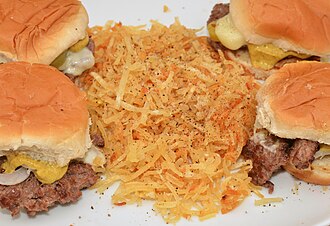
Photo: Wikipedia
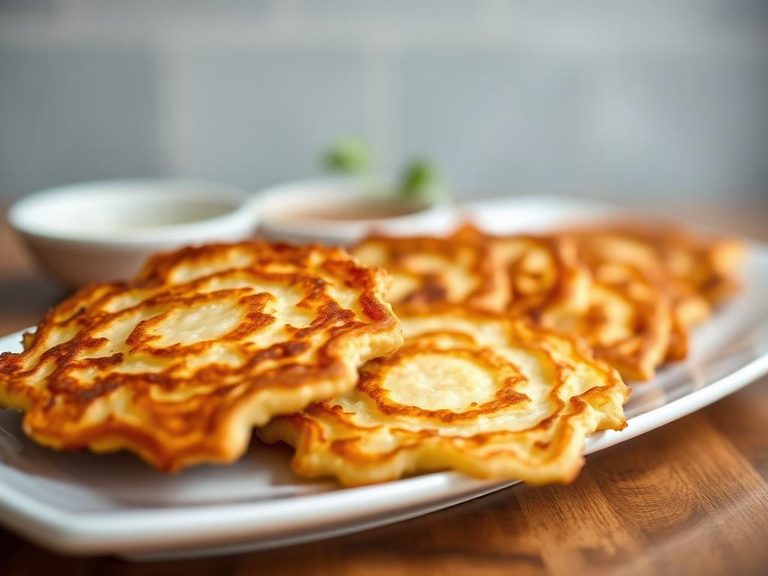
Hash browns are shredded or diced potatoes, pan-fried until the exterior is a deep, golden-brown crust that shatters upon the fork, while the interior remains tender and steamy. Their defining characteristic is the satisfying contrast between the salty, crispy outside and the soft, starchy inside. Nutritionally, they are a concentrated source of carbohydrate energy, with a significant portion of their calories coming from the cooking oil absorbed during frying.
Calorie split: 5% protein · 50% carbs · 46% fat
↓ Full nutrition💚 Why it's loved
People love hash browns for their irresistible crispy texture and savory, salty flavor that serves as the quintessential breakfast comfort food. Their versatility allows them to be a simple side or a canvas for loaded toppings like cheese, onions, and eggs.
⚠️ Watch-outs & how to enjoy it better
The high carbohydrate load and frying method can cause a rapid blood-sugar spike, making portion control important for those managing glucose levels. To counteract this, pair them with a protein like eggs or a healthy fat like avocado to slow digestion. Also, be mindful of sodium content in pre-shredded or frozen varieties; rinsing before cooking can help reduce surface starch and sodium.
Key benefits
- Provides quick, accessible energy from complex carbohydrates.
- Contains potassium, an essential electrolyte for muscle and nerve function.
- Offers dietary fiber, particularly if the potato skin is included in the shred.
- A familiar, comforting food that can be a base for many nutrient-dense toppings.
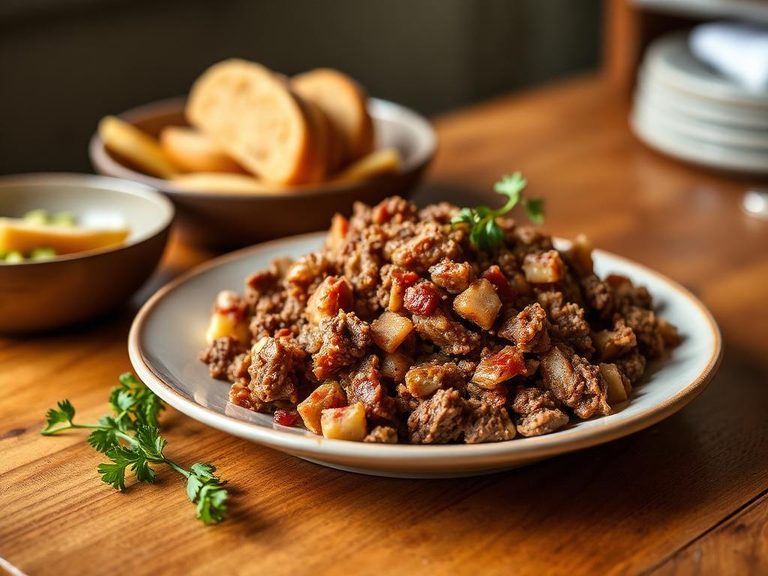
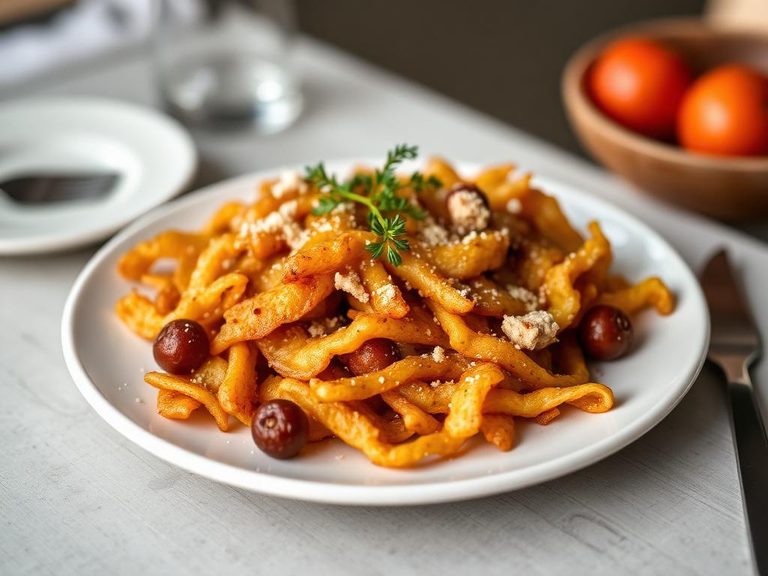
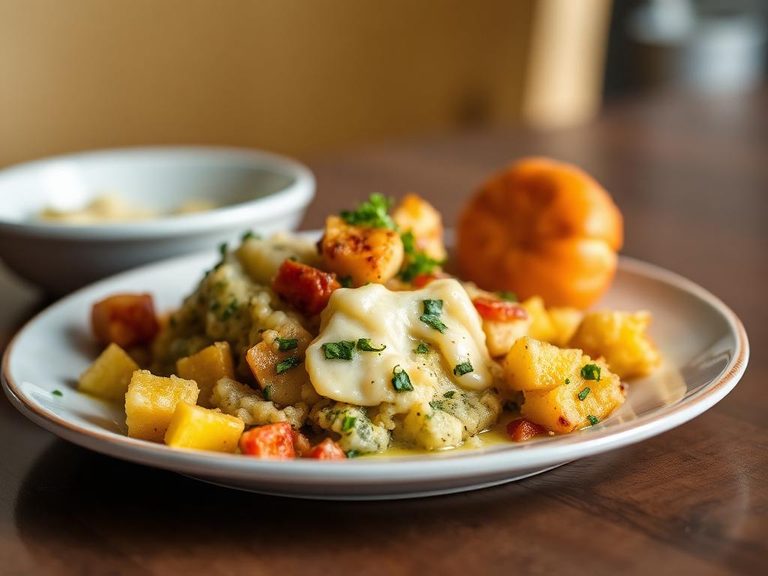
🍽️ Popular dishes

🌍 Where it's eaten
💡 Did you know?
The term 'hash' comes from the French word 'hacher,' meaning to chop or hack, reflecting the original method of using leftover chopped meat and potatoes.
Full nutrition (USDA data · scales with serving)
| Water | 55.4 g |
| Energy | 217 kcal |
| Protein | 2.6 g |
| Total lipid (fat) | 11.5 g |
| Carbohydrate, by difference | 28.2 g |
| Fiber, total dietary | 3.2 g |
| Total Sugars | 0.27 g |
| Calcium, Ca | 17.0 mg |
| Iron, Fe | 0.54 mg |
| Magnesium, Mg | 28.0 mg |
| Phosphorus, P | 78.0 mg |
| Potassium, K | 491 mg |
| Sodium, Na | 398 mg |
| Zinc, Zn | 0.38 mg |
| Copper, Cu | 0.11 mg |
| Selenium, Se | 0.50 ug |
| Vitamin C, total ascorbic acid | 6.6 mg |
| Thiamin | 0.13 mg |
| Riboflavin | 0.03 mg |
| Niacin | 2.3 mg |
| Vitamin B-6 | 0.23 mg |
| Folate, total | 16.0 ug |
| Folic acid | 0.00 ug |
| Folate, food | 16.0 ug |
| Folate, DFE | 16.0 ug |
| Choline, total | 23.0 mg |
| Vitamin B-12 | 0.00 ug |
| Vitamin B-12, added | 0.00 ug |
| Vitamin A, RAE | 0.00 ug |
| Retinol | 0.00 ug |
| Carotene, beta | 0.00 ug |
| Carotene, alpha | 0.00 ug |
| Cryptoxanthin, beta | 0.00 ug |
| Lycopene | 0.00 ug |
| Lutein + zeaxanthin | 0.00 ug |
| Vitamin E (alpha-tocopherol) | 2.2 mg |
| Vitamin E, added | 0.00 mg |
| Vitamin D (D2 + D3) | 0.00 ug |
| Vitamin K (phylloquinone) | 17.9 ug |
| Alcohol, ethyl | 0.00 g |
| Caffeine | 0.00 mg |
| Theobromine | 0.00 mg |
Fat & fatty acid profile (per 100g)
| Fatty acids, total saturated | 0.93 g |
| SFA 4:0 | 0.01 g |
| SFA 6:0 | 0.00 g |
| SFA 8:0 | 0.00 g |
| SFA 10:0 | 0.01 g |
| SFA 12:0 | 0.00 g |
| SFA 14:0 | 0.01 g |
| SFA 16:0 | 0.52 g |
| SFA 18:0 | 0.24 g |
| Fatty acids, total monounsaturated | 7.2 g |
| MUFA 16:1 | 0.02 g |
| MUFA 18:1 | 7.0 g |
| MUFA 20:1 | 0.20 g |
| MUFA 22:1 | 0.01 g |
| Fatty acids, total polyunsaturated | 2.8 g |
| PUFA 18:2 | 2.3 g |
| PUFA 18:3 | 0.44 g |
| PUFA 18:4 | 0.00 g |
| PUFA 20:4 | 0.00 g |
| PUFA 20:5 n-3 (EPA) | 0.00 g |
| PUFA 22:5 n-3 (DPA) | 0.00 g |
| PUFA 22:6 n-3 (DHA) | 0.00 g |
| Cholesterol | 0.00 mg |
Amino acid profile (per 100g)
Estimated from Snacks, potato chips, made from dried potatoes, reduced fat — USDA does not publish this profile for Potato.
| Tryptophan | 0.04 g |
| Threonine | 0.24 g |
| Isoleucine | 0.25 g |
| Leucine | 0.37 g |
| Lysine | 0.35 g |
| Methionine | 0.07 g |
| Cystine | 0.07 g |
| Phenylalanine | 0.26 g |
| Tyrosine | 0.22 g |
| Valine | 0.33 g |
| Arginine | 0.27 g |
| Histidine | 0.13 g |
| Alanine | 0.20 g |
| Aspartic acid | 1.1 g |
| Glutamic acid | 0.94 g |
| Glycine | 0.19 g |
| Proline | 0.20 g |
| Serine | 0.23 g |
FAQ
What's the difference between hash browns and home fries?
Hash browns are made from shredded or riced raw potatoes, while home fries are typically diced or cubed potatoes that are par-boiled or raw before frying, resulting in a chunkier texture.
How do I get hash browns extra crispy?
The key is to remove as much moisture as possible from the shredded potatoes. Squeeze them thoroughly in a clean towel, and ensure your pan and oil are very hot before adding them in a single, undisturbed layer.
Are frozen hash browns as nutritious as fresh?
Frozen hash browns are often flash-frozen at peak freshness and can be equally nutritious. However, check labels for added sodium or preservatives, and they may have a slightly softer texture upon cooking.
Nutrient density (calculated · NRF9.3)
Nutrient Rich Foods index: beneficial nutrients (protein, fiber, vitamins, minerals) minus saturated fat, added sugar & sodium, per 100 kcal.
NRF9.3 index — Fulgoni, Keast & Drewnowski, 2009. Computed from USDA nutrients.
Weight-loss friendliness (composite index)
Energy density 2.17 kcal/g · 5% calories from protein · 3.2 g fiber · 0.3 g sugar per 100 g.
Composite of energy density (Rolls et al., 1999), protein & fiber satiety, minus sugar. A calculated heuristic — ranks satiety-per-calorie, not a clinical measure.
Dietary load (calculated from USDA values)
Potential renal acid load. Positive = acid-forming, negative = alkaline-forming.
Sodium-to-potassium ratio: 0.81 (lower is better — aim for ≤ 1)
Sodium:potassium per WHO potassium guidance. Computed from USDA nutrients.