

Potato, french fries, with cheese, school
Common food

Photo: Wikipedia
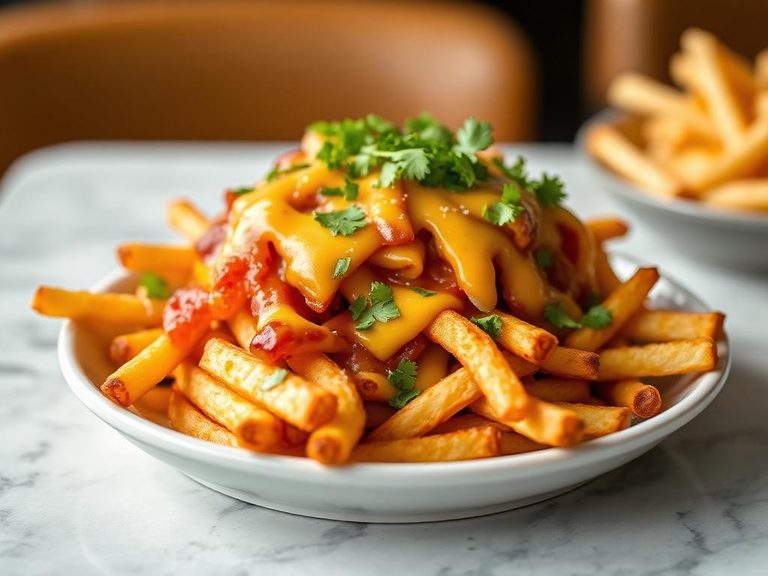
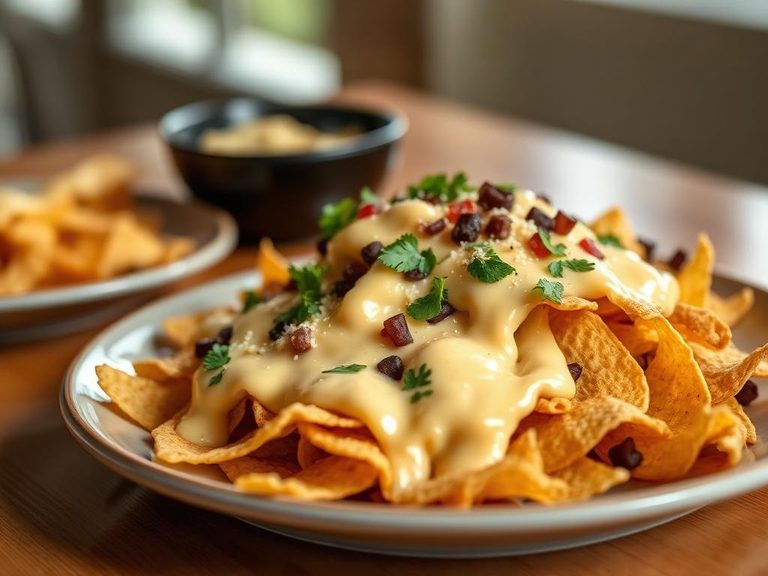
This is a classic school lunch staple: golden, crispy french fries blanketed in a warm, savory cheese sauce. The texture is a delightful contrast between the fluffy, starchy potato interior and the smooth, salty cheese coating. Nutritionally, it's a calorie-dense side dish, primarily providing quick energy from carbs and fat.
Calorie split: 10% protein · 39% carbs · 51% fat
↓ Full nutrition💚 Why it's loved
People love it for the ultimate comfort combination of salty, crispy fries and creamy, umami-rich cheese. It's a nostalgic, satisfying treat that feels like a special occasion in a school cafeteria.
⚠️ Watch-outs & how to enjoy it better
This dish is high in sodium, refined carbs, and fat, which can contribute to energy crashes and is less ideal for those monitoring blood sugar or heart health. To counteract, pair it with a source of protein (like a side of beans or a hard-boiled egg) and a fiber-rich vegetable (like steamed broccoli) to slow digestion and improve satiety.
Key benefits
- Provides quick energy from carbohydrates
- Contains some dietary fiber from the potato
- Offers a small amount of plant-based protein
- A familiar, comforting food that can encourage eating in school settings
- The cheese adds calcium and a boost of flavor
🍽️ Popular dishes
🌍 Where it's eaten
💡 Did you know?
The cheese sauce served on school fries is often a processed 'cheese product,' which uses emulsifying salts to prevent the cheese from separating into oil and solids when melted.
Full nutrition (USDA data · scales with serving)
| Water | 65.7 g |
| Energy | 181 kcal |
| Protein | 4.5 g |
| Total lipid (fat) | 10.3 g |
| Carbohydrate, by difference | 17.7 g |
| Fiber, total dietary | 1.5 g |
| Total Sugars | 1.2 g |
| Calcium, Ca | 84.0 mg |
| Iron, Fe | 0.61 mg |
| Magnesium, Mg | 24.0 mg |
| Phosphorus, P | 101 mg |
| Potassium, K | 384 mg |
| Sodium, Na | 195 mg |
| Zinc, Zn | 0.71 mg |
| Copper, Cu | 0.14 mg |
| Selenium, Se | 3.9 ug |
| Vitamin C, total ascorbic acid | 9.1 mg |
| Thiamin | 0.07 mg |
| Riboflavin | 0.07 mg |
| Niacin | 1.2 mg |
| Vitamin B-6 | 0.26 mg |
| Folate, total | 17.0 ug |
| Folic acid | 0.00 ug |
| Folate, food | 17.0 ug |
| Folate, DFE | 17.0 ug |
| Choline, total | 13.5 mg |
| Vitamin B-12 | 0.14 ug |
| Vitamin B-12, added | 0.00 ug |
| Vitamin A, RAE | 15.0 ug |
| Retinol | 14.0 ug |
| Carotene, beta | 5.0 ug |
| Carotene, alpha | 0.00 ug |
| Cryptoxanthin, beta | 0.00 ug |
| Lycopene | 0.00 ug |
| Lutein + zeaxanthin | 13.0 ug |
| Vitamin E (alpha-tocopherol) | 1.6 mg |
| Vitamin E, added | 0.00 mg |
| Vitamin D (D2 + D3) | 0.00 ug |
| Vitamin K (phylloquinone) | 9.3 ug |
| Alcohol, ethyl | 0.00 g |
| Caffeine | 0.00 mg |
| Theobromine | 0.00 mg |
Fat & fatty acid profile (per 100g)
| Fatty acids, total saturated | 2.4 g |
| SFA 4:0 | 0.04 g |
| SFA 6:0 | 0.04 g |
| SFA 8:0 | 0.02 g |
| SFA 10:0 | 0.06 g |
| SFA 12:0 | 0.07 g |
| SFA 14:0 | 0.21 g |
| SFA 16:0 | 1.4 g |
| SFA 18:0 | 0.45 g |
| Fatty acids, total monounsaturated | 4.0 g |
| MUFA 16:1 | 0.06 g |
| MUFA 18:1 | 3.8 g |
| MUFA 20:1 | 0.06 g |
| MUFA 22:1 | 0.00 g |
| Fatty acids, total polyunsaturated | 3.3 g |
| PUFA 18:2 | 2.9 g |
| PUFA 18:3 | 0.37 g |
| PUFA 18:4 | 0.00 g |
| PUFA 20:4 | 0.00 g |
| PUFA 20:5 n-3 (EPA) | 0.00 g |
| PUFA 22:5 n-3 (DPA) | 0.00 g |
| PUFA 22:6 n-3 (DHA) | 0.00 g |
| Cholesterol | 8.0 mg |
Amino acid profile (per 100g)
Estimated from Snacks, potato chips, made from dried potatoes, reduced fat — USDA does not publish this profile for Potato.
| Tryptophan | 0.04 g |
| Threonine | 0.24 g |
| Isoleucine | 0.25 g |
| Leucine | 0.37 g |
| Lysine | 0.35 g |
| Methionine | 0.07 g |
| Cystine | 0.07 g |
| Phenylalanine | 0.26 g |
| Tyrosine | 0.22 g |
| Valine | 0.33 g |
| Arginine | 0.27 g |
| Histidine | 0.13 g |
| Alanine | 0.20 g |
| Aspartic acid | 1.1 g |
| Glutamic acid | 0.94 g |
| Glycine | 0.19 g |
| Proline | 0.20 g |
| Serine | 0.23 g |
FAQ
Is this the same as poutine?
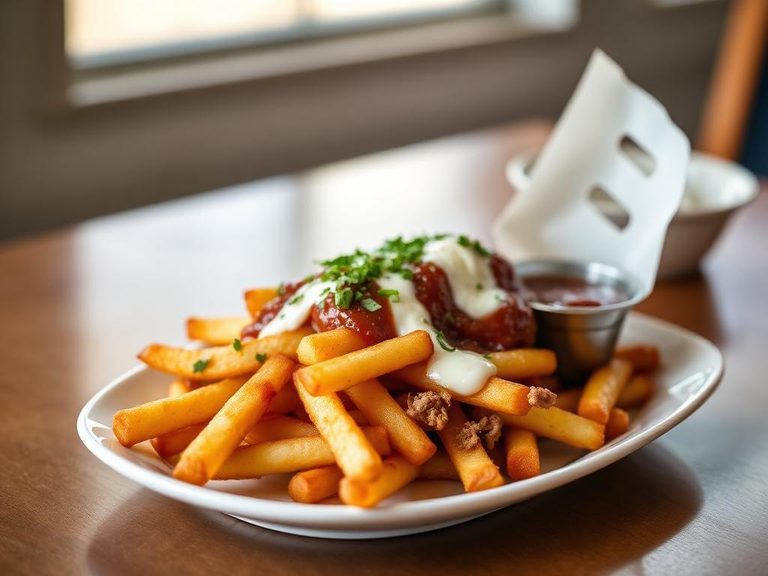
No. Poutine is a Canadian dish of fries topped with cheese *curds* and brown gravy. The school version typically uses a smooth, processed cheese sauce.
Why is the cheese so smooth and doesn't separate?
Processed cheese sauces contain emulsifying salts (like sodium citrate) that bind the cheese proteins and fats together, creating a stable, creamy texture that won't break when heated.
Can I make a healthier version at home?
Yes. Bake or air-fry potato wedges instead of deep-frying, and make a sauce with real cheddar, a splash of milk, and a touch of mustard. This reduces fat and sodium while increasing flavor.
Nutrient density (calculated · NRF9.3)
Nutrient Rich Foods index: beneficial nutrients (protein, fiber, vitamins, minerals) minus saturated fat, added sugar & sodium, per 100 kcal.
NRF9.3 index — Fulgoni, Keast & Drewnowski, 2009. Computed from USDA nutrients.
Weight-loss friendliness (composite index)
Energy density 1.81 kcal/g · 10% calories from protein · 1.5 g fiber · 1.2 g sugar per 100 g.
Composite of energy density (Rolls et al., 1999), protein & fiber satiety, minus sugar. A calculated heuristic — ranks satiety-per-calorie, not a clinical measure.
Dietary load (calculated from USDA values)
Potential renal acid load. Positive = acid-forming, negative = alkaline-forming.
Sodium-to-potassium ratio: 0.51 (lower is better — aim for ≤ 1)
Sodium:potassium per WHO potassium guidance. Computed from USDA nutrients.