

Pie, pecan
Common food

Photo: Wikipedia
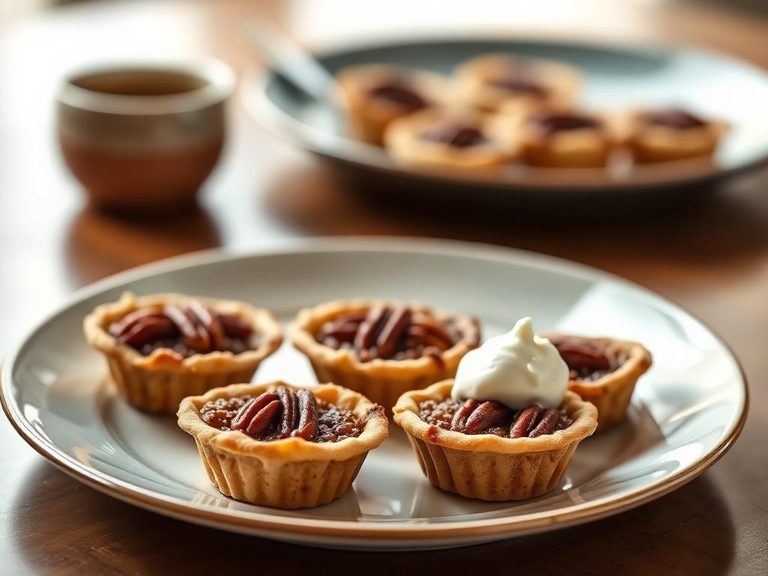
Pecan pie is a rich, sweet dessert with a gooey, caramel-like filling made from corn syrup or molasses, eggs, and butter, studded with crunchy pecan halves, all nestled in a flaky pastry crust. Each bite offers a satisfying contrast between the crisp, buttery crust and the dense, chewy, nutty filling. Nutritionally, it is a high-energy treat, delivering a significant amount of sugar and fat per serving.
Calorie split: 5% protein · 44% carbs · 51% fat
↓ Full nutrition💚 Why it's loved
People love pecan pie for its decadent, comforting flavor profile—a perfect balance of sweet, buttery, and toasty nutty notes. It is a cultural staple of Southern U.S. cuisine, especially associated with holidays like Thanksgiving, evoking nostalgia and tradition.
⚠️ Watch-outs & how to enjoy it better
Its high sugar and fat content can lead to blood sugar spikes and is not suitable for low-sugar or low-fat diets. The pie is also a common allergen (tree nuts, wheat, eggs) and very calorie-dense; enjoying a small slice with a source of protein (like a dollop of Greek yogurt) can help moderate the glycemic impact.
Key benefits
- Provides a quick source of energy from carbohydrates and fats
- Contains some dietary fiber from the pecans
- Pecans offer plant-based protein and minerals like manganese
- A traditional dessert that can be part of celebratory meals
🍽️ Popular dishes
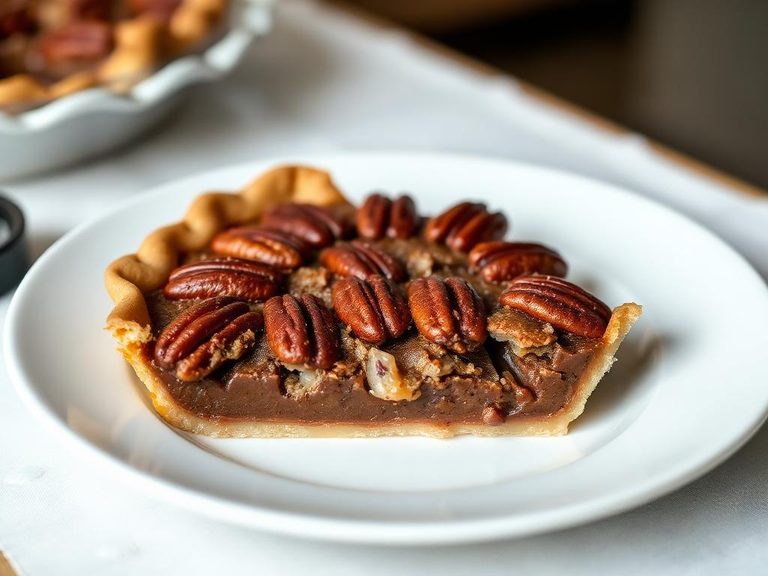
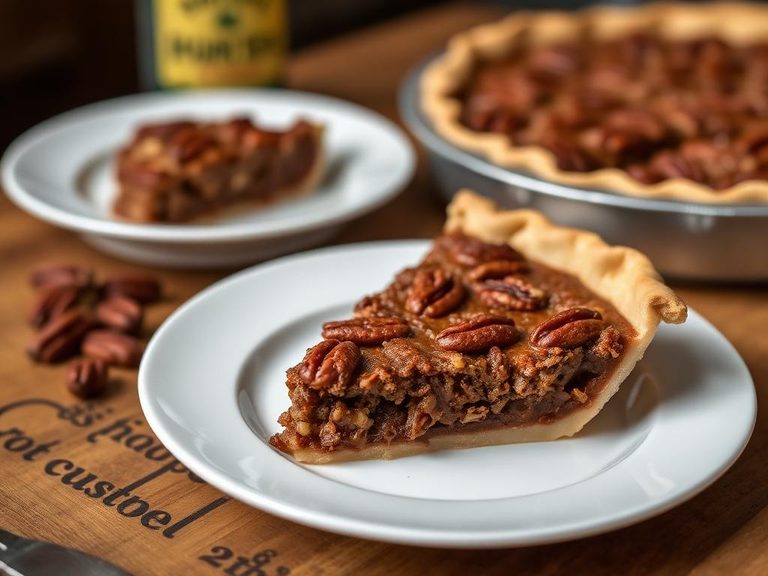
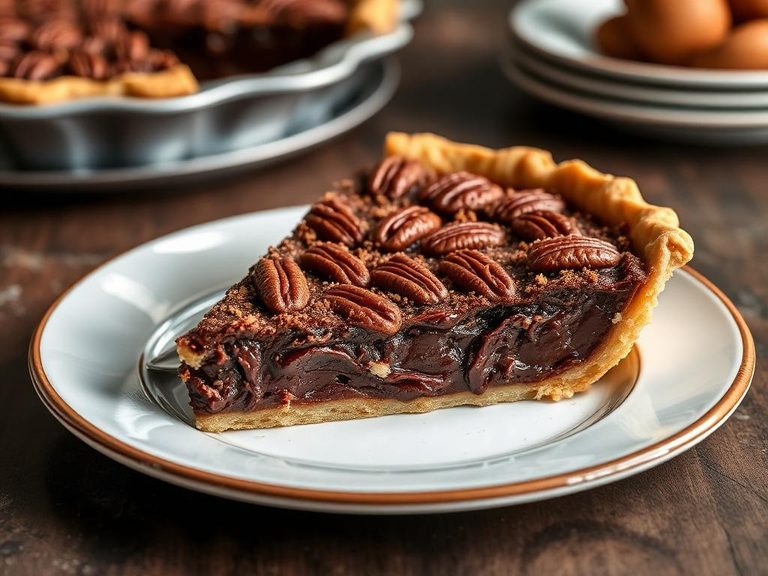
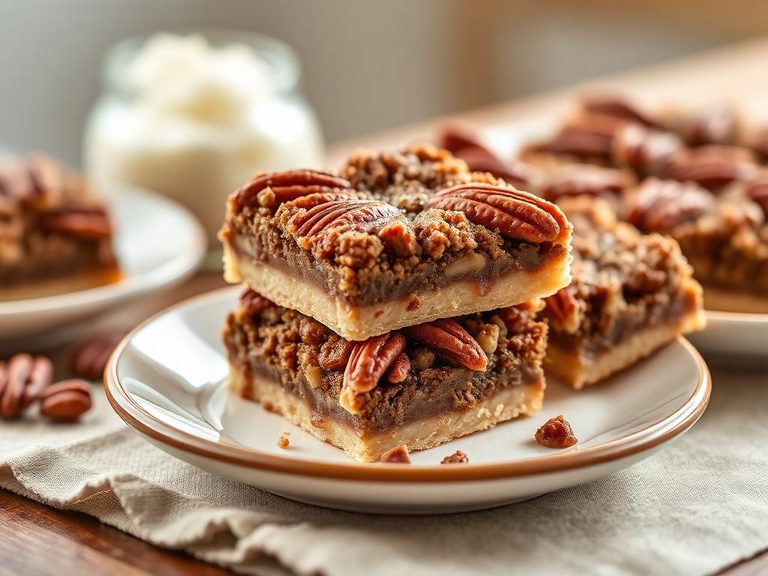
🌍 Where it's eaten
💡 Did you know?
The corn syrup commonly used in modern pecan pie recipes was popularized in the U.S. in the early 20th century, but earlier versions of the pie often used molasses or maple syrup.
Full nutrition (USDA data · scales with serving)
| Water | 18.0 g |
| Energy | 449 kcal |
| Protein | 6.0 g |
| Total lipid (fat) | 25.3 g |
| Carbohydrate, by difference | 49.5 g |
| Fiber, total dietary | 1.9 g |
| Total Sugars | 31.0 g |
| Calcium, Ca | 25.0 mg |
| Iron, Fe | 1.6 mg |
| Magnesium, Mg | 23.0 mg |
| Phosphorus, P | 100 mg |
| Potassium, K | 117 mg |
| Sodium, Na | 299 mg |
| Zinc, Zn | 0.98 mg |
| Copper, Cu | 0.17 mg |
| Selenium, Se | 9.0 ug |
| Vitamin C, total ascorbic acid | 0.20 mg |
| Thiamin | 0.19 mg |
| Riboflavin | 0.15 mg |
| Niacin | 1.3 mg |
| Vitamin B-6 | 0.05 mg |
| Folate, total | 36.0 ug |
| Folic acid | 16.0 ug |
| Folate, food | 20.0 ug |
| Folate, DFE | 47.0 ug |
| Choline, total | 62.9 mg |
| Vitamin B-12 | 0.16 ug |
| Vitamin B-12, added | 0.00 ug |
| Vitamin A, RAE | 65.0 ug |
| Retinol | 63.0 ug |
| Carotene, beta | 11.0 ug |
| Carotene, alpha | 0.00 ug |
| Cryptoxanthin, beta | 4.0 ug |
| Lycopene | 0.00 ug |
| Lutein + zeaxanthin | 100 ug |
| Vitamin E (alpha-tocopherol) | 0.58 mg |
| Vitamin E, added | 0.00 mg |
| Vitamin D (D2 + D3) | 0.50 ug |
| Vitamin K (phylloquinone) | 3.5 ug |
| Alcohol, ethyl | 0.00 g |
| Caffeine | 0.00 mg |
| Theobromine | 0.00 mg |
Fat & fatty acid profile (per 100g)
| Fatty acids, total saturated | 6.4 g |
| SFA 4:0 | 0.08 g |
| SFA 6:0 | 0.06 g |
| SFA 8:0 | 0.03 g |
| SFA 10:0 | 0.07 g |
| SFA 12:0 | 0.09 g |
| SFA 14:0 | 0.37 g |
| SFA 16:0 | 3.7 g |
| SFA 18:0 | 1.8 g |
| Fatty acids, total monounsaturated | 11.5 g |
| MUFA 16:1 | 0.22 g |
| MUFA 18:1 | 11.4 g |
| MUFA 20:1 | 0.09 g |
| MUFA 22:1 | 0.00 g |
| Fatty acids, total polyunsaturated | 4.9 g |
| PUFA 18:2 | 4.5 g |
| PUFA 18:3 | 0.20 g |
| PUFA 18:4 | 0.00 g |
| PUFA 20:4 | 0.01 g |
| PUFA 20:5 n-3 (EPA) | 0.00 g |
| PUFA 22:5 n-3 (DPA) | 0.00 g |
| PUFA 22:6 n-3 (DHA) | 0.00 g |
| Cholesterol | 89.0 mg |
Amino acid profile (per 100g)
Estimated from Pie Crust, Cookie-type, Chocolate, Ready Crust — USDA does not publish this profile for Pie.
| Tryptophan | 0.08 g |
| Threonine | 0.20 g |
| Isoleucine | 0.23 g |
| Leucine | 0.38 g |
| Lysine | 0.24 g |
| Methionine | 0.07 g |
| Cystine | 0.11 g |
| Phenylalanine | 0.28 g |
| Tyrosine | 0.16 g |
| Valine | 0.32 g |
| Arginine | 0.29 g |
| Histidine | 0.11 g |
| Alanine | 0.24 g |
| Aspartic acid | 0.45 g |
| Glutamic acid | 1.3 g |
| Glycine | 0.24 g |
| Proline | 0.42 g |
| Serine | 0.26 g |
FAQ
Why does pecan pie sometimes have a runny filling?
The filling can be runny if the pie is underbaked or if the ratio of eggs to syrup is off. The eggs are crucial for setting the filling. Letting the pie cool completely after baking allows it to firm up properly.
Can I make pecan pie without corn syrup?
Yes, you can substitute corn syrup with maple syrup, golden syrup, or even a honey-based syrup. Each will give a slightly different flavor and texture, but the pie will still set well due to the eggs and butter.
Is pecan pie gluten-free?
The filling itself is typically gluten-free, but the traditional pie crust contains wheat flour. To make a gluten-free version, use a crust made from almond flour, gluten-free flour blend, or a nut-based crust.
Nutrient density (calculated · NRF9.3)
Nutrient Rich Foods index: beneficial nutrients (protein, fiber, vitamins, minerals) minus saturated fat, added sugar & sodium, per 100 kcal.
NRF9.3 index — Fulgoni, Keast & Drewnowski, 2009. Computed from USDA nutrients.
Weight-loss friendliness (composite index)
Energy density 4.49 kcal/g · 5% calories from protein · 1.9 g fiber · 31.0 g sugar per 100 g.
Composite of energy density (Rolls et al., 1999), protein & fiber satiety, minus sugar. A calculated heuristic — ranks satiety-per-calorie, not a clinical measure.
Dietary load (calculated from USDA values)
Potential renal acid load. Positive = acid-forming, negative = alkaline-forming.
Sodium-to-potassium ratio: 2.56 (lower is better — aim for ≤ 1)
Sodium:potassium per WHO potassium guidance. Computed from USDA nutrients.