

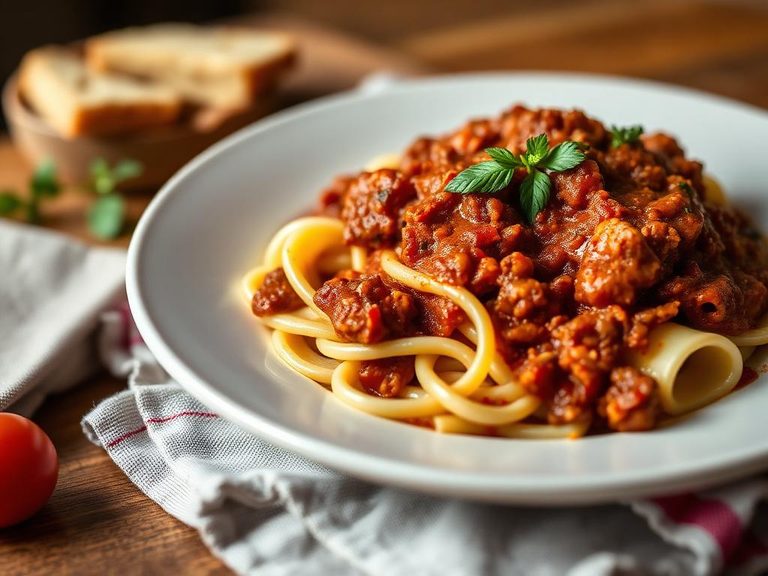
Pasta, whole grain, with tomato-based sauce and meat, restaurant
Common food
A hearty, savory dish of whole-grain pasta tossed in a rich, meaty tomato sauce, offering a satisfying chew and deep umami flavor. The whole-wheat base provides a nutty, earthy backbone that complements the tangy, savory sauce. With 5.52g of protein and 2.5g of fiber per 100g, it's a more nutrient-dense and filling option than its refined-pasta counterpart.
Calorie split: 12% protein · 39% carbs · 49% fat
↓ Full nutrition💚 Why it's loved
People love it for its comforting, familiar flavors that combine the heartiness of meat with the tangy richness of tomato sauce, all on a satisfyingly chewy whole-grain base. It's a versatile, crowd-pleasing meal that feels both indulgent and nourishing, often evoking a sense of home cooking and cultural tradition.
⚠️ Watch-outs & how to enjoy it better
The combination of pasta and a meat sauce can be high in sodium and saturated fat, and the refined carbohydrates in the sauce (like added sugar) may cause blood-sugar spikes for some. To counteract this, opt for lean meat (like turkey or chicken), use a low-sugar tomato sauce, and pair the meal with a side of leafy greens or a salad to add fiber and slow digestion. Portion control is also key, as restaurant servings can be large.
Key benefits
- Provides sustained energy from complex carbohydrates and fiber
- Contains a balanced mix of protein, carbs, and fats for satiety
- Whole-grain pasta offers more micronutrients and fiber than refined pasta
- Tomato sauce is a source of lycopene, an antioxidant
- A versatile meal that can be adapted with various vegetables and lean meats
🍽️ Popular dishes
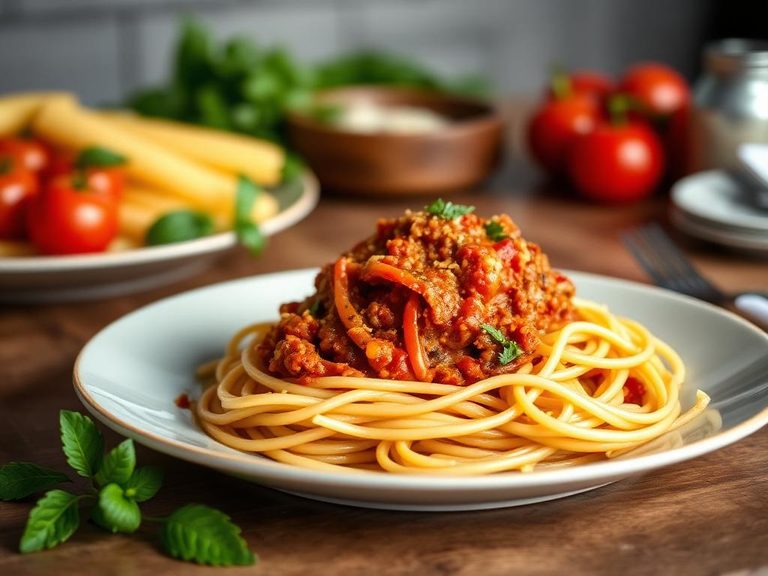
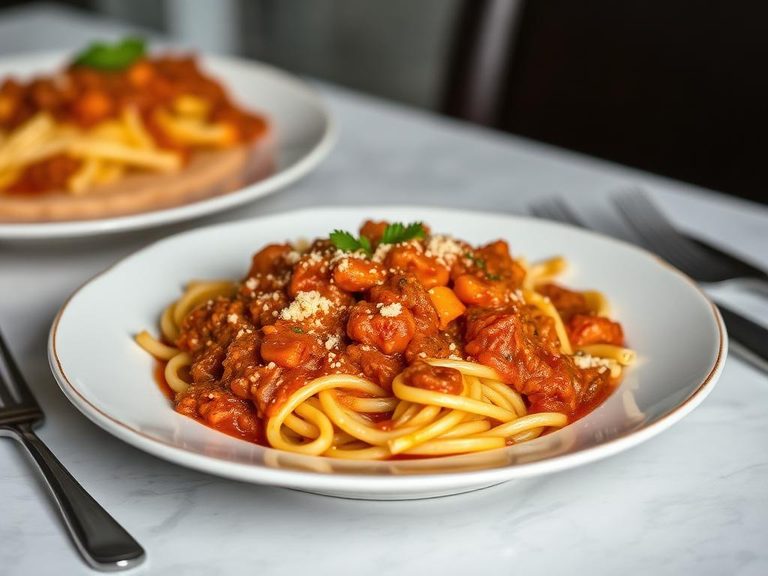
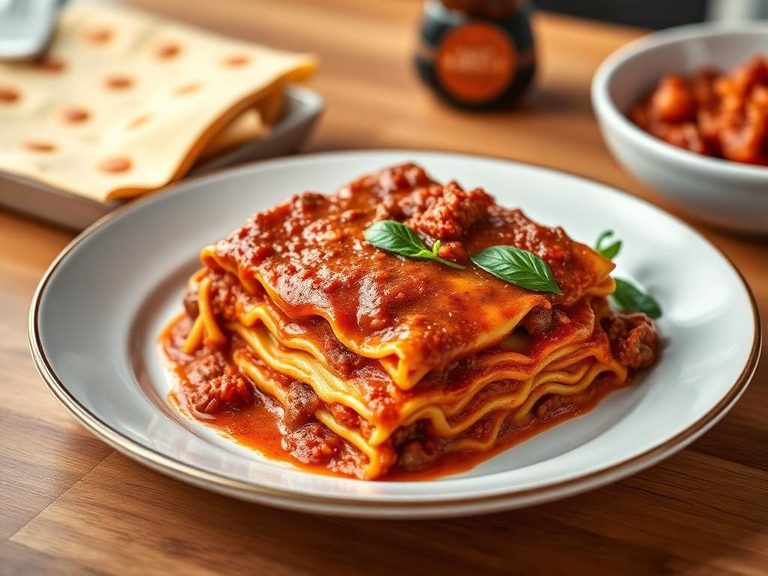
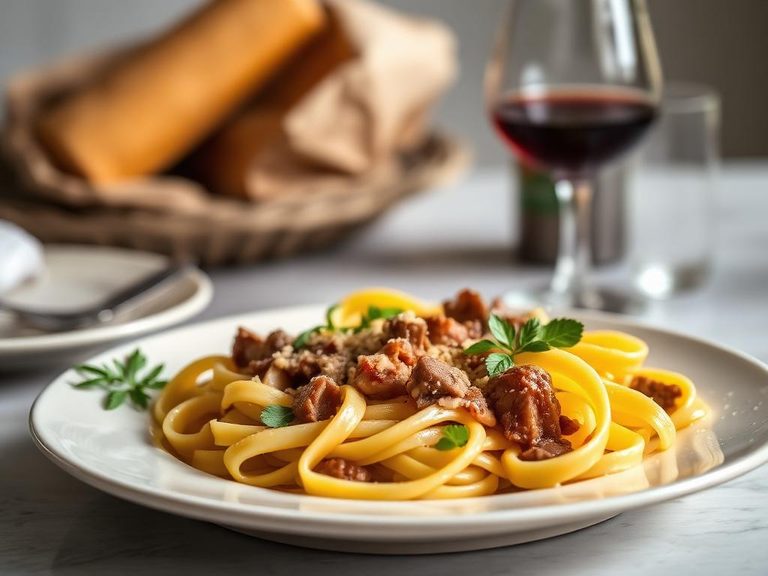
🌍 Where it's eaten
💡 Did you know?
The classic 'Spaghetti Bolognese' as known internationally is actually a misnomer; in Bologna, Italy, the authentic ragù is traditionally served with tagliatelle, not spaghetti.
Full nutrition (USDA data · scales with serving)
| Water | 66.1 g |
| Energy | 174 kcal |
| Protein | 5.5 g |
| Total lipid (fat) | 9.6 g |
| Carbohydrate, by difference | 17.4 g |
| Fiber, total dietary | 2.5 g |
| Total Sugars | 2.4 g |
| Calcium, Ca | 18.0 mg |
| Iron, Fe | 1.3 mg |
| Magnesium, Mg | 34.0 mg |
| Phosphorus, P | 89.0 mg |
| Potassium, K | 187 mg |
| Sodium, Na | 385 mg |
| Zinc, Zn | 1.2 mg |
| Copper, Cu | 0.14 mg |
| Selenium, Se | 19.7 ug |
| Vitamin C, total ascorbic acid | 0.70 mg |
| Thiamin | 0.09 mg |
| Riboflavin | 0.08 mg |
| Niacin | 3.3 mg |
| Vitamin B-6 | 0.14 mg |
| Folate, total | 16.0 ug |
| Folic acid | 0.00 ug |
| Folate, food | 16.0 ug |
| Folate, DFE | 16.0 ug |
| Choline, total | 14.8 mg |
| Vitamin B-12 | 0.23 ug |
| Vitamin B-12, added | 0.00 ug |
| Vitamin A, RAE | 12.0 ug |
| Retinol | 0.00 ug |
| Carotene, beta | 142 ug |
| Carotene, alpha | 0.00 ug |
| Cryptoxanthin, beta | 0.00 ug |
| Lycopene | 4602 ug |
| Lutein + zeaxanthin | 114 ug |
| Vitamin E (alpha-tocopherol) | 2.3 mg |
| Vitamin E, added | 0.00 mg |
| Vitamin D (D2 + D3) | 0.00 ug |
| Vitamin K (phylloquinone) | 12.4 ug |
| Alcohol, ethyl | 0.00 g |
| Caffeine | 0.00 mg |
| Theobromine | 0.00 mg |
Fat & fatty acid profile (per 100g)
| Fatty acids, total saturated | 1.6 g |
| SFA 4:0 | 0.00 g |
| SFA 6:0 | 0.00 g |
| SFA 8:0 | 0.00 g |
| SFA 10:0 | 0.00 g |
| SFA 12:0 | 0.00 g |
| SFA 14:0 | 0.05 g |
| SFA 16:0 | 1.1 g |
| SFA 18:0 | 0.39 g |
| Fatty acids, total monounsaturated | 3.8 g |
| MUFA 16:1 | 0.08 g |
| MUFA 18:1 | 3.6 g |
| MUFA 20:1 | 0.06 g |
| MUFA 22:1 | 0.00 g |
| Fatty acids, total polyunsaturated | 3.1 g |
| PUFA 18:2 | 2.8 g |
| PUFA 18:3 | 0.35 g |
| PUFA 18:4 | 0.00 g |
| PUFA 20:4 | 0.00 g |
| PUFA 20:5 n-3 (EPA) | 0.00 g |
| PUFA 22:5 n-3 (DPA) | 0.00 g |
| PUFA 22:6 n-3 (DHA) | 0.00 g |
| Cholesterol | 8.0 mg |
Amino acid profile (per 100g)
Estimated from Restaurant, Italian, chicken parmesan without pasta — USDA does not publish this profile for Pasta.
| Tryptophan | 0.20 g |
| Threonine | 0.66 g |
| Isoleucine | 0.72 g |
| Leucine | 1.3 g |
| Lysine | 1.3 g |
| Methionine | 0.41 g |
| Cystine | 0.20 g |
| Phenylalanine | 1.1 g |
| Tyrosine | 0.53 g |
| Valine | 0.81 g |
| Arginine | 0.93 g |
| Histidine | 0.50 g |
| Alanine | 0.79 g |
| Aspartic acid | 1.4 g |
| Glutamic acid | 2.8 g |
| Glycine | 0.61 g |
| Proline | 1.3 g |
| Serine | 0.70 g |
| Hydroxyproline | 0.04 g |
FAQ
Is whole-grain pasta healthier than regular pasta?
Yes, whole-grain pasta retains the entire grain kernel, providing more fiber, vitamins, and minerals than refined pasta, which can help with digestion and blood sugar regulation.
How can I make this dish healthier at home?
Use lean ground meat (like turkey or chicken), reduce added sugar in the sauce, add plenty of vegetables (like zucchini, carrots, or spinach), and choose a whole-grain or legume-based pasta.
What's the best way to store leftovers?
Store in an airtight container in the refrigerator for up to 3-4 days, or freeze for up to 3 months. Reheat gently on the stovetop or in the microwave, adding a splash of water or broth to prevent drying.
Nutrient density (calculated · NRF9.3)
Nutrient Rich Foods index: beneficial nutrients (protein, fiber, vitamins, minerals) minus saturated fat, added sugar & sodium, per 100 kcal.
NRF9.3 index — Fulgoni, Keast & Drewnowski, 2009. Computed from USDA nutrients.
Weight-loss friendliness (composite index)
Energy density 1.74 kcal/g · 13% calories from protein · 2.5 g fiber · 2.4 g sugar per 100 g.
Composite of energy density (Rolls et al., 1999), protein & fiber satiety, minus sugar. A calculated heuristic — ranks satiety-per-calorie, not a clinical measure.
Dietary load (calculated from USDA values)
Potential renal acid load. Positive = acid-forming, negative = alkaline-forming.
Sodium-to-potassium ratio: 2.06 (lower is better — aim for ≤ 1)
Sodium:potassium per WHO potassium guidance. Computed from USDA nutrients.