

Muffin, English, with fruit other than raisins
Common food

Photo: Wikipedia
A dense, cake-like quick bread, the English muffin with fruit (like blueberries or cranberries) offers a tender, slightly chewy crumb with bursts of sweet-tart fruit flavor. Nutritionally, it's a moderate-energy carbohydrate source, notable for its relatively high protein content compared to many sweet baked goods. Its texture is perfect for toasting, creating a crisp exterior that contrasts with the soft, fruit-studded interior.
Calorie split: 15% protein · 78% carbs · 7% fat
↓ Full nutrition💚 Why it's loved
People love it for its comforting, familiar taste and the delightful surprise of fruit in every bite, making it a beloved breakfast staple. Its sturdy yet tender texture is ideal for toasting and holds up well to toppings, from butter to cream cheese.
⚠️ Watch-outs & how to enjoy it better
The refined flour and added sugar can cause a rapid blood-sugar spike, especially if consumed alone. To mitigate this, pair it with protein (like eggs or Greek yogurt) or healthy fat (like nut butter) to slow digestion. Those with gluten or wheat allergies should avoid it entirely.
Key benefits
- Provides a quick source of energy from complex carbohydrates.
- Offers a good protein boost for a baked good, aiding satiety.
- Contains dietary fiber to support digestive health.
- Fruit additions contribute natural sweetness and micronutrients.
- Versatile base for both sweet and savory preparations.
🍽️ Popular dishes
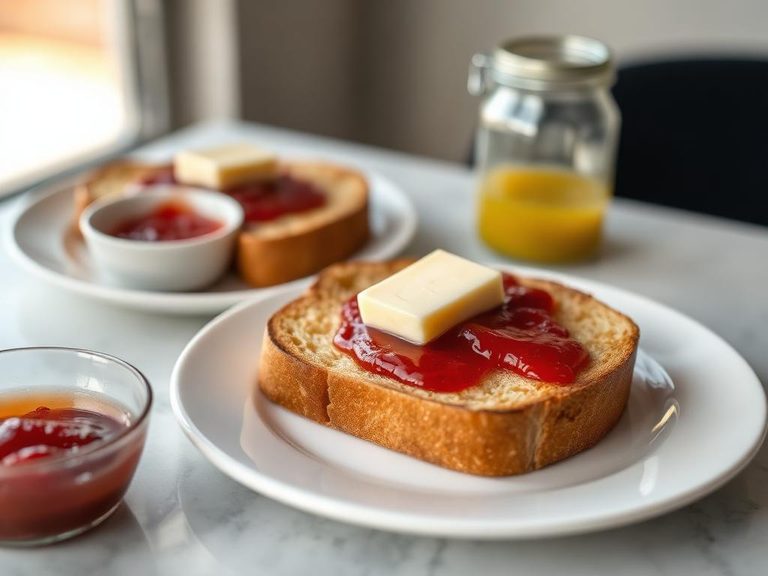
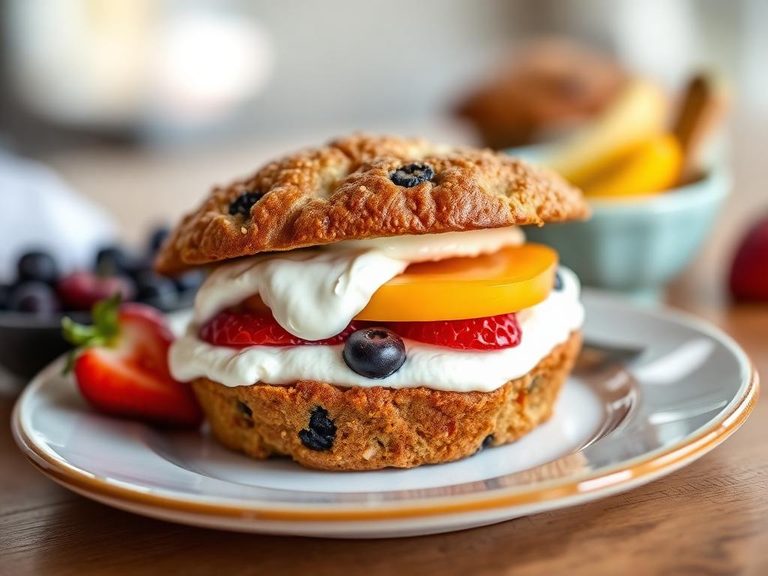
🌍 Where it's eaten
💡 Did you know?
The English muffin is not actually English in origin; it was created in New York City in the 1870s by Samuel Bath Thomas, a British immigrant.
Full nutrition (USDA data · scales with serving)
| Water | 39.5 g |
| Energy | 244 kcal |
| Protein | 9.3 g |
| Total lipid (fat) | 1.8 g |
| Carbohydrate, by difference | 47.6 g |
| Fiber, total dietary | 3.9 g |
| Total Sugars | 4.8 g |
| Calcium, Ca | 171 mg |
| Iron, Fe | 4.2 mg |
| Magnesium, Mg | 26.0 mg |
| Phosphorus, P | 97.0 mg |
| Potassium, K | 122 mg |
| Sodium, Na | 442 mg |
| Zinc, Zn | 1.1 mg |
| Copper, Cu | 0.14 mg |
| Selenium, Se | 23.3 ug |
| Vitamin C, total ascorbic acid | 2.6 mg |
| Thiamin | 0.50 mg |
| Riboflavin | 0.27 mg |
| Niacin | 4.3 mg |
| Vitamin B-6 | 0.06 mg |
| Folate, total | 98.0 ug |
| Folic acid | 57.0 ug |
| Folate, food | 42.0 ug |
| Folate, DFE | 138 ug |
| Choline, total | 17.3 mg |
| Vitamin B-12 | 0.04 ug |
| Vitamin B-12, added | 0.00 ug |
| Vitamin A, RAE | 0.00 ug |
| Retinol | 0.00 ug |
| Carotene, beta | 3.0 ug |
| Carotene, alpha | 0.00 ug |
| Cryptoxanthin, beta | 0.00 ug |
| Lycopene | 0.00 ug |
| Lutein + zeaxanthin | 52.0 ug |
| Vitamin E (alpha-tocopherol) | 0.39 mg |
| Vitamin E, added | 0.00 mg |
| Vitamin D (D2 + D3) | 0.00 ug |
| Vitamin K (phylloquinone) | 3.5 ug |
| Alcohol, ethyl | 0.00 g |
| Caffeine | 0.00 mg |
| Theobromine | 0.00 mg |
Fat & fatty acid profile (per 100g)
| Fatty acids, total saturated | 0.77 g |
| SFA 4:0 | 0.00 g |
| SFA 6:0 | 0.00 g |
| SFA 8:0 | 0.00 g |
| SFA 10:0 | 0.00 g |
| SFA 12:0 | 0.09 g |
| SFA 14:0 | 0.04 g |
| SFA 16:0 | 0.31 g |
| SFA 18:0 | 0.33 g |
| Fatty acids, total monounsaturated | 0.40 g |
| MUFA 16:1 | 0.00 g |
| MUFA 18:1 | 0.40 g |
| MUFA 20:1 | 0.00 g |
| MUFA 22:1 | 0.00 g |
| Fatty acids, total polyunsaturated | 0.54 g |
| PUFA 18:2 | 0.48 g |
| PUFA 18:3 | 0.06 g |
| PUFA 18:4 | 0.00 g |
| PUFA 20:4 | 0.00 g |
| PUFA 20:5 n-3 (EPA) | 0.00 g |
| PUFA 22:5 n-3 (DPA) | 0.00 g |
| PUFA 22:6 n-3 (DHA) | 0.00 g |
| Cholesterol | 0.00 mg |
Amino acid profile (per 100g)
Estimated from Muffins, blueberry, commercially prepared (Includes mini-muffins) — USDA does not publish this profile for Muffin.
| Tryptophan | 0.07 g |
| Threonine | 0.18 g |
| Isoleucine | 0.22 g |
| Leucine | 0.42 g |
| Lysine | 0.20 g |
| Methionine | 0.12 g |
| Cystine | 0.11 g |
| Phenylalanine | 0.28 g |
| Tyrosine | 0.18 g |
| Valine | 0.26 g |
| Arginine | 0.24 g |
| Histidine | 0.13 g |
| Alanine | 0.21 g |
| Aspartic acid | 0.32 g |
| Glutamic acid | 1.5 g |
| Glycine | 0.19 g |
| Proline | 0.54 g |
| Serine | 0.30 g |
| Hydroxyproline | 0.00 g |
FAQ
Is this the same as a regular fruit muffin?
No. An English muffin with fruit is a leavened, yeast-risen bread with a distinct nooks-and-crannies texture, while a regular fruit muffin is a chemically leavened quick bread with a cake-like crumb.
Can I freeze these?
Yes, they freeze very well. Slice them first, then wrap tightly in plastic or foil. Toast directly from frozen for a quick breakfast.
What fruits are typically used?
Common additions include blueberries, cranberries, raspberries, and sometimes diced apple or strawberry. The fruit is usually folded into the batter before baking.
How does the nutrition compare to a plain English muffin?
The fruit version will have slightly more sugar and calories due to the added fruit and sometimes a touch of extra sugar, but the protein and fiber content remain fairly similar.
Nutrient density (calculated · NRF9.3)
Nutrient Rich Foods index: beneficial nutrients (protein, fiber, vitamins, minerals) minus saturated fat, added sugar & sodium, per 100 kcal.
NRF9.3 index — Fulgoni, Keast & Drewnowski, 2009. Computed from USDA nutrients.
Weight-loss friendliness (composite index)
Energy density 2.44 kcal/g · 15% calories from protein · 3.9 g fiber · 4.8 g sugar per 100 g.
Composite of energy density (Rolls et al., 1999), protein & fiber satiety, minus sugar. A calculated heuristic — ranks satiety-per-calorie, not a clinical measure.
Dietary load (calculated from USDA values)
Potential renal acid load. Positive = acid-forming, negative = alkaline-forming.
Sodium-to-potassium ratio: 3.62 (lower is better — aim for ≤ 1)
Sodium:potassium per WHO potassium guidance. Computed from USDA nutrients.